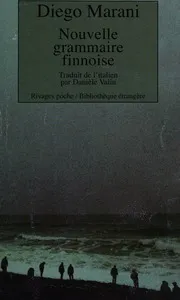
by Diego Marani
““I was suddenly sickened by the idea of that unknown presence beside me, demanding warmth and care. I would be required to take an interest in another life and all its petty doings, to feign concern for a person who was nothing to me, to share my anxieties with someone else and agree to lower my gaze to meet their own. Above all I would have to listen – listen to someone else’s story, sympathize, mull over their feelings, be dragged into sufferings not my own, though I would have to serve as comforter; have that face before me each day, pleading for understanding, pity, help; promising me joys I do not seek, affection I do not want to give. (...) The idea was abhorrent to me. I was repelled by the way all those around me clung so doggedly to life, the way they were born again beneath the ruins, instantly rebuilding what the bombs had flattened, in the grip of that unquenchable desire to be brought back to life which is the scourge of the human race. My own instinctive desire was to get through such life as remained to me without sullying myself, with the least possible damage and the least involvement. Because mine was no longer a life, but a leftover, some leavings I had picked up along the way. To rediscover my true past was an impossibility; to seek out a future, a huge effort. Doctor Friari was right: language is our mother, and it is through language that we come into this world. But I had lost both, forever; to me, rebirth was denied.”
“I was suddenly sickened by the idea of that unknown presence beside me, demanding warmth and care. I would be required to take an interest in another life and all its petty doings, to feign concern for a person who was nothing to me, to share my anxieties with someone else and agree to lower my gaze to meet their own. Above all I would have to listen – listen to someone else’s story, sympathize, mull over their feelings, be dragged into sufferings not my own, though I would have to serve as comforter; have that face before me each day, pleading for understanding, pity, help; promising me joys I do not seek, affection I do not want to give. (...) The idea was abhorrent to me. I was repelled by the way all those around me clung so doggedly to life, the way they were born again beneath the ruins, instantly rebuilding what the bombs had flattened, in the grip of that unquenchable desire to be brought back to life which is the scourge of the human race. My own instinctive desire was to get through such life as remained to me without sullying myself, with the least possible damage and the least involvement. Because mine was no longer a life, but a leftover, some leavings I had picked up along the way. To rediscover my true past was an impossibility; to seek out a future, a huge effort. Doctor Friari was right: language is our mother, and it is through language that we come into this world. But I had lost both, forever; to me, rebirth was denied.”
““For us, language is the word of God, even when you don’t believe in Him, and grammar is an exact science, made up of commensurable meanings and based on unquestionable theorems. The right word gives thought a sense of harmony, the mathematical inevitability of music. But each age plays different music, and chords which were once regarded as the work of the devil no longer frighten anyone. There is no such thing as eternal harmony: like everything else in this world, sounds too have their day, and man has to invent new ones in order to ward off silence. What we today regard as music would have been seen as noise a hundred years ago. Yesterday’s mistake is just today’s harmless oddity. The rule always succeeds the word: this is the great weakness of all grammar. The rule is not order, it is just a description of some form of disorder.”
“For us, language is the word of God, even when you don’t believe in Him, and grammar is an exact science, made up of commensurable meanings and based on unquestionable theorems. The right word gives thought a sense of harmony, the mathematical inevitability of music. But each age plays different music, and chords which were once regarded as the work of the devil no longer frighten anyone. There is no such thing as eternal harmony: like everything else in this world, sounds too have their day, and man has to invent new ones in order to ward off silence. What we today regard as music would have been seen as noise a hundred years ago. Yesterday’s mistake is just today’s harmless oddity. The rule always succeeds the word: this is the great weakness of all grammar. The rule is not order, it is just a description of some form of disorder.”
Trieste, WWII. An amnesic soldier is saved by a Finnish neurosurgeon.