
In the 1800s a fringe group of Mennonites migrated to central Asia, following the millenarian prophecies of the minister Claas Epp Jr. Hoping to be the first to meet Christ on his return to earth, they settled in the Khanate of Khiva, just south of the Aral Sea. Their church became known to locales as the white mosque, but by the 1930s their community had largely dissolved.
Sofia Samatar, a half-Mennonite half Somali author names her memoir after this structure, details her own trip to Uzbekistan, sightseeing and following in the footsteps of the earlier Anabaptist sojourners. Throughout, she examines the liminality of the area’s culture all while reflecting on her own past and the intersectionality of her identity.
In one of my favorite chapters, she explores the 9th century Ismail Samani Mausoleum, and compares its network of multifaith decorative religious symbols to that of more recent political geography:
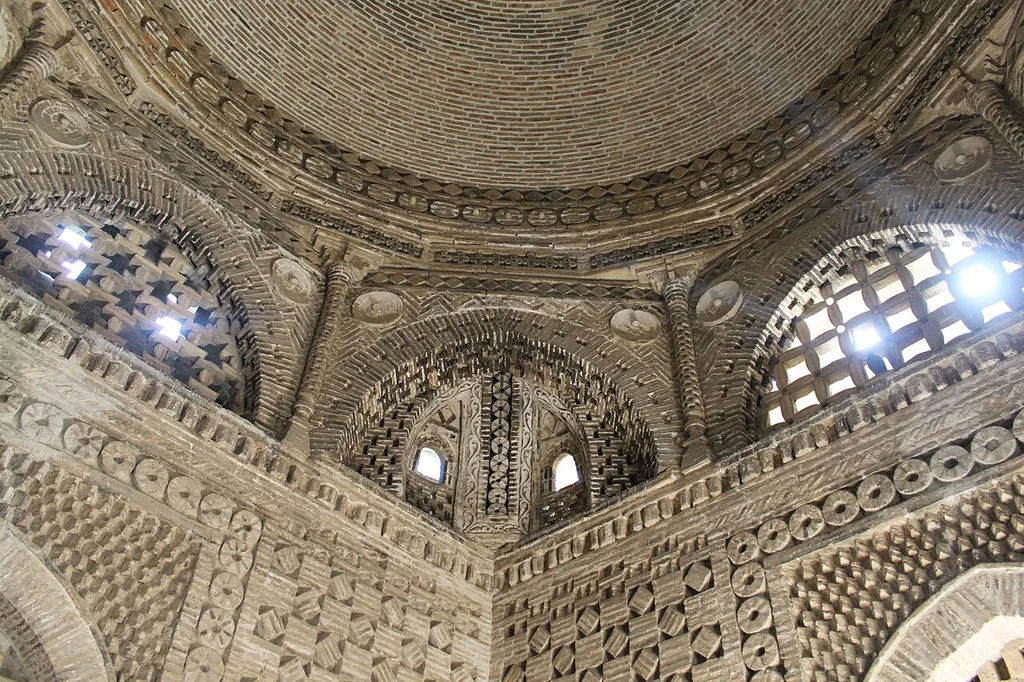
How strange that this region should have been cut up and named along ethnic lines in the Soviet era, precisely during the ambitious dream of belonging beyond ethnicity, of dissolving the boundary of skin. I have read that it was a strategy of both Lenin and Stalin to ward off potential nationalist insurgencies by granting certain forms of nationhood, such as borders and languages, to the ethnic minorities of the Soviet Union. So two styles of homeland, ethnic and Soviet, developed in the same place.
After exploring the mausoleum further, she closes the chapter with the following meditation:
Usmon points out the holes pierced at either end of the brick monument at the center of the mausoleum. Samanid rulers were said to reign for forty days after their death, and during this time you could send them messages through the holes. I think of the Swahili words sasa and zamani, loosely translatable as now and then, and the idea that for a certain period the dead remain with us in the sasa, the now, before fading into the zamani. If only we could keep them with us longer. I’d tear out this page of my notebook, crumple it up, and stuff it between the bricks. And the Samanid kings, poised between life and death, would read that I tasted sunflower oil. That I felt a film of dust.
We walk outside to admire the building’s ornate heather-gray molding and the salt that makes it look lightly sprinkled with snow. There used to be an ancient cemetery here, but the Soviets razed it to build an amusement park. Now the Ferris wheel carves the sky, like the Zoroastrian symbol for the sun.
While I came to this book out of an interest in the region, Samatar’s prose and deft handling of ideas has committed me to picking up her fiction sometime soon.