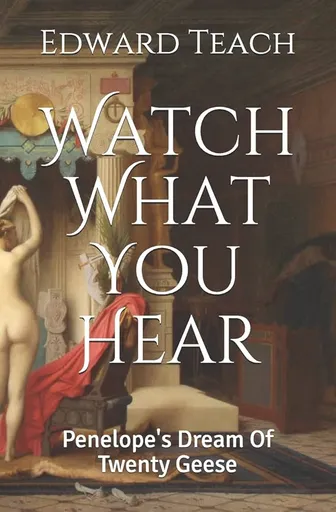
Watch What You Hear: Penelope's Dream of Twenty Geese (2020), like many of the most interesting works of the 21st century, was published pseudonymously. "Edward Teach"––a name doubtlessly chosen in part for its difficulty to be Googled (it's the real name of Blackbeard the Pirate)––is a pen name of the author of The Last Psychiatrist, one of the great blogs of the free blogging era, which has been quiet since May 2014. He is not someone I am intimately familiar with, but I instantly recognized the tone as the one behind "Hipsters on Food Stamps," one of the most popular and insightful essays of the "Wild West" years of social media "content aggregators," before its consolidation into the familiar walled gardens of today.
True to his origins, in Watch What You Hear, Teach exemplifies that rambly, discursive longform style: erudite yet pop-culture-savvy, the use of weird analogies coupled with counterintuitive insights, defensively preempting potential commenters, not afraid to challenge or even belittle the reader because "if you're reading this, it's for you." When you first read such things after consuming nothing but required readings and mainstream media, it hits like a Starbucks Frappuccino after a lifetime of Coca Cola. Can I just mainline this stuff directly into my body? But after a few subsequent episodes, you soon realize that even these have their tricks and tropes and that there is a time and place for such things; at the beach, in the evening, with a burger, you just want a coke. With all due respect, Teach could have used an editor with a heavy hand––or at least a well-caffeinated proofreader––but if you can get past the typos and weird formatting errors and copious footnotes and repetitive tone of something that tries to place itself somewhere between essay and speech, he has some interesting things to say, things that you're probably not going to find anywhere else. At the very least, the book format seems better-suited for Teach's writing style than a blogpost, as it allows for his many digressions to be boxed in and revisited later, as opposed to placing such text inline and obscuring the main argument even further. (This whole book was originally a long footnote in .)
The overarching thesis of Watch What You Hear is that we are vastly misreading The Odyssey. A bold proposition, given that this is among the most-studied works in human history, but Teach brings two powerful tools to the table, seemingly never applied together in this context. The first is psychoanalysis––in the tradition of Freud, especially its further realization through Lacan––whose principles and techniques he applies to the characters' unconscious. The second is a focus on the auditory aspects of The Odyssey, where Teach goes back into the original Greek, contrasting it with the Fagles English translation (arguably the one most faithful to the poetry); not only is the choice of words, meter, and phrasing––recall that the Odyssey was originally a purely oral story, canonized over the course of centuries by the "Homeric poets"––subject to inspection, but there is an emphasis placed on what is literally spoken by the characters. (Opening lines: "What are the first words spoken out loud by a character in the Odyssey? Why?") Such utterances are contrasted with the narration, and are a prime target of analysis.
While it is possible to grasp Teach's analysis as a patient layman––the level he pitches the book is at roughly the same level of his blogposts, as far as I can tell––I think it helps to be familiar with a couple aspects of Lacanian psychoanalysis to better grasp his approach.
Lacan develops the language aspects of psychoanalysis well beyond mere "Freudian slips." A primary guiding hypothesis is that while language does not directly reflect the unconscious (i.e. the "obverse" Sapir-Whorf hypothesis also seems false), it is not wholly unrelated and may even be used as a medium for its study. This explains why Teach delves so deeply into the literal words of the Odyssey, blowing up the text of Penelope's dream––which spans about a half-page in my copy of The Odyssey––to a technical analysis of about 100 pages. Such tendencies seem to be a hallmark of certain Lacanians, as I've heard of entire seminars dedicated to a single line of Lacan's Ecrits. (It doesn't help that Lacan seems to revel in being abstruse.) The focus on language is probably the most easily noticeable difference from other major psychoanalytic traditions, such as that of Jung or Adler.
It is also helpful to know about the key Lacanian concept of desire. This is a rich and complicated topic––one the main goals of Lacanian psychoanalysis is to recognize and uncover the truth about the analysand's desire, and much of Lacan's writings and seminars are dedicated to elaborating upon and making this notion precise––but I can give a cartoon version here. One of the ways that Lacan develops past Freud is that he draws a careful distinction between conscious and unconscious yearnings. For example, a child might be hungry and so asks their mom for a snack; according to Lacan, there are two levels of processes happening here: there is (a) the conscious articulation "Mom! Can you make me a snack?" of translating a physical need into language, called demand (demande); and (b) the secret unconscious expression of a wish ("pay attention to me"/"show me you care"), called desire (désir). This inability of language to fully convey the scope of the child's need is fundamental to Lacan, as desire is primally repressed, requiring techniques of psychoanalysis to untangle. Coming back to the subject of Penelope's dream, Teach's main focus is in analyzing the desire of the characters, which necessitates not only looking at what is said, but on what is unsaid. What things are only obliquely alluded to, secretly gestured at, missing when it should be present in the text? Those are the things to drill in on to understand the hidden unconscious aspects.
Teach does not follow the typical protocol of a scholarly article by stating his conclusion in the beginning. I suppose this is employed for dramatic effect––the big reveal––and there are lots of interesting observations and deductions that he makes along the way, but I think it hurts the clarity of his argument when it's not really clear what he is going for, so I'll state it here.
The conclusion of Teach's analysis is that Penelope's dream is not conveying her own desire, nor Odysseus's desire, but Agamemnon's obsessive desire, with Penelope as a mere proxy; she is but the last domino to fall, not the one that started the chain reaction. The implications of this are dramatic, despite the seemingly minor role of this brief episode near the conclusion of story. It says that the entire story of The Odyssey is really Agamemnon's dream.
How is this possible? It is by looking at what is said and not said. The argument hangs on Agamemnon's few episodes in The Odyssey: when Agamemnon's ghost meets Odysseus in Book XI (about halfway through the work) and in Book XXIV (the last book) when Agamemnon is talking with Achilles in Hades. Notably, in Book XXIV, Agamemnon does not seem to care at all about Odysseus and what he did in Ithaca at all; his long journey, his disguised return, his interactions with Penelope, the murder of the suitors, Agamemnon does not say a word about any of this. All Agamemnon seems to care about is Penelope and what she didn't do.
Why Penelope? Penelope's famed fidelity is no concern of Agamemnon's; he is not even aware of it. It's because to Agamemnon, she represents the proper woman. Helen represents the dangers of will-less feminine sexuality: tossed among the waves of masculine will, resulting in countless deaths. Her twin Clytemnestra, Agamemnon's wife, has the opposite problem: too much will, leading to her traitorous acts and, of course, Agamemnon's death in spite of his glories in war. Penelope, their cousin, is Agamemnon's ideal, synthesizing the best of both: she is desirable, she has her own desires, but will not act on them. This passivity, this maintenance of the status quo, is what he considers to be the pinnacle of womanly virtues. And she is justly rewarded: Penelope achieves her goal––and that of her husband––through this very inaction. Thus, Penelope wants what she wants––expressed unconsciously through her dream––influenced by what Odysseus wants her to want, which is what Agamemnon wanted him to want her to want, all because Clytemnestra acted on her own desires, a betrayal not only of marriage, but of her own femininity.
Zooming out from the story itself, why would the Homeric poets encode such a message in The Odyssey? Teach has a psychoanalytic explanation for this, too. His hypothesis is that the Athenian canonizers of Homeric songs––active during the Pisistratid era––were ashamed of their origins: their civilization was not established by some noble democratic revolution, but by a dishonorable murder driven by lust and envy, leading to a conflict that they could not even resolve themselves, but could only solve by appealing to the help of outsiders (the Spartans). They had to rewrite history, or at least, cast it in such a way that they could live with themselves. As Teach himself writes: "dishonored Odysseus is consciously redeemed by acting out the unconscious redemption of honored Agamemnon: the form of the story that can be told solves the problem of the story that cannot be thought." Now Agamemnon's story––an mighty king, surviving ten years of war and returning with honor and spoils, only to be killed by his wife and rival––and Odysseus's story––a side character who returns home empty-handed, thoroughly dishonored, ultimately succeeding not due to his bravery and wit, but to the inexplicable intervention of a god––now both have a purpose, sublimating their collective anxieties and allowing the Athenians to move on and introduce the things (democracy, philosophy, theatrical drama, architecture, etc.) that we now know them for.
Flaws aside, What What You Hear is an approachable example of psychoanalytic close reading. While it is dense, unlike a paper aimed at a more academic audience, it tries to explain some of the background notions––if briefly––and applies it to a tractable example. The arguments and kinds of conclusions made along the way make it clear why Lacanianism has had such a wide impact on areas outside of psychology, such as in literary or critical theory; since the tools can be applied to almost any "text," the potential applications are nearly endless, with even old, well-trodden paths capable of taking you to new vistas. Of course, whether you feel such conclusions are warranted is another thing entirely, and for those skeptical of such methods, What What You Hear isn't going to convince you. But even forgetting its validity, it's an interesting argument and in following its journey, you can't help but learn a thing or two. Far from The Last Psychiatrist's highest note, perhaps, but in a way, it's just good to know he's out there somewhere, singing his song, keeping his skills sharp and ever-evolving on his own journey. If he ever comes back, I'll most certainly be there to listen.
omfg. I fucking loved this book so much. I tried to get a couple buddies to read this or Sadly, Porn but they didn't really budge.
I also agree with you (if you do) that the most interesting aspect of the book is not Teach's literal interpretation of the dream, but the meta-analysis of how he (almost obsessively) interprets the dream across the Homeric/Athenian meta and wields it to delve into psychoanalytic "defense" we create in dreams. I know this concept of defending against interpretation was also introduced in Sadly Porn and some of his other blog posts, but I thought it was bewildering when I first encountered the subject because I haven't really seen the concept in other psychoanalytic books (which I haven't read too much of). It's a strange sensation to know that there is some taboo that is so dangerous (to be dramatic) to the psyche that we ourselves will actively defend against the internalization.



omfg. I fucking loved this book so much. I tried to get a couple buddies to read this or Sadly, Porn but they didn't really budge.
I also agree with you (if you do) that the most interesting aspect of the book is not Teach's literal interpretation of the dream, but the meta-analysis of how he (almost obsessively) interprets the dream across the Homeric/Athenian meta and wields it to delve into psychoanalytic "defense" we create in dreams. I know this concept of defending against interpretation was also introduced in Sadly Porn and some of his other blog posts, but I thought it was bewildering when I first encountered the subject because I haven't really seen the concept in other psychoanalytic books (which I haven't read too much of). It's a strange sensation to know that there is some taboo that is so dangerous (to be dramatic) to the psyche that we ourselves will actively defend against the internalization.