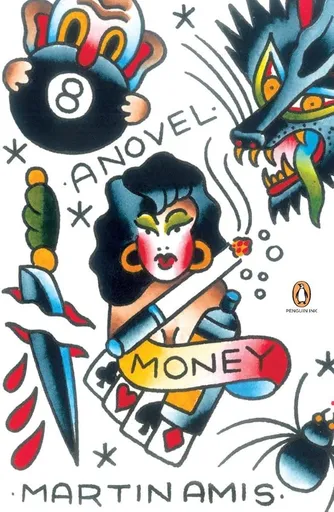
The plaque-ridden heart of this book is the following: Money…money is everything. Money shines upon the world’s every nook & cranny, crease & fold, and bit & piece. Nothing escapes the spotlight of money. Everything is a gimmick employed to angle for new streams of income, and the “whole trouble with dignity and self-respect: they cost you so much fucking money” (144). Our hero, John Self, is a Looney-Tunes Virgil touring the descending rings of porn, violence, indulgence, and hatred. As he himself says: “Happening to have turned out as the human being I am, the first thing I wonder about a woman is: will I fuck it? Similarly, the first thing I wonder about a man is: will I fight it?” (222). He is the unadorned logic of consumption. He fucks, he fights, he drinks, and he bumbles about (literally crashing into posts and polls, falling down stairs, heaving, and tripping over himself), and he spends a shit load of money. John charmingly graces us with a wanton hard-R mere pages into the book. (As an aside, I sometimes wonder whether British authors experience that word with the same heft and gravitas as Americans. Sometimes they’re fairly devil-may-care in their usage of it, as if it’s like any other off-color epithet, like gypsy.) He beats women, though he’s trying to be better about that. He blacks out and subsists on heroic quantities of fast food, though he’s trying to be better about that. He doesn’t just drink, he drowns himself in alcohol, though, admittedly, he trying to be better about that.
More reviews
is
He’s a scumbag exploring diverse forms of debauchery, and any modicum of sympathy one may dredge from this 300-page cesspool of sweat and grease is the looming shadow of John’s mortality. Campaigns of slapstick partying are punctuated by brief confrontations with the Why of it all: “Sometimes I feel that life is passing me by, not slowly either, but with ropes of steam and spark-spattered wheels and a hoarse roar of power or terror. It’s passing, yet I’m the one who is doing all the moving. I’m not the station. I’m not the stop: I’m the train” (108). He describes a haunting lack of center, one he feels fulfilled only by human touch. He gets a lot of handjobs to fill that hole, but it proves an enduring pit for his ejaculations (fluid & vocal). The void consumes his cries, so he consumes to fill the void. He’s used to the hedonistic demands of consumption (i.e., spending, pornography, alcohol, drugs), but he struggles with a new voice “of rage and weepiness made articulate in spasms of of vividness” (105). His mortality eats of him just as voraciously as he eats away his mortality. In a moment of clarity, he says: “As with vampires, you have to ask [the anxieties] in. But once they’re there, once you’ve given them headroom, they seem pretty determined to stick around. Don’t let them in, these crashers. Don’t let them in, whatever you do” (105).
What bugs me about this book, however, is Martin Amis’ smirking face emerging from the pages like a phantom haunting the story. Aside from the self-insert Martin Amis character, on which more in a moment, there is a major friction for me: John Self is supposed to be an oafish philistine, yet he waxes on like an Oxford-educated English novelist…for 350 pages. At one point, a woman friend gives John a copy of Animal Farm to read. After multiple failures to start, he finally commits to reading the (famously short) novella, and doesn’t realize it’s an allegory. I can understand not understanding it is specifically an allegory for the Bolshevik revolution, but he outright fails to grasp it being a metaphor whatsoever. There are numerous moments in which a character asks John an open-ended question, and he just says “Uh?” Fielding, a major character, even asks him if he knows how to read. Yet this bumbling glutton describes his musings on mortality as a “dance of anxiety and supplication, of futile vigil.” In the first third of the book, John uses the word “zugzwang” metaphorically to describe the frenetic inevitability of his life; in the last third of the book, the Martin Amis self-insert uses the same word in a chess game, its most literal application, and John is confounded and needs it defined for him. “I think how dismal it is, how hard, how heavy, to watch the rain and not know why it falls” (172). I actually love this line, but it also makes my point because there is an implication John means this rather literally when he says it.
Martin Amis, the author, was an outspoken fan of Nabokov, and so I think he fancies himself a stylist. I’m not being a scrooge about this: Amis’ prose in this book is excellent. It’s fun, dynamic, and rich. The difference between Amis and Nabokov, however, is the latter would devise a narrator which allowed him to write like Nabokov. Most of Nabokov’s narrators are (huh!) extremely educated, conniving, clever, and charmingly pompous. This makes it really easy for him to be as charmingly pompous as he was anyway–he could just be himself. There is a yawning gulf between John Self and Martin Amis. It makes no sense for the narrator of Money to sound like Martin Amis, but I don’t think Amis could help himself from his wordy pyrotechnics. Doing so, though, takes the conceit of fiction and says “Fuck it.” It treats fiction like a slapdash vessel for whatever prosaic party tricks you feel like showing this time around. The boat’s springing leaks and sinking, and you’re pulling a coin from behind my ear.
There are two counters I have to this critique:
I’m being classist and even the John Selfs of the world can speak in technicolor.
This contrast between style and character is deliberate and metafictional, and this novel is being narrated by Martin Amis (real and fictional) as a sort of ventriloquist act.
Regarding 1, I have a fountain of faith in the everyman to speak in technicolor. In fact, if life shows you anything, the stylists of the world live wherever there are human beings. If you haven’t met the odd laborer who spins yarns better than an MFA student ever could, I’d suggest you go out and talk to people more. The working world is brimming with would-be authors. In this novel’s case, Martin Amis has overplayed his hand in making John a simple-minded hedonist hostile to culture mid-to-high.
Regarding 2, it’s an interesting idea, if so, but not for this many pages. For a novel with as empty a stomach as this one, ideas-wise, it really belabors the reader to endure such an objectionable character in return for a post-modern parlor trick. There are moments where it seems Martin Amis (the character) is Money’s man in the MacIntosh, if you buy into Nabokov’s theory that the man in the MacIntosh is James Joyce himself. In the (fun) piece linked above, Tyler Malone says that for the MacIntosh man to be Joyce himself would amount to no more than a “metafictional gag,” and then explores the interpretation that the character is God Himself. As far as fiction is concerned, why not both? There’s an argument to be made that Martin Amis is inserting himself as John’s creator, meeting with him when he’s at his most mortally wounded; John is speaking with his creator, so to speak. John even plays chess with Martin, similar but not identical to The Seventh Seal. This may be the case given Martin Amis is surprised himself to find John alive at the end of the book, as if he, the author, was certain he’d killed him through all his narrative flogging. The problem is it simply doesn’t add depth to the story, because the story is basically a cautionary tale of capitalism. And despite all his efforts, it wasn’t money which bought John’s happiness in the end, but love and compassion.
Martin Amis–who’s witty, too upstanding to care about money, and effortlessly crushes at chess–made a good point towards the end of his novel: “Towards the end of a novel you get a floppy feeling. [...] For how long do you immerse yourselves in other lives? Five minutes, but not five hours” (331). Unfortunately, Amis’ ironic wink does not spare him from being the target of his own critique. Overlong books do get floppy, flaccid. The characters overstay their welcome, the plot goes soft, and the author’s bag of prosaic tricks is empty and coughing up dust. What Money lacks in ideas it only initially makes up for in style, but the experience of living alongside a character like John Self for so many pages is a lot like the nature of late-stage capitalism itself: the gloss over cheap plastic doesn’t make it any less a piece of cheap plastic. New coat of paint, same old gimmick. For my money, this would have been a killer novella. It suffers its own floppy feeling, and making the reader consume “junkfurters” for that long doesn’t come with much of a reward. You aren’t reimbursed for your investment in Money.
That all being said, I do wanna commend the few instances where the winks yield to a real existentialism. John is seeking something, but he truly does not know what. We are seeking something, and we truly do not know what. How each of us goes about our search is where we differ. Capitalism (I’m sorry because “capitalism does this and that" is such a hackneyed observation at this point, but unfortunately, like all clichés, there is truth to it) convinces us that there is life at the end of a receipt. I feel a lack in my being and if I just get the right pair of pants… As John says, “Our lives, they harbour form, artistic shape, and we want our form revealed even though we only move in our detail, with keys, spongebag, coffee-cups, shirt drawer, cheque-books, linen, hairstyle, curtain-rod holders, fridge guarantee, biros, buttons, money” (333). We’re surrounded by coherent images of potential: lives with a discernible terminus, lines that lead to a point. Unfortunately, our lives are more like an asymptote: lines which (if we’re lucky) bend toward something but never reach it. There is pleasure but there is no real fulfillment, yet capitalism promises the latter in spades, and to make that promise, everything must be marketable. We don’t have the privilege of a creator who spells our fate in advance as an author would. We’re mired in life’s details, and Money is a cacophony of details with no end, no point.
You could be depressed about this, but that’s partially the pain of extracting one’s mind from capitalism’s labyrinth of false starts and dead ends. At the end of Money, the young daughter of John’s friend hands him her toy umbrella to fix:
The toy umbrella dangled from my hand. It was cheap and knew it wasn’t meant to last long. It knew it was meant to break. They say everything wants to persist its being. Even sand wants to go on being sand. It doesn’t want to break. But I don’t know. This umbrella looked relieved that it had broken, had broken out of the world definition and was just a sprig of plastic tackle again. (337)
To be a sprig of plastic tackle again is really the beauty of humanism. No just system should evaluate its people by their wealth or potential to produce wealth. It’s the Big Other which demands you shoehorn yourself into a marketable form. It determines what you ought to be doing and where you ought to find enjoyment. Life will not be a Horatio Alger story. Life will not be an episode of Friends. There is a freedom to breaking free of an imposed form, to seeing beyond the diktats of hegemonic culture. This is where one says, “Be you; be your authentic self,” but doesn’t this function within the same frame of capitalist fulfillment? If I just suffer through the funhouse, I’ll find the end and emerge in the real world. We’re stuck in the funhouse, but we're stuck together. John doesn’t find his authentic Self, but he finds an enjoyment without suicide, an enjoyment without the constant destruction and reassembly of the Self. He finds an enjoyment alongside and not at the expense of.