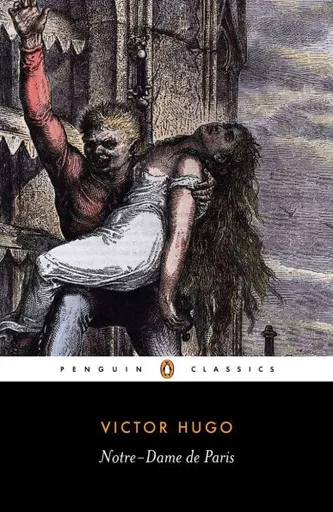

in english, the title of victor hugo's 1831 notre dame de paris is most commonly rendered as 'the hunchback of notre dame.' there is some notion of wishful thinking in this translation, perhaps a nod to what the reader might remember the novel to be about more than the actual text itself. in the original french, the cathedral stands alone--and as one reads our lady of paris, it becomes rapidly apparent why hugo would have chosen such a blunt title.
hugo wrote this entire novel in the span of 4 months after years of promising-without-delivering, and it is essentially a trussed-up public argument for the preservation of gothic architecture. the gothic and romantic elements of the novel--the shadowy figures lurking on the 15th century streets, obsessive and demonic love, the deformed and the maligned exterior hiding the noble heart, beauty disguising ugliness, mysticism, alchemy, you name it, it's there--feel somewhat haphazardly tacked onto and around the book's real subject, much like the attempted 'renovations' of the notre dame he so vehemently criticizes.
at the time of this novel's publication, the notre dame de paris was falling into disrepair; hugo's novel revived public interest in the cathedral and in 1842, the french government decided to undertake a major renovation to which 5 million francs would eventually be allocated. in this sense, the novel's "project" (SAVE. OLD. CHURCH.) was a resounding success; and it is perhaps to this novel that the notre dame owes its modern brand recognition and tourism stats.
to imagine any artist of today having the kind of impact that hugo effected on the french public is nigh unbelievable: a popular novel provoking not only discussion but actual policy change in parliament, the artist himself turned politician and then exile, a state funeral attended by millions. in the present, where art seems to function as "...another aspect of the same society...part of the spectacle of negation... 'self—expression' in which [the artist] can live out a dull reflection of what has not been possible in real life." an artist as earnestly and unabashedly committed to literature-as-social-project as hugo seems almost... gauche? foolish? naive? but he really did, with notre dame at least, accomplish the thing he set out to do: over two centuries, and they're still rebuilding that damn church today.
when was the last time any of us believed, even fractionally, in the ability of art to alter reality? and not just in the ~superstructure~ ideas thoughts feelings images nebulous way where we are all constantly being subconsciously altered by the media to which we are being exposed, exposing ourselves, but in cold hard dollars francs?
in notre dame de paris, hugo strove to save a church from dilapidation; in les misérables, his magnum opus, he strives to save a society from the suffering of its own machinations. in the former, written hastily on deadline from his publisher, hugo is light-hearted and fanciful, his style garrulous as a symptom of procrastination; in the latter, which took over 17 years and political exile to guernsey to write, he is moving and magnanimous and his verbosity feels more like a deliberate choice, honed and elevated to the level of beauty. notre dame functions a bit like les mis's "before" picture--the nascent, unrestrained outpouring of a younger artist and a younger man, one who will never win many points in the competition for the most 'literary' or technical of writers, but has wormed his way into the canon all the same for writing books of outsize social (and emotional) impact. i'd recommend notre dame only to the most avid of hugo fans (which i am), people who know and care enough about this particular dead french guy to want to plow through laborious descriptions of the exact layout of streets in paris, 1482, all in order to form an incrementally richer tableaux of the artist. for anyone else, it suffices to treat the novel as palimpsest, and cut straight to the heart of the man: that is, to read les misérables.