I once had a bizarre dream in which my beloved was telling me that most of my books were uninteresting except for this one. I thought it was a good reason to finish reading it, as I had once skimmed through it some 20 years ago.
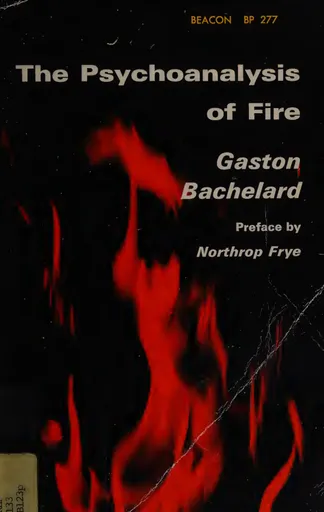
Bachelard is mostly known for his Formation of the scientific mind, and his project in Psychoanalysis of Fire is in line: poetry and science have opposite goals, and we need to explore the poetic ideas we entertain in order to get rid of them and be able to make proper science.
So he offers to explore these poetic ideas in order to take them out of their hiding in our collective unconscious in a series of books going through basic symbols : Fire, Water, Space, Duration, Earth (there are two other reviews of his works in this series here https://www.lit.salon/reviews/OL1304839W/f7KaukFbjuLpULA86y1Z/a-science-of-vibes and there https://www.lit.salon/reviews/OL1304839W/kmd2FGzeVLufJ1pjQQpy/very-cosy Both are right : this is very cosy vibe science).
Of course, this is the early 20th century, so Freud and Jung are the main references when it comes to human psychology. Although the title speaks of psychoanalysis, it is almost an analysis of the social representations of fire among scientists: psychoanalysis deals with the individual dream (le rêve) and Bachelard deals with the rather sociological daydream (la rêverie). We humans daydream in front of the fire and about the fire. Fire is full of associations and contradictions (sexuality, purity...). So what are these rêveries made of?
The Prometheus complex: about the acquisition of fire to grow, and it has to be stolen to an authority
The Empedocle complex: there is an appel du feu (call of the fire) like there is an appel du vide (call of the void), a temptation to destruct oneself in the fire.
The Novalis complex: no fire is born without friction, and friction is a primitive/natural act longed for. Here, Bachelard has great fun collecting the descriptions of sexual activity disguised as descriptions of fire in scientific literature.
The Hoffmann complex: alcohol as a symbolic reconciliation of fire and water and spontaneous combustion. He also goes on a tangent about alcohol and creativity.
Most of the complexes are illustrated by his childhood memories around fire and regular critiques of literature and scientific discourse on fire.
What Bachelard is trying to do seems to be part of the humanist daydream project: beyond lands, cultures and times, we are all humans and we share a common quality. To reveal (or create) this truth, we need to build the infrastructure so we can travel the many roads to each other.
The same way European societies decided Roman and Greek societies were part of them and thus built and maintained many roads, which allow us to travel regularly from Europe to Athens and Rome, Bachelard in the 1930s points to the lack of roads we have with the humanity revealed by the new sciences of the 19th century (such as prehistory and ethnology): it’s not enough to imagine how a prehistoric human might have had the idea of making fire with two pieces of wood. We need to understand the psychological landscape that was able to generate this idea, and this quest starts from our own psychological landscape around fire, since us and these homo something might be similar.
Son of a cobbler, he worked as a mailman, failed to enter Polytechnique school, and stayed in philosophy. He went through the WWI trenches and raised his only daughter as a widower (she herself became a philosopher; she died some 10 years ago). Eventually the Sorbonne took in that strange, bearded guy (I mean look at him).
At heart, I believe he is more of a poet than a scientist: his goal is to keep poetry out of science, but to do so, he decides to devote himself to the plucking of every one of these misplaced flowers and the carrying of magnificent bouquets out of the tower of science. His conclusion even sketches a method to understand the psychoanalytic articulations of poetic metaphors.
His work is baroque, outdated, charming in its musings, beautiful in its ambitious scope.
