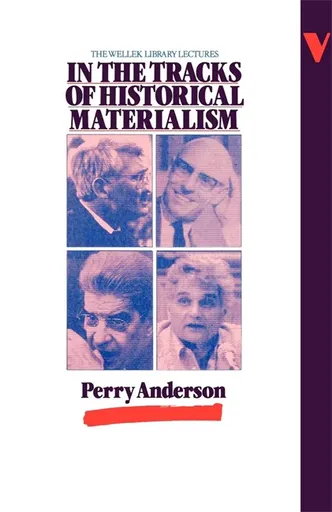

Tras las Huellas del Materialismo Historico / In the Tracks of Historical Materialism
Write Review
Tras las Huellas del Materialismo Historico / In the Tracks of Historical Materialism
Write Review

The wrecking crew

User avatar fallback
May 20, 2026

This is a short but dense book that presents three successive lectures that the New Left Review editor Perry Anderson gave on what he calls French "critical theory" but which nowadays we usually call (post)structuralism, which touches on all the major players associated with this current, including Althusser, Lacan, Derrida, and Foucault, and provides an overall critique of their tendency from a Marxist point of view. (Habermas is also included, which I guess explains why Anderson opted for the more general term "critical theory").

One way that I definitely don't think this book should be used (though I did kinda use it this way anyway) is as a general introduction to poststructuralism, for which I'd instead recommend Perry's friend Fredric Jameson's The Years of Theory, which is a bit more conversational but does a good job outlining the basic "deal" of these players plus some others. Anderson, on the other hand, is engaged in a more focused and interpretive project of trying to assess the overall import of the postructuralist current, which he ultimately judges as inadequate in ways partly tied to its attempt to recast social relations within the paradigm of language.

This idea, from which all the rest of structuralism follows, produces a lot of brilliant analysis (which I think Jameson does a better job highlighting), but for Anderson this conceit also has crippling and ultimately disqualifying limits, such as what he terms "a gradual megalomania of the signifier" wherein external reality gradually disappears and everything becomes about the continual play of signifiers.

But some of the ways that Anderson judges structuralism as inadequate are ones that it actually shares with Marxism, and one of the surprising insights of this book is the inversion of the thesis that postructuralism "killed" Marxism. Instead, for Anderson, it could only gain the prominence it did because Marxism was already suffering under internal intellectual problems (for instance, the dichotomy between agency and structure) and its loss of a living connection to a revolutionary workers' movement in most of the developed world--which ties this back into the companion book Considerations on Western Marxism, where Anderson provides his interpretation of the strengths and weaknesses of non-Soviet Marxism. In fact, one of the more invaluable parts of this book, technically unrelated to what it's about, is the afterward where he discusses the predictions he made in Considerations. Spoiler: turns out May '68 didn't solve everything after all!

LP+3
0 comments
User avatar fallback

No comments yet. Be the first to share your thoughts.