
I spent the majority of my teenage years with Richard Siken's Crush on my bedside table. I would read it, finish it, and then leave it there, to begin again the next night. I was also almost entirely socially and romantically isolated until adulthood—I did not yet know how it truly felt to drive one's body into another's like a crash-test car, or to walk into a bar and say make it a double. But Siken wrote with a cadence that, for once, aligned with the urgency I felt everything carried in my youthful head. I did know how it felt to want someone so badly that the weight of it nearly pressed you into dust. He made it something I could wrap my head around.
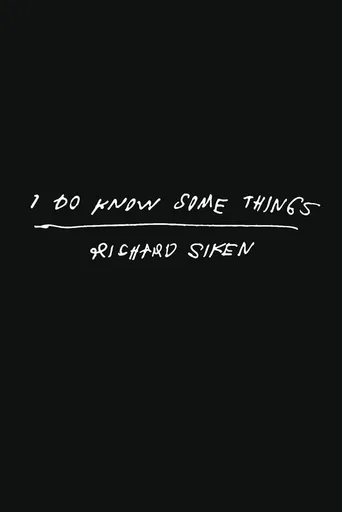
Today I am almost twenty-one and I am still a child. I, too, now know some things, but as I have aged so has Siken—I do not know how it feels to suffer a stroke, forgetting how to perform all the necessary human functions and having to relearn what words mean, how to harness control. I Do Know Some Things is an extremely different book from both Crush and War of the Foxes. Where lines were once meticulously arranged on the page, they have now abruptly changed forms: now falling in tight blocks of text, it is in your hands to put the pieces together and take them apart. The book's back-cover synopsis goes on about bravery. In some sense, I disagree with its sentiment—as a writer, I do not think it is brave to write about the intensely personal, nor do I think it is brave to return to writing as a form of parsing it. If poetry and prose are what you want, this is second nature. I do, however, think it takes bravery to recognize that one's hold on reality has loosened, and to forgo structure accordingly. It takes acceptance. For a poet, this is hardly a natural impulse at all.
Acceptance is an especially unexpected turn for someone whose body of work rests on the very lack of it. Fear not—in spite of its singularity among his works, Siken hits all the usual notes here, albeit fewer and further between. The bluntness and intensity that made him famous never leave. Neither do the suffering of unrequited lust, or his bitter nature. More often now than ever, I have been seeing people complain about Siken's online presence, asking who is in the wrong? and posting screenshots of Twitter arguments in which the answer is obviously him. Of course the easy answer is, who cares, but I can't help but notice that those who love his poetry and hate his personality are missing the irony of their plight. Of course Richard Siken is insufferable. If he didn't feel the need to push back against everything, he wouldn't be writing anything at all.
Although I Do Know Some Things contains both hits and misses, the best of them hit the same nerve that Crush did when I was fifteen. The only difference is that where they once struck with the beauty of violence, now they just hit till you bleed. It's not a bad thing. I met the man I'm currently seeing because he saw me post one of these poems, Pornography, and he sent me a message to say he liked it as much as I did. I've caught myself wondering a few times what this means. I'm sure Siken would hate me for putting words in his mouth, but I imagine that if I asked him, he would say nothing. After decades of making a career of metaphor, I respect that he has come to the end of illusion. I imagine he would be right.
