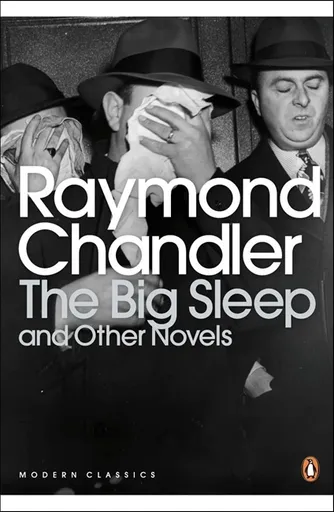

He comes home and the young daughter of his client is lying naked in his bed:
"I went over to the floor lamp and pulled the switch, went back to put off the ceiling light, and went across the room again to the chessboard on a card table under the lamp. There was a problem laid out on the board, a six-mover. I couldn't solve it, like a lot of my problems. I reached down and moved a knight, then pulled my hat and coat off and threw them somewhere. All this time the soft giggling went on from the bed, that sound that made me think of rats behind a wainscotting in an old house.
...
"I looked down at the chessboard. The move with the knight was wrong. I put it back where I had moved it from. Knights had no meaning in this game. It wasn't a game for knights."
There's the knight imagery that is central to Chandler's concept of the hardboiled inhabitant of these "mean streets." There's the obsession with interior design and fashion that runs throughout the novel. Part of me wonders if he had to spend so much time describing furniture and design objects because of the way the narration is so externally-focused. Doesn't matter, it rules. I loved this book. As much as I want to imitate it, because Chandler's voice is so distinct and powerful, I worry about how to pull off a hardboiled mystery without just entering into pastiche. Some things I noted: 50% through the book, the plot looks like it's wrapping up. 85% through, the main plot is wrapped up, but there is still an unresolved thread that heightens the denoument. His dialogue, with the period slang, is amazing. His blocking in chase scenes through the city streets is also amazingly well-done even if his means are quite minimal. I found myself pretty early on not worrying about plot details---I kinda lost track of the characters and the double-crossings and what the heck was going on fairly early on, and didn't really worry about them. I think this is his thesis in the essay "The Simple Art of Murder" (haven't finished it yet).I will say that the story was not really that scandalous or like, harrowing. Not as dark or disturbing as I would have thought. You have nude photography of young girls, presumably of-age, used as blackmail and ransom; you have pornography dealers in homosexual relationships with racialized boys; you have murder, corrupt cops, and criminals; you have a girl who tries to kill men who reject her advances ... These elements are all fine, but they weren't like, that dark or anything. Most of the unpleasantness comes from Philip Marlowe himself, who slaps women and abuses himself with cigarettes and drink---but even he's a good guy in the end. It's not the point, that's fine.