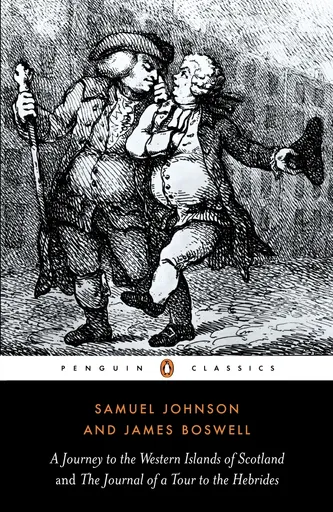
As agreeable as a pineapple in a desert | Review of The Journey to the Western Islands Scotland and The Journal of a Tour to the Hebrides (Penguin Classics) | lit.salon
• He's a consummate self-mythologist, a sesquipedalian showman/showoff who knows what's expected of him. Boswell calls a certain mountain "immense". Johnson: 'No; it is no more than a considerable protruberance.' You can just hear him enunciating "protruberance" with fathomless scorn.
• His hilarious, self-aware egotism. On emigration to America: "To a man of mere animal life, you can urge no argument against going to America, but that it will be some time before he will get the earth to produce. But a man of my intellectual enjoyment will not easily go and immerse himself and his posterity for ages in barbarism." [note: Johnson had no posterity other than letters].
• He "maintained the superiority of Homer" (over Virgil). I agree.
More reviews
• His thoroughgoing contempt for "Ossian" and all believers in the phony Celtic bard is a joy. No flies on Samuel J!
• His relish in mansplaining. "He this morning explained to us all the operation of coining, and, at night, all the operation of brewing, so very clearly, that Mr M'Queen said, when he heard the first, he thought he had been bred in the Mint; when he heard the second, that he had been bred a brewer."
• Certainly the oddest passage in either book, Johnson's thoughts on clean and unclean fabrics and dreams of keeping a harem (in Boswell):
All animal substances are less cleanly than vegetables. Wool, of which flannel is made, is an animal substance; flannel therefore is not so cleanly as linen. I remember I used to think tar dirty; but when I knew it to be only a preparation of the juice of the pine, I thought so no longer. It is not disagreeable to have the gum that oozes from a plumb-tree upon your fingers, because it is vegetable, but if you have any candle-grease, any tallow upon your fingers, you are uneasy till you rub it off. I have often thought, that, if I kept a seraglio, the ladies should all wear linen gowns, or cotton — I mean stuffs made of vegetable substances. I would have no silk; you cannot tell when it is clean: it will be very nasty before it is perceived to be so. Linen detects its own dirtiness.
• His social conscience is in perplexing conflict with his Toryism. He says it is "a problem for politicians" that "those who procure the immediate necessaries of life" (i.e. labourers, workers in general) are the worst paid. He can't agree with raising their wages, because this would increase prices, and lamely suggests that they should be given charity when times are good (he doesn't say what should be done when charity is lacking).
• Johnson is arguably on the spectrum in terms of his near-eidetic textual memory/facility for quotation. It's hard to tell sometimes if his lack of affect is real or affected, but I think it's the latter.
Notes on Boswell
• B loves to play the humble amanuensis, but he uses this cover to get in plenty of cheeky digs at his friend. The relationship is much more bilateral than it seems. They're really partners masquerading as idol and idolator. We're charmed to learn that J calls B "Bozzy".
• You sense that Boz takes a quiet pleasure in Johnson's rare slip-ups. One Pennington, an army man, tells them of the notorious fidelity of the Arabs to those under their protection:
Johnson: Why, sir, I can see no superiour virtue in this. A serjeant and twelve men, who are my guard, will die, rather than that I shall be robbed.
Pennington: But the soldiers are compelled to do this, by fear of punishment.
Johnson: Well, sir, the Arabs are compelled by the fear of infamy.
Pennington: The soldiers have the same fear of infamy, and the fear of punishment besides; so have less virtue, because they act less voluntarily.
• One night he gets absolutely wankered: "we were cordial, and merry to a high degree; but of what passed I have no recollection, with any accuracy." The teetotal Johnson wakes him at noon the next day, laughs at him, and gives him the hair of the dog.
• His occasional plugs for his "forthcoming life of Dr Johnson" are quite endearing. B's ambition is never much disguised.
Notes on Boswell on Johnson (or, per B, "the transit of Johnson over the Caledonian hemisphere")
• Boswell's mission is maximal — he isn't satisfied if he lets a single moment go unrecorded. "Much has thus been irrecoverably lost" he laments, by his having ceased keeping a scrupulous journal at the tail-end of their trip. Johnson is notably thanatophobic, and it's as if Boswell sees his writings not just as a memorial of the great man, but as a way of actually keeping him alive, somehow postponing the inevitable. There's a desperation about Boswell's biography; he writes like a man trapped in a drowning automobile. It's hard to look away.
• Boswell is at heart a romantic. "It was like enchantment" he says of a day spent in cultivated company at a remote army fort, "my warm imagination jumped from the barren sands to the splendid dinner and brilliant company..." Johnson plays the rationalist, but you sense that one of Boswell's main attractions for him is as an outlet for, or reflection of, his own romantic heart. Boswell's life-writing drinks deep from this contrast, and hints or warns how dangerous the beguiling Boswellian romanticism is, if it becomes policy and not just art.
• Even when he (B) is in the right, Boswell makes allowances for Johnson: "I think Dr Johnson mistaken [...] but so great a mind as his cannot be moved by inferior objects: an elephant does not run and skip like lesser animals."
• By portraying his subject in this pointillist fashion, Boswell is able to excavate the real Johnson, deeply concealed beneath layers of bluster and blubber.
Other gleanings
• Johnson: "I was told at Aberdeen that the people learned from Cromwell’s soldiers to make shoes and plant kail." Make shoes and plant kail is surely the 18th century "chew bubblegum and kick ass."
• Boswell: "Every man should keep minutes of whatever he reads. Every circumstance of his studies should be recorded; what books he has consulted; how much of them he has read; at what times; how often the same authors; and what opinions he has formed of them, at different periods of his life. Such an account would much illustrate the history of his mind."
• On Skye, B tells us, they join with the locals in "a dance which [...] the emigration from Sky has occasioned. They call it 'America'. Each of the couples, after the common involutions and evolutions, successively whirls round in a circle, till all are in motion; and the dance seems intended to shew how emigration catches, till a whole neighbourhood is set afloat."
• J's accurate etiology of sea-legs. Boswell: "I felt still the motion of the sea. Dr Johnson said, it was not in imagination [J's rationalism again], but a continuation of motion on the fluids, like that of the sea itself after the storm is over."
• J's impromptu satirical "Meditation on a Pudding" is a highlight.
• I can empathise with Johnson being mistaken (by a half-deaf laird) for a Johnston.
• Insular J’s slander of the Chinese:
Boswell: You yourself, sir, have never seen, till now, any thing but your own native island.
Johnson: But, sir, by seeing London, I have seen as much of life as the world can shew.
Boswell: You have not seen Pekin.
Johnson: What is Pekin? Ten thousand Londoners would drive all the people of Pekin: they would drive them like deer.
• B describes a letter from Garrick as being "as agreeable as a pineapple in a desert".



This review is the funnest time I've spent on this site.