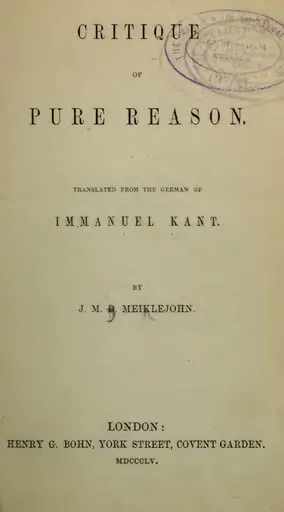

We know the general story for the first Critique: "dogmatic slumbers," publication from "within three months" turned to a decade of research, into the arms of reviewers that "knew of no other book in the world that was so strenuous to read," turned into a classic that makes him one of the greatest philosophers of all time.
The interesting story that never gets told is how this became a classic at all. The first or "A" version in 1781, and the friendlier expository Prolegomena of 1783, did little to attract attention. Kant and the Critique were not unknown fully but rather ignored from their difficulty. Kant was hooked partially into the pantheism controversy in 1785, when both Jacobi and Mendelssohn used Kant against each other in their writings, though both without a full comprehension of him. The controversy was over whether the Enlightenment rationalism did or did not ultimately resolve into Spinozism: and if it did, whether it should be abandoned for Jacobi's salto mortale. Reinhold's Letters on the Kantian Philosophy in 1786 were the tipping-point for the "Kantian fever" by essentially posing, in response to Jacobi's challenge, a philosophy that solved the empiricist issues raised by Hume, avoided superstition and Spinozism, and kept alive the promise of the Enlightenment. The "B" version of the first Critique in 1787, the second Critique in 1788, and the third Critique in 1790 completed the "critical project."
Discussion of Kant in the modern day, if you are not I suppose a scholar of Kant, seems unfortunately to pay too much attention to the analytic/synthetic and a priori/a posteriori distinctions. That is all in a sense merely introductory: the point of the book is to prove there are synthetic a priori truths, not to prove that the concept of a synthetic a priori truth is well-founded. The heart of the book lies in the categories and the schemata. The criticisms made about the categories and especially those about the thing-in-itself are somewhat well founded, but this gives no one an excuse not to read Kant. A few too many people are allowed to get away with a degree in philosophy while only having read a few chapters of the Prolegomena.
If you want to be able to understand anything about philosophy, you have to read the first Critique in its entirety. A conservative 30% of the namby-pamby academic philosophy published today is namby-pamby because the author didn't understand Kant. If you don't want to read Kant: content yourself with pre-Kantian philosophy; I promise there is enough there.
Recommended reading before Kant: Hume, either the Treatise or the first Enquiry; and Descartes' Meditations. Don't bother reading Kant without reading them first.


“A few too many people are allowed to get away with a degree in philosophy while only having read a few chapters of the Prolegomena.“ 😫Guilty, but in my defense I didn’t pursue a graduate degree, and I’m just a hobbyist. I do need to get around to reading it someday though.
I commend your ability to escape from its clutches as a hobbyist. I fear its allure is too strong for me...