
My Archive No. 3: A Thousand Plateaus

Sep 07, 2025
Guarantee there’s going to be a lot of “lol you didn’t read that no one reads that.” Well, ,fuck you, I did read that. Whether I truly understood A Thousand Plateaus is a different story, but I can safely say that I finished the fucker.
Like most anyone outside France, I discovered Deleuze in caaaah-lege, in a critical theory course. This is because little me decided to pack his brain with French theory and hallucinogens. Synergistic, for sure, but results may vary to say the least. I’ll get to where I landed later.
I didn’t get Deleuze at first, at all, because nobody does. Like many of his mid-century fellow travelers, he wanted to go wild with the form, and to engage in ecstatic bursts rather than linear arguments, with the critical belief that the function must be embodied in the form. Raised on empirical science and Henry David Thoreau, it took a minute for me to take the bait.
But after I got intrigued with GD, FG, and their buddies (Michel Fuck-You, Rollin’ Bart, Walt Bisney, Big Teddy A. and the Hork), I decided to try my hand at A Thousand Plateaus.
The aforementioned ecstatic form makes it difficult to summarize, but you can think of A Thousand Plateaus as a series of vague, poetic propositions, expressed through an entirely new vocabulary – “war machine,” “bodies without organs,” and of course “rhizome.” As 20-ish year old who could easily get stars in his eyes, it was a challenge I wanted to rise to. And even now, as much as I might roll my eyes at the neologisms, I have to conclude that most of them are pretty necessary terms for revolutionary concepts. I couldn’t have been drawn to Deleuze and Guattari if they were pure bullshitters – they had enough reality to them that they didn’t seem like mere pontificating French alcoholic pederasts.
If I had to sum it up, I’d say that Deleuze and Guattari sought to rewire philosophy, focusing less on order and hierarchy, and more on stochasticity and moments of intensity, immanence rather than transcendence, contradiction rather than harmony, incredulity rather than verifiability, micro-level tactic rather than grand strategy. In other words, the exact sort of thing that a 20 year old who didn’t like being told what to do would like. It makes sense that in the orderly dirigiste world of mid-century France, in which technocratic social democracy was the establishment, as represented by both the institutional socialist parties and the conservative Gaullists, that the fuck-you vibes here would be the radical alternative.
But I became frustrated with the lack of a path forward. Rather than guiding me to emancipation, their ideas made me feel more helpless in a web of unnameable control systems (Bush era coming in hot). And you have to conclude that as influential as these ideas were in my own thoughts, they were grounds for diddly-squat. Rather, they’re best when you think of them as provocations.
Because if we actually follow the Deleuzo-Guattarian line, what we arrive at is essentially late capitalism, in which there is no preordained good and virtue, making might the only right. In checking my ascertainments as I wrote this, I found that the IDF has been using A Thousand Plateaus as something of a theoretical vade mecum – the Geneva Convention is just so passe. It’s easier to justify the mass murder of civilians if you see them as part of the rhizome that links them to terrorism.
However, I don’t think that means we can call A Thousand Plateaus a fascist text or anything like that, and I’m sure D&G would be mortified if they heard that war criminals in Israel were looking to their work for inspiration. But it does mean that we should read with caution, and while I’m thankful to them for their contributions to my way of thinking about the world, I do have to depart with them at a certain point, and move on in decidedly non-rhizomatic ways.
All of which is a more pretentious way of saying “it’s about the journey, man.” And maybe that, too, could be classified as a Deleuzean line of flight. You never know.
No comments yet. Be the first to share your thoughts.

My way of approaching literature is essentially and at its heart quietist. I don't read for entertainment, generally, even if I am entertained.

This isn’t Auster’s best known book – that would be The New York Trilogy. And it’s not his most technically accomplished – that’s 4 3 2 1.
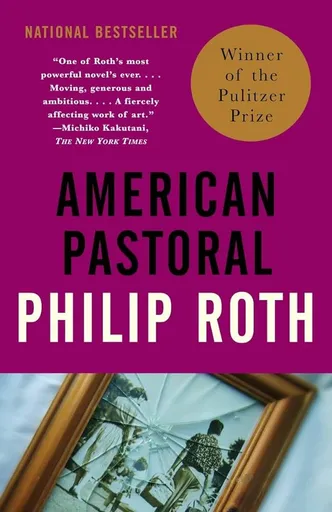
As tired a term as “great American novel” is, this might just be it. Firstly, scope is a requirement.