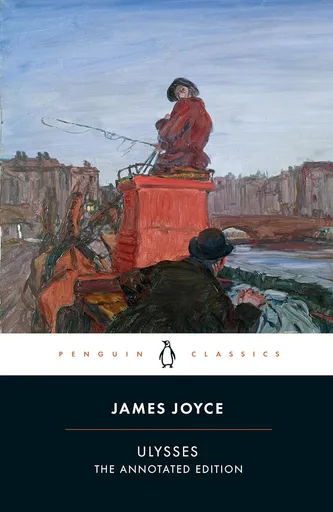
For me, James Joyce’s is not merely a novel; it is a revolution. It reshaped the literary landscape of the 20th century, establishing itself as a defining monument of modernism. First published in 1922, is one of those rare works that challenges, delights, frustrates, and ultimately rewards the reader in a way no other novel can. It’s a triumph of style, structure, and substance—an epic of the everyday that dares to find the sacred in the mundane. Reading is a rite of passage, an intellectual and emotional journey that is as transformative as it is unforgettable.
More reviews
Ulysses
Ulysses
Ulysses
At its core, Ulysses is the story of one day—June 16, 1904—in the lives of three characters in Dublin: Stephen Dedalus, a young intellectual adrift in existential uncertainty; Leopold Bloom, a middle-aged Jewish advertising agent navigating personal grief and domestic insecurity; and Molly Bloom, his passionate, intelligent, and emotionally complex wife. On the surface, not much “happens”: Stephen lectures and drinks, Bloom attends a funeral and walks around town, Molly lies in bed. And yet, through Joyce’s kaleidoscopic narrative lens, this single day expands into a universe. The epic scope of Homer’s Odyssey is transposed into the prosaic rhythms of modern life—and in doing so, Joyce reminds us that heroism resides not only in myth, but in the quiet, uncelebrated corners of reality.
What makes Ulysses so singular is not just what it says, but how it says it. Each chapter is a dazzling stylistic experiment, a shifting lens through which we encounter the characters and their world. The narrative voice is a shape-shifter, slipping between perspectives and tones, moods and registers, past and present, with an audacity and virtuosity that still feels daring over a century later. Chapter 3 ("Proteus"), for instance, immerses us in the stream-of-consciousness of Stephen Dedalus as he walks along Sandymount Strand, his mind unraveling with philosophical abstraction and literary allusion. The syntax is dense, lyrical, and free-associative—demanding careful attention, but richly rewarding it.
Then there’s Chapter 14 ("Oxen of the Sun"), in which the development of the English language itself is parodied and celebrated. Joyce mimics prose styles from Anglo-Saxon chronicle to Victorian purple prose, culminating in a boisterous explosion of working-class slang. It’s a tour de force—a living history of English that playfully enacts the birth of a child in the maternity hospital, while metaphorically gesturing toward the evolution of language and humanity itself.
And how could I ever forget the final chapter, the legendary soliloquy of Molly Bloom? In a flowing, unpunctuated monologue, we enter the unfiltered consciousness of a woman at rest and in reflection. Molly’s voice is earthy, sensual, humorous, and deeply human. It’s one of the most powerful expressions of female interiority in literature—at once intimate and universal. Her final word, "yes," echoes like an affirmation of life itself: resilient, enduring, loving.
What elevates Ulysses beyond mere intellectual pyrotechnics is its profound humanity. Leopold Bloom, in particular, emerges as one of the most richly realized characters in fiction. Kind, curious, lonely, and introspective, Bloom is an everyman, an Odysseus of the modern city. He wanders through Dublin not in search of glory, but in search of connection, understanding, and reconciliation—with himself, his wife, and the world around him.
Joyce imbues Bloom with a psychological depth and emotional texture that is unmatched. His thoughts drift from the trivial to the profound, from advertising slogans to memories of his dead son, from voyeuristic curiosities to moral dilemmas. In Bloom, we see a portrait of the human mind in all its complexity—fickle, fragmented, but endlessly striving for meaning.
Stephen Dedalus, reprised from A Portrait of the Artist as a Young Man, serves as the novel’s intellectual counterpoint to Bloom’s earthy sensibility. His journey is a spiritual and philosophical one, wrestling with questions of art, identity, history, and faith. Though often aloof and tormented, Stephen is a vessel for Joyce’s exploration of creativity and the burdens of inheritance—cultural, familial, and artistic.
Molly Bloom, though physically static for most of the novel, is emotionally dynamic. Her monologue reclaims narrative space for female desire and perspective, challenging the male-dominated literary canon. Through Molly, Joyce critiques the limitations imposed on women by society, even as he celebrates the richness of her inner life.
Ulysses is, among many things, an encyclopedic tribute to Joyce’s beloved Dublin. Indeed, the topography of the city is rendered with meticulous specificity. Streets, shops, pubs, churches, bridges—each is named and situated, anchoring the novel’s flights of language in a very real place. Dublin becomes a character in its own right: vibrant, flawed, sprawling, alive.
But more than Dublin, Ulysses is a love letter to language itself. Joyce revels in the elasticity of English, pushing it to its breaking points and beyond. Puns, portmanteaus, foreign tongues, invented words, and playful phonetics abound. Language in Ulysses is not merely a vehicle for meaning—it is meaning. It is sound and rhythm and texture. It is a thing to be sculpted, broken, and remade.
This linguistic exuberance can be challenging. Ulysses demands active engagement; it refuses to be passively consumed. But therein lies its joy. Reading Ulysses is an act of participation. We are not simply reading a story; we are decoding, interpreting, re-reading, discovering. Every sentence is an invitation to deeper understanding. Every chapter offers a new way of seeing the world.
Since its controversial release—banned for obscenity, celebrated for genius—Ulysses has remained a lightning rod for critical discussion. It has been hailed as the greatest novel of the 20th century, and perhaps of all time. Its influence reverberates through the works of countless writers: Samuel Beckett, William Faulkner, Virginia Woolf, Salman Rushdie, Don DeLillo, Zadie Smith, and many more.
It is no coincidence that June 16 is now celebrated globally as Bloomsday—a literary holiday in which readers retrace Bloom’s steps, perform readings, and toast to Joyce’s audacity. How many other novels have inspired such devotion? Ulysses is not just read; it is lived, studied, debated, adored. It continues to generate new interpretations, scholarly works, adaptations, and homages. It is inexhaustible.
Yet for all its towering reputation, Ulysses is also deeply democratic. It grants dignity to the overlooked and ordinary. It insists that a man buying soap or defecating in an outhouse can be the hero of an epic. It elevates the quotidian into the poetic. In this sense, Ulysses is not elitist but profoundly humanist. It is literature not just as artifact, but as experience—fluid, alive, and brimming with possibility.
I can assure you that reading Ulysses is not easy, but it is essential. It will test your patience, stretch your intellect, and expand your sense of what literature can do. It is not a book to be hurried through, but savored—sometimes sentence by sentence, word by word. It rewards perseverance with flashes of humor, insight, and transcendence that no other novel can match.
More than a century after its publication, Ulysses still feels ahead of its time. It is a mirror of the human mind, a hymn to language, a record of a city, a meditation on mortality, a celebration of life. It reminds us that even the smallest acts—walking, thinking, remembering, loving—are worthy of attention and art.
In Ulysses, Joyce gave the world a masterpiece that is endlessly challenging, endlessly rewarding, and endlessly alive. It is the Everest of literature—not to be feared, but to be climbed. And at its summit, the view is incomparable.