
Aug 20, 2024 12:06 AM
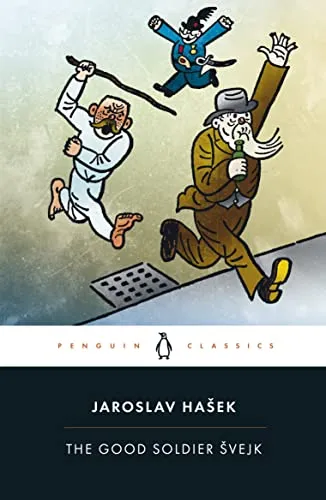
Not quite as satisfying on a reread, but still one of the great 20th Century picaresques and a seminal war satire, passing the baton directly from Simplicissimus to the likes of Heller and William Eastlake. The characters are indelible: the terminally uptight Lt Dub, the apelike, arm-swinging glutton Baloun, the long-suffering but essentially noble Lt Lukáš, and of course Švejk himself with his inexhaustible fund of pointless anecdotes and reductio ad absurdums, a kind of super-moronic Sancho Panza (to Lukáš' Quixote?) whose response to the idiocy of endless war is to meet it on its own idiotic, interminable terms.
Hašek's disgust for the role of the Church in war is extremely palpable. Here he is describing some prayer-cards, penned by the Archbishop of Budapest and distributed to the men by a couple of well-meaning old ladies:
According to the venerable archbishop the merciful Lord ought to cut the Russians, British, Serbs, French and Japanese into mincemeat, and make a paprika goulash out of them. The merciful Lord ought to bathe in the blood of the enemies and murder them all, as the ruthless Herod had done with the Innocents.His Eminence, the Archbishop of Budapest, used in his prayers such beautiful sentences as for instance: 'God bless your bayonets that they may pierce deeply into your enemies' bellies. May the most just Lord direct the artillery fire onto the heads of the enemy staffs. May merciful God grant that all your enemies choke in their own blood from the wounds which you will deal them!'
And although the plot, such as it is, never makes it to any actual combat (I wonder if it would have done had the author lived to complete it?), the horror of the front is never far away. Here's an anonymous character in a discussion on the prevalence of shit on the battlefield:
'And a dead man, who lay on top of the cover with his legs hanging down and half of whose head had been torn off by shrapnel, just as though he'd been cut in half, he too in the last moment shitted so much that it ran from his trousers over his boots into the trenches mixed with blood. And half his skull together with his brains lay right underneath. A chap doesn't even notice how it happens to him.'
Ultimately though, Švejk is a pre-postmodern work, the theatre of war meeting the theatre of the absurd. Exchanges like this, very near the end of the book, capture the spirit of it, I think:
Vaněk asked with interest:
'How long do you think the war will go on, Švejk?'
'Fifteen years,' answered Švejk. 'That's obvious because once there was a thirty years' war and now we're twice as clever as they were before.'
And at its heart, amid all the inanity, the tedium, the degradations, if you squint very hard, there's a kernel of something decent:
Lieutenant Lukáš walked along the track thinking: 'I ought to have given him a few on the jaw, but instead I've been gossiping with him as though he were a friend.'