
Aug 25, 2025 4:33 PM
(I'm writing about books that were significant to me in some way because it seems a worthy project -- review, not a review, whatever)
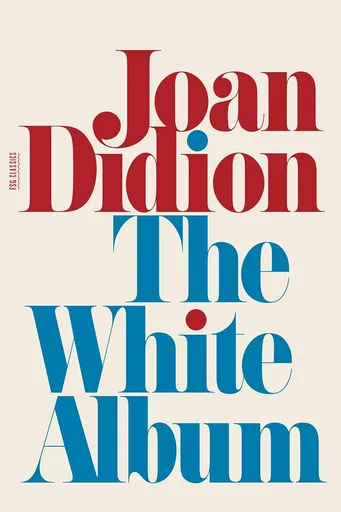
It’s very strange to me that Joanie D. has been so en vogue the past few years. Sure there’s a renewed interest in explicitly feminine writing, and Didion does have the sort of harridan chic that a lot of publishers love to put on display, but at the same time, to shoehorn her into contemporary women’s writing, or women’s writing in general, would be a disservice to her. She would have probably called such things condescending and infantilizing. Especially given how bitter she is in The White Album towards the feminism of her day. Her politics, such as they were, leaned right, but above all else, she was apolitical. She’s unsparing here towards Ronald Reagan, for instance, but that mostly seemed to be because of his tasteless imitation of taste (sidenote, her examination of the Getty Center later on in the text celebrates that institution’s tasteful imitation of tastelessness). Meaning that many of the same writers and critics who lionize her today would have called her a reactionary were her opinions still current.
No, Didion was at pains to point out how her generation – Silent, Anxious, whatever you want to call it – really sought salvation in the personal rather than the political, in the resolution of Freudian “complexes” rather than sociopolitical accountability. This is part of the reason that the essays of The White Album resonate so hard, because rather than focusing on the minutiae of the moment, she steps back and takes a cool critical eye, focusing on ironic detail and snide commentary rather than being swept up in the great zeitgeist.
I read The White Album when I was 16. My dad, of all people, told me to read it, which in this light makes perfect sense too – another intellectual grump from another era.
The opening essay doesn’t have much to do with the Beatles album. It has to do with The Doors, though, and the Manson trial, My Lai, Hawaiian vacations, and a psychotic break. We are treated to portraits of Eldridge Cleaver, Joan Baez, Linda Kasabian, stories about life in Malibu, about the California water and traffic crises, meetings of the Jaycees failing to find their place in a new era, and all the rest. It’s genuinely hard for me to talk about them without feeling like I’m detracting from the originals. So because this isn’t a real review, I’m just going to leave it there.
For the past decade or so, I’ve reread passages and essays at least a few times a year. They’re the sort of thing that are good to read when I wake up at 2:30 in the morning, and I need to be told that no, it’s not OK, but it’s OK that it’s not OK.
This is to say that her sentences are like cigarettes stubbed out into your coffee. She’s fine telling you to fuck off, really, and what makes it work, what makes you want to stick around, is that she’s actually not a misanthrope. Alienated and weird? Sure. But someone with love in their heart.
When I was younger I wanted to emulate her in attitude and style, because I wasn’t anywhere near assured enough of my place in the world. She would have, politely and with ladylike poise, told me to go kick rocks.
But then when I moved into my current address – the longest residence I’ve had as an adult – I knew it was home immediately, and not least of all because the cracked tile patio going out towards the pergola and the pool and the tennis court, all of which had seen better days, reminded me so much of a house on Franklin Avenue in Hollywood. And at night, sometimes I throw open the windows and let the scent of the jasmine and the ylang ylang in.