
Oct 24, 2025 7:59 PM
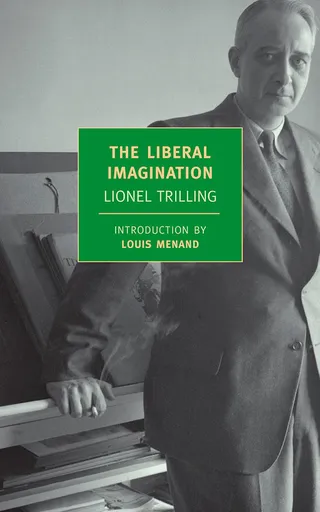
Fancy universities sometimes like to give each member of the incoming undergraduate body a copy of the same book, which is intended to inaugurate them in the Great Intellectual Tradition. It occured to me partway through this one that "The Liberal Imagination" would make an excellent choice for this. It's not that everything written here is correct, or even that people still broadly agree with Trilling; it's more that the book seems to gather many of the free-floating critical ideas of his time and give them their canonical, most elegant expression. Nowadays, if you're a critic, you're probably not arguing against Trilling, but you probably are arguing against someone who made their bones fighting him forty years ago.
Often these are ideas about the relationship between the world and literature and how "the liberal imagination" connects these. Trilling believes that the novel has the heroic task of making us better people (is "morally hygienic" as Louis Menand puts it in his intro) by intelligently excavating society's dense texture and training us in making wise discriminations between appearance and reality. But this isn't advanced in the service of a brittle "dogmatic realism" (a term he uses to attack Sartre at one point, in fact), but comfortably sits with an endorsement of modernist books like those of Kafka and Faulkner. Likewise, Trilling enthusiasm for Freudianism is above all as another tool in the critic's kit, not a master interpretive schema: he always wants to amplify, complicate, nuance instead of simplify or reduce.
Or take the essay about the Kinsey Report, which most people know nowadays for helping legitimize homosexuality by empirically demonstrating how common it is. I expected some old-fashioned ideas on the subject from Trilling but in fact his criticisms—e.g. that the report conflates "normal" as in common and "normal" as in non-objectionable, and that it's hamstrung by narrowly focusing on the quantitative, mechanical aspect of sex—are astute, correct, and still relevant. This is a guy who carefully delimits his arguments in order to make them all the more powerful.
Of course, there are off-ramps in the text if you're not ultimately a proponent of the liberal imagination. At least twice Trilling swerves from an issue on the grounds that it would involve "ultimate considerations" involving the "social question"—that is, capitalism. Famously, notoriously, Partisan Review and its associated New York Intellectuals were anti-communists, so "liberal" here is always implicitly shadowed by the qualifier "as opposed to socialist."
Well, seventy years on, those "ultimate considerations" have caught up with us. I don't really think it makes sense anymore to talk about literary culture or any type of culture without talking about how capitalism is in the process of turning absolutely everything from your childhood memories to your sexual habits into grey TikTok slop, and even Trilling's liberal sensibility has undergone a kind of commodification into thought-cancelling bromides about "nuance" or "complexity" or "art that inspires" that you get from CNN assholes or Ivy League deans. Libs, as Trump would put it, aren't sending their best. But damn, they used to.