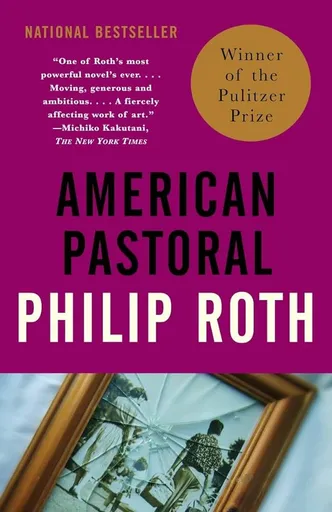

There’s a particularly facile school of social criticism that I can define only as the “American” school. That’s not to say that the school itself is American. This field is distinguished by its use of the word “American” in the title. American Hustle. American Beauty. American Pie. And American Pastoral, Philip Roth’s autopsy of mid-20th century values in the good ol’ U-S-of-A. These works often revolve around cutting insights such as “America isn’t as free as it claims to be” and “Domestic bliss is often a thin veneer over a turbulent reality.”
You may have gathered that I don’t particularly care for this book. That’s true. Whatever American Pastoral’s virtues may be, they simply don’t register with me. This was my second time reading it in roughly ten years, and I found it much as I did before: uninspired, morally dull, and boring as shit.
This novel os essentially written as one long stream of consciousness, discursive and long-winded. For certain people, that makes for thrilling literature. It makes my eyes glaze over. While Roth’s sense of humor and irony occasionally enlivens proceedings – I got a chuckle out of the Swede propping up baseball books between two miniature statues of The Thinker – I often found his narrative, or lack thereof, enervating, if not borderline intellectually insulting. “Wait a second… kid gloves? Is that a metaphor for what the American way of life does to innocent children? By God, I’ve cracked the code! Roth, you’re a genius!”
There is precisely one interesting element to this novel, however, and that is the framing device. If all Roth wanted to do was deconstruct the American way of life, he could have written it without the hundred-page prologue. So what does that prologue accomplish, exactly, especially when the narrator himself states that what follows is entirely a product of his imagination? Why distance the reader in this way?
I may not like Roth, but I know he isn’t dumb. Far from it. I think he included the framing device in order to angle the narrative away from literalism and instead show how a man explains the disintegration of his reality with limited perspective. For Zuckerman, the disintegration is that of his and his classmates’ lives as represented most forcefully by the Swede. For the Swede, it’s the disintegration of his faith in his daughter, his wife, and his lifestyle.
These are tasty sprinkles on what I consider to be a donut-shaped turd. Smart as Roth was, even he fell prey to the illusion of American literature: that he could quantify, in full, an unquantifiable nation. America, its dreams and beauties and ills, cannot be broken down into a mathematical equation. There is no way to encompass it. It is gargantuan in size and Protean by nature. This country changes too fast for us to see.
Want to read an examination of America’s mid-20th century turmoil? Here’s a recommendation: James Ellroy’s American Tabloid. Ignore the title. It’s arguably more powerful than this novel, and a hell of a lot more entertaining.


I agree with your review completely. As someone who loves Roth, I was always frustrated that I could never seem to "get" this novel because it's constantly brought up as his magnum opus. I found it to be overwritten and sanctimonious. As the pages go on, you just want him to shut up about the Swede already. Hell, the only parts that didn't feel like a chore to read were about the Swede's dad and his work in the gloves industry.