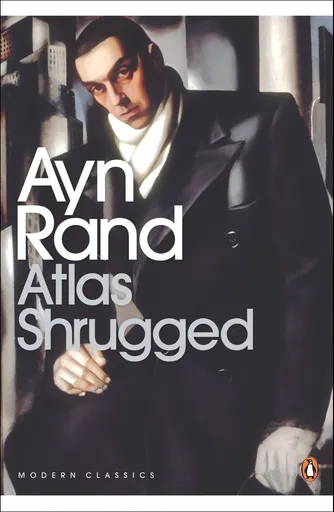

It's been years since I read any of Rand's work so consider a general review of her body of fictional work as a whole:
I think the first time I ever felt alive was when I was maybe 18 or 19 riding my bike and I was at the top of this really tall hill and you could see across the Long Island Sound into Long Island. I had just gotten to the top of this hill as the crescendo in the song I was listening to was building up and I started to go down. I didn't apply the brakes at all and just let it go fast with the wind rushing past me and the crescendo of the song playing. I had never before experienced a feeling like I did in that moment, the best way I can describe it is, and as cliche as it is, “being high on life.” Another way it can be put is: “Something for which there is no human word, maybe an ecstasy, but that doesn't express it, a feeling that needs no reason and no explanation, a feeling complete, absolute, when one can be the justification of all existence, a moment of life that would be life itself condensed.”
That comes from the play “Ideal” by Ayn Rand. When I was 18 and still very depressed I heard of this book “Atlas Shrugged” which I knew nothing about other than it was very dense and spouted as important by ‘successful’ people. So I decided to read it. I also read Ayn Rand’s three/four main works, Anthem, We the Living, The Fountainhead, and that lesser known work “Ideal”.
Ayn Rand’s work can be summed up in one word: Objectivist, which is a pretentious way of saying in addition to a fiction author Ayn Rand was a philosopher who created the philosophy of objectivism. To explain what it is I could quote the 60 page uninterrupted monologue from Atlas Shrugged (I am not kidding it’s literally 5% of the book) which acts as a manifesto for the ideology. In essence it was built upon Four pillars, but the main three are 1) Objective reality exists. 2) It is through our capacity to reason that we navigate objective reality. 3) It is through acknowledgment and acceptance of the relation to objective reality and the use of logic and reason to navigate it that one achieves self esteem. 4) Using the previous three the obvious logical conclusion to draw is that anarchocapitalism is the best political system in which to promote the previous three pillars.
In Rand’s books there is something known as the “Randian Hero”. The Randian hero embodies Objectivism and is the Ideal of what a person can (or should) be. They are a Rational Hedonist, their own happiness is the highest good and one’s moral compass. Happiness is achieved through the completion of goals, goals chosen by virtue of their values, values stemming from reason and ethical egoism. They act out of compassion and empathy rather than guilt or pity, the ideas of the latter two are foreign. Not even, they are utterly inconceivable. They love themselves and life itself and it is only through this that they can love others. Love is an expression and an assertion of self esteem, a response to one’s own values in another person.
That love of others is a love of the Randian Heroes own values being reflected back or expressed in others, a Randian Hero could never love someone who didn’t also love themselves first. They gain a profoundly personal selfish joy from the mere existence of the person they love. It is that own personal happiness that they seek, earn, and derive love from. Love is reverence, worship, and glory, total passion for the total height of one's being. Self or other. They are an end in themselves and see others as the same, never a means to an end but an end in themselves. They swear by their life and their love of it to never live for the sake of another man, nor ask another man to live for theirs. They work for their rational-self interest which is that achievement of their own happiness as the highest moral purpose. They are a radical individualist, stoic, intelligent, disciplined, capable, handsome. It is the projection of what a person could be if they were to achieve the heights of their being. Der Übermensch. In the best ways embodying the myth of Prometheus (which I personally am extremely fond of). They are like this from birth until death, although the idea of them dying seems like an impossibility, like they always existed and always would exist. Physically human, spiritually divine. Perfect.
And as appealing as this is, more importantly to me was the core feeling that Objectivism got at. That life wasn’t complete shit, but rather something more. Something to cherish and to… well to live. As if raising a toast and saying “To a life, which is reason unto itself." That happiness is possible on earth (as opposed to in heaven which I didn’t believe). That my own happiness needs no higher aim to vindicate it. That my life needs no higher aim to vindicate it. That my happiness and my life, being alive, are one in the same, that my happiness is not the means to an end. It is the end. It is its own goal. It is its own purpose.
It was also a reaffirmation of some of the values I held at the time. To reject the superficial and unprovable, use only logic and reason and reject emotions. To live only for myself. “To ask nothing. To expect nothing. To depend on nothing.”
All that being said, Objectivism is a cult and Ayn Rand is, or was, a cult leader based around the myth of “great men” and anarcho-capitalism. The Randian hero is not a real person. The idea that a great man comes along and through the sheer virtue of their being they drive history forward is a myth. Aristotle, Alexander the Great, Julius Caesar, Jesus Christ, Genghis Khan, Christopher Columbus, Hernan Cortez, Shakespeare, Isaac Newton, George Washington, Napoleon Bonaparte, Karl Marx, Lenin and Stalin, Adolf Hitler. All “great men of history” and none of who lived in a vacuum.
It is an odd feeling to find myself retroactively looking back and agreeing with passages describing how the only moral good is to live authentically, independently, for the sake of the highest value that is life itself. To “Swear by my life and my love of it that I shall never live for the sake of another man, nor ask another man to live for mine.” But all the context around those “good bits” is drenched in such abhorrent politics and conclusions.
Rand grew up the daughter of a textile factory owner in the years leading to the Bolshevik revolution, of the rise of the soviet union, and the turmoil from the transitionary period from Tsar (king) to socialism. I can understand her disdain for communism and any form of collectivism. Hell she practically outlines it herself in one of her books which is loosely autobiographical of her time in the USSR. I can also understand why she is such a rabid supporter of capitalism to the point where she doesn’t think the only function of government should be the courts to uphold contracts and property rights, and the military to protect a nation’s borders. Surely nothing bad would ever come from letting corporations have free run of whatever the fuck they want to do and I totally couldn’t give you an hours worth of real world examples followed by another hour of fictions examples if we were to go as far as she wanted. “Every man is an end in themselves” she states but in the next breath will say “Indigenous Americans deserved to be genocided and conquered because they were barbarous savages who didn’t drive society forward.” Oh did I also mention that her vastly rational mind knew that anti smoking campaigns were communist bullshit and smoking is actually good for you? Completely unrelated btw but she also had lung cancer, I don't know why I felt the need to bring that up though. You can have no nose and smell her shit coming from a mile away.
I say all this to make the point that I was 18 or 19,and ego so large that if I ever wanted to kill myself I could jump off it, a background of poverty and all the trauma that entails, and living in these here great united states where the idea of the myth of the American Dream is shoved down your throat from birth and how if you just work hard enough you can be a kajillionaire. Of course Ayn Rand would seem a godsend to me.
If you can wade through the copious amounts of bullshit and simple prose, and it pains me to say, there is some nugget of good, of some truth in her work. That good relates back to that feeling of being alive. Something that I personally have never seen reflected in any other author's writing. It may exist and I just haven't encountered it yet. I leave you with this once again:
“Something for which there is no human word, maybe an ecstasy, but that doesn't express it, a feeling that needs no reason and no explanation, a feeling complete, absolute, when one can be the justification of all existence, a moment of life that would be life itself condensed.” -Ayn Rand, Ideal

After reading I should probably clarify I have seen other works (the tumblr story/comic of "The God of Arepo"), songs, video games (Outer Wilds and Disco Elysium), etc., convey or be in the same vein as the *thing* that I find is the only redeemable quality of Rand's work. Rand was merely my first encounter with the idea and as such it has stuck with me especially so. Furthermore I think she consistently encapsulates that *feeling* several times in a unique way each time through her five fictional works.
P.P.S: If you did want to read her work to see that nugget of Good I would suggest “We The Living.” If you can get past all the anti soviet propaganda I actually think its a solid enough story save for the ending. The Fountainhead would be my next recommendation after that followed by Ideal. Anthem is short and easy to read but not a good story unless you want to really dive into her ethical egoism. Atlas Shrugged is almost wholly irredeemable and that nuggets of that “good” or “truth” are in it are sone far better by the other works. Atlas Shrugged is basically Rand getting high off her own farts and praising capitalism and fabricates A LOT of contrivances to prove its point. Also if you do decide to read any of her work (gods help you) I think it is worth noting that Rand stated all of her works are in essence love letters (or something to that effect) and I think it would be worth keeping that in mind you do read her.