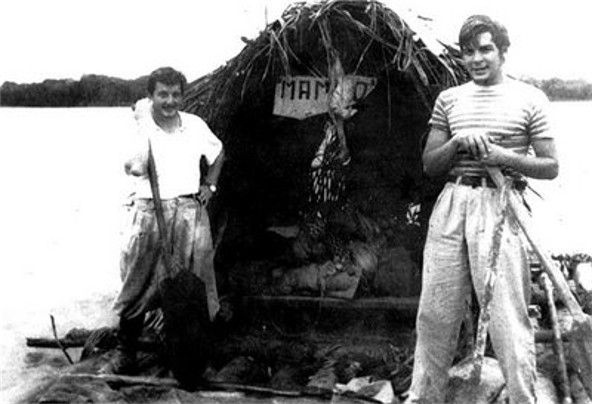
It's one of these books that has taken on a life on its own - in Che's already mythologised life, this nine-month trip through South America was purportedly the turning point in the life of this then-23-year-old medical student, away from his petit bourgeouis upbringing, educated and formed as a physician-to-be at Argentina's finest university, to a true-bred revolutionary, an iatros philosophos, and a prescriber of social ailments over individual cures, with San Cristóbal in one hand and serum in the other. If you read the Wikipedia page or the most raving reviews, the trip from december 1951 to se 1952 through Argentina, Chile, Peru, Colombia and Venezuela was chock-full of social injustices, poverty, illness, and a head-on look at disasterous capitalist expoitation, with Che's proto-revolutionary musings and willingness to upend the foundation of the inequalities he was a spectator to bubbling right below the surface.
Of course! The mythos of Che demands that his class consiousness developed at a rate far exceeding his classmates, compatriots and even comrades, his conscientiousness and steadfastness far deeper than any of us mere mortals - there is simply no space for the stealing and lying rascal we get to know him as in this diary.
Because a good 50 % of this diary is Ernesto Guevara and his friend Alberto Granado driving on their bike until it breaks down, then going to some poor locals to beg for food and a place to sleep, under the pretense that they are world-famous medical experts or marking the one-year aniversary of the trip, before running away with the rest of the food and some wine. He actually writes down their then-perfected technique while in Peru:
The technique is as follows:
Say something loudly, immediately identifiable as Argentine, something with a che in it and other bits of slang and drawl. The candidate takes the bait, immediately asking where we’re from; we strike up a conversation.
Begin to speak of the hardships but don’t make too much of them, all the while maintaining a gaze fixed in the distance.
I intervene and ask for the date; someone provides it and Alberto sighs, saying: ‘Imagine the coincidence, it was a year ago today.’ The candidate asks, a year ago since what; we respond that it was when we began our journey.
Alberto, much bolder than I am, lets out a gigantic sigh, saying, ‘Such a pity we’re in these dire circumstances, we aren’t able to celebrate’ (he says this quietly, as if confiding in me). The candidate immediately offers to pay; we pretend to refuse for a while, admitting it would be impossible for us to ever pay him back, etc., and then finally, we accept the offer.
After the first drink, I steadfastly refuse to accept another and Alberto makes a face at me. Our host becomes a little angry and insists, but I refuse, without giving reasons. The man asks and asks until I confess, full of embarrassment, that our custom in Argentina is to eat when we drink. Just how much we eat depends on how we judge the candidate’s face. All in all, this is a highly refined technique.
In San Ramón we tried it again and, as always, were able to concretize the enormous amount we had to drink with some solid food. In the morning we rested on the shores of the river – a very pretty landscape even though its beauty escaped our aesthetic attentions somewhat, transforming itself into terrifying mirages of all types of edible delicacies. Nearby, peeking through a fence, the plump forms of oranges materialized. Our feast was fierce and sad; in one minute our stomachs felt full and acidy and in the next the stabbing of a severe hunger resumed.
And so on, in a seemingly bastardised and unreflective bizarro-version of Hamsun's Hunger.
However, I did end up enjoying the diary, not only in the unintendedly humanising look of him and the neccesary correction to every hagiograhy, but also in the bits and pieces of florid prose, exemplified in the last paragraph quoted above. Guevara was never a novelist or a writer of philosophical works (unlike many of his contemporary revolutionaries, Che's theoretical contributions to the Marxist tradition are scanty and overblown), but I'd argue his predilection as a poet is succesful.
But because this is a diary of his own belonging, written in late evenings, during cold dust storms, under an open sky, and after consultations with leper patients, his prose is quick, at times hurried, and rarely dives as deep as if one were to write a proper novel. But to criticise the diary on these marks is to miss the point - nobody criticises this review for being slightly amateurish. Instead, criticise the Wikipedia editors and the publishing press for blowing a personal chronicle up into something larger-than-life, just as you would criticise The Spectator if they were to front-page this review.
This book is best read as what it is: as a depiction of an adventurous, intelligent and mischeavous young man in his own words first, with a revolutionary outlook in a historical time and place second.