
Jul 10, 2025 6:08 PM
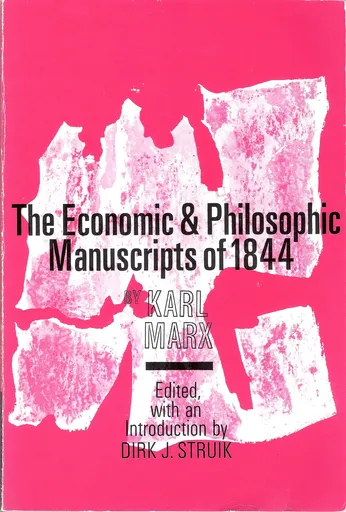
Marx's 1844 Manuscripts are an early attempt from him to describe the nature of labor, capital, wages, and alienation; working within a Hegelian/Feuerbachian framework; sitting unpublished until 1932 and thereafter providing a concrete link between absolute idealist philosophy and his later work with historical materialism for continental philosophers to ooh and ahh over.
There are about three different undercurrents through the manuscripts (which are often unfinished, or are missing pages, or were merely drafts). The economic parts are mostly notes on Smith/Say/Ricardo. One difference between the earlier and later manuscripts is that Marx seemed only to encounter Ricardo's notion of rent at a later date; meaning his earlier treatments of it are still vague, but he later acknowledges it as the foundation of the direct opposition between wages and profit, which Ricardo noted as well.
The second undercurrent is the alienation of labor. I don't know how the later Marx treats many of these topics, since I haven't read those yet, but what I can say here is that alienation of labor is directly and immutably tied to Hegelian alienation. E.g. the labor of the worker is not for-himself, but for-another; the objects (commodities) he creates are foreign & "confront him as alien"; the division of labor itself is the reducing of man to a machine-like (inhuman) role. The evolution of political economy (= the system of capitalism contemporary to Marx) is in such fashion a necessary historical consequence of private property; the system of communism (and its preceding revolution) is taken as a historical necessity in the same way. There is also an interesting section on money.
The third is the criticism of Hegel, which I find the most interesting, since his economic stuff is not revolutionary. (His idea of economics is essentially the same as Ricardo and James Mill; but he wants something to be done about what he takes to be its injustices.*) The criticism that Marx makes of Hegel is interestingly the same that Hegel makes of Fichte, which is that of being too idealistic. Hegel's thought is abstract, and needs to sublate itself to become concrete and sensuous, since Hegel's thought is itself an alienation of thought. Yet the sublation of this alienation is only negation of negation since Hegel does not grasp the positive by-itself, but only the positive as a result of negating and sublating movements. Feuerbach's humanism does have the in-itself positive (man qua species-being) but it is still too abstract for Marx, for some reason I forget.
What is striking to me is the depth to which this is inspired by Hegel. I sort of assumed Marx just skimmed off the parts which can be used to argue for revolution and historical necessity and went from there, but he is a full and true student. Private property in the Manuscripts is the cornerstone that sets in progress the development of capitalism, alienation of labor, etc. etc. in a necessary way. It is not enough to simply make everyone's property equal or to give equal wages to everyone, it is the concept of private property itself which must be abolished for progress to be made. Marx includes little critiques of Proudhon for this.
I would be wary of any attempts to "demystify" the Manuscripts, and translate it into plain language, the way some commentators of Hegel and Marx often do. The ideology at work there is one that Hegel/Marx had correct (or nearly) correct views on the large-scale functionings of society but from some defect wrapped them up in obscure philosophic terminology. But doing this then presents concepts such as alienation of labor etc. as empirical and therefore accidental phenomena. But there is no room for accident or chance in their philosophies. If you take the route of trying to understand the philosophies of Hegel and the early Marx within their own philosophies, you must adopt their language and methods of reason; if from the outside, it is necessarily an attempt at supersession, so you cannot claim to be a mere interpreter.
As an aside, some reviewer of Vico mentioned that "vulgar Marxism" takes the progress of history as a line from feudalism to capitalism to communism. This is in truth Marx's view himself. He has a quote that is almost exactly that, but I don't have the book with me right now.
I don't agree with Hegel or the young Marx, since their concepts of history are integral to their philosophies, and those concepts have of course failed. I don't think, as some do, that you can surreptitiously chop off the parts of their philosophy which have not survived (their philosophies of history, their naturephilosophies, etc.) and keep the rest, this is abhorrent to the systemic, circular, and complete character of their philosophies. I think some of the notions they developed do have some truth but do not have the same relations they were thought to have.
Worth reading, had a large impact on continental philosophy, and makes me excited to read Capital.
* I suppose not entirely true: he argues that the landlord class, as rents fall, will either be forced to become capitalists as well and manage the farming of their own land, as opposed to renting it to tenant farmers; or be forced to sell their land to the capitalists; in both cases the landlord class will be collapsed into the capitalist class. I do not remember anything of this sort in Ricardo, and it does not seem something he would say, so I think this is an improvement by Marx to the pure science of economics.
3 Comments
5 months ago
The chapter on alienation is one of my all-time-favorite pieces by Marx. Although it's probably slightly imprecise to say that Marx was concerned with the *injustice* of the capital relation, so much as he was interested in (what he took to be) its inevitable dynamics, which were (are?) contrary to human life. (This theme—that capital is contrary to the life of the species—is later taken up by the Italian Marxist Amadeo Bordiga, and taken to its furthest extremes by the recently departed Jacques Camatte.) To say that the *concept* of private property need be abolished is also somewhat imprecise within a Marxist frame, since concepts merely reflect material realities in the mode of production. Just some random thoughts.
5 months ago
Hm... I still think he's concerned with its injustices; even if the transition to communism is inevitable, it's worth speeding up... and in the 1844 Manuscripts the vibe I got was that abolition of the concept is synonymous & necessarily attending to the abolition of the material circumstances, since he's operating still at this point within Hegel. Perhaps later he distinguished between the two. What do Bordiga and Camatte say?
5 months ago
It's possible that his emphasis in the 1844 manuscripts is more Hegelian, I haven't done a thorough read of the text in a while. There's a famous anecdote though that he would laugh whenever people would talk about morality. Which isn't to say that he was totally unconcerned with injustice, but that part of the materialist methodology (if such a thing exists) necessitates a deflation of the ethical component of things. Bordiga is a very "traditional" reader of Marx, so he emphasizes a lot of these sorts of things, as well as writing, famously, about how "the hell of capitalism is the firm", rather than the intricacies of its administration—which, again, aligns with a materialist / structuralist critique, rather than an idealist critique which focuses on, say, the actions and attitudes of "great men". Camatte was a member of Bordiga's circles, and some time in the 60s began arguing that the proletariat could no longer function as the revolutionary subject, that they had been subsumed into the capitalist order, and that the real conflict was not a class conflict but the conflict between capital, on the one hand, and humanity on the other. Sort of like the humanist obverse to Nick Land's accelerationist coin.