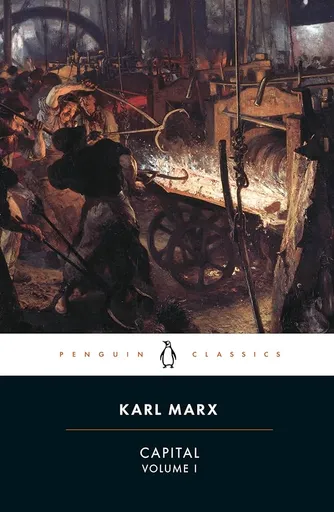
Books whose reputations so forcefully precede themselves deserve, usually, the little clarification they can get. Capital is a work of economics which claims to describe what the economic system of his day was, how it came to be, why it is perpetuated, and how it adversely affects the working population. The first volume was published in 1867 during Marx's lifetime, after his death in 1883, Engels published the second volume in 1885 and the third in 1894, from unfinished manuscripts which Marx left. The fourth volume was published in the 1900s in three volumes under the title Theories of Surplus Value. The first volume is concerned with the production process of capital, the second with the circulation process, the third with the forms of the whole, and the fourth a "historico-critical" section on various economic theories. The work was conceived as a whole, though the first is the most widely read and discussed.
More reviews
Going through the names of the eight parts in the first volume pretty accurately tells the structure of the whole: in order, "Commodities and Money", "The Transformation of Money into Capital", "The Production of Absolute Surplus-Value" (i.e., surplus-value which is gained by extracting more labor out of the worker, notably through lengthening of the working day but keeping the same wage), "The Production of Relative Surplus-Value" (i.e. surplus-value gained by reducing the time the worker needs to produce his part of the resulting product, notably by reducing the cost of the worker's necessities through more efficient production), "The Production of Absolute and Relative Surplus-Value", "Wages", "The Process of Accumulation of Capital", and "So-Called Primitive Accumulation" (i.e. how the capitals required to start the modern production process were historically built, before capitalism was self-sustaining). I exclude an appendix chapter (the Resultate) which existed in manuscript, originally intended as a part of Vol. 1 but later omitted by Marx.
The Marxist economic doctrine, as it stood in 1867, aligned itself often by way of critique of earlier doctrines. The first is that when it presents capitalism, it does so, not like Smith and Ricardo and all the rest, as an eternally existing state of relations, but rather as a specific form of social production, which had arisen historically from another specific form (the feudal system), and which will resolve itself, by force of its own inevitable instability, into another (communism). The second is that it claims, of the classical political economics, necessary contradictions and gaps within that science, which cannot be resolved until the essence of the production of surplus-value is grasped. (More on this later). Those are of sorts the two pillars of the theory, the practical and theoretical contradictions within capitalism.
The Hegelian terminology that the book occasionally adapts, especially in the theoretical sections, is more from Marx's obstinacy than from any sycophantic attitude. He says as much in the postface to the second edition, that his dialectic is diametrically opposed to Hegel's, but that when "the ill-humoured, arrogant and mediocre epigones who now talk large in educated German circles" were criticizing Hegel too much for his taste, that he "openly avowed himself the pupil of that mighty thinker" and "coquetted with the mode of expression peculiar to him." It is not an uncommon tendency of Marx to criticize quite liberally writers he disagrees with, like Hegel, but also to criticize even more vehemently others who criticize them, if he thinks their critique is vulgar or backstepping.
Another review on this site of Vol. 1 was posted a week ago, and it was enjoyably written but not particularly accurate about the material. For instance.
Many things surprised me about Capital, but one that didn't was the ham-handedness of Marx's try at economic theory. His insistence on the "use-value" of a thing correlating with the amount of human labour that's gone into it — his "labour theory of value" — is just head-spinningly wrong-seeming from the outset.
The "labor theory of value" (championed not first by Marx, but by Ricardo, and possibly even preceding that) is not that the "use-value" of a commodity is correlated with the labor that it took to produce it, but the "exchange-value" (always synonymous with what Marx calls "value") of a commodity is. This incredibly important distinction, which appears also to Smith and Ricardo, is explained in the very first chapter of Capital Volume 1: "The Two Factors of the Commodity: Use-Value and Value", on the second page.
The usefulness of a thing makes it a use-value ... This property of a commodity is independent of the amount of labor required to appropriate its useful qualities. (p. 126, in the Penguin edition)
And further, the value of a commodity is not simply proportional to the amount of labor time which has produced it. It is rather proportional to the average amount of labor time required, given the social conditions of production in that society, to produce an instance of that commodity. Thus when an optimization in production of a commodity occurs, it lowers the value of all such commodities, not just the ones which are produced after the optimization is implemented. I would be at a loss to try and estimate what the reviewer learned from reading this book, if its first and least controversial lesson was so poorly understood.
On the other hand, the apostles of Marx are far too eager to flatter his prose. (The back of my copy calls it a "literary masterpiece".) The torturous sentence that the other reviewer reproduces is a good example of the deep end. On occasions he can conjure up images* in the great vein of Plato and Rousseau, but bar for bar, a lot of Vol. 1 is solid but not mindblowing academic prose, interspersed with quotes and long footnote polemics which, though in small doses entertaining, lose their effectiveness when the random mediocre 18th-century economist making a scientific mistake attracts the same ire as easily as the factory owner arguing that small children need to work 15 hour days or else profits won't be made.
The contradiction that grasps classical political economy is this: labor is sold at its value. But the means of production are bought at some price, and the product is sold at a higher price. How does e.g. $500 worth of cotton + $100 worth of labor + $20 of wear and tear to a machine, if we are working with a labor theory of value, not simply come out to be $620 of yarn with no profit? The profit is not made during the exchange of commodities (as the mercantilists suppose): but during the production. The answer, according to Marx, is that while the value (i.e. exchange-value) of labor is, perhaps $100 a day of congealed labor (food, necessities, housing), the use-value on the other hand could be perhaps $200 of living labor. The laborer can live on 6 hours' worth of necessities - that means: things which take 6 hours of labor, in the society, to produce - but in that day, perform 12 hours of labor. The capitalist thus can make a profit. (In Marxist terms, the necessary labor time and the surplus labor time comprise the working day; the value of the necessary labor time goes to the worker in the form of wages, and the surplus labor time to surplus-value for the capitalist. The game is then to increase, as much as possible, to augment the surplus labor time, by lengthening the working day, depressing wages, lowering the cost of necessities, intensifying the labor, hiring less-skilled workers, etc.)
Whether this is true, I do not know. Keynesian economics, from the little I know of it, does not observe the labor theory of value, and it is ostensibly the father of most modern economic theories. Regardless, there is much to learn from Marx. Historical materialism, when expressed without mysticism, and without eschatology, is something I can get behind. As much for his prediction that capitalism would collapse - I worry about the "any day now!" apologists never being able to admit the failure of this theory; certainly the revolution has not happened within the expected timeframe of the original Marxists. However, on the other hand, we can without too much hesitation assert that immiseration in the West has been alleviated and delayed, to a certain extent, by exploitation of foreign labor. The bestial conditions of the English working class portrayed in Capital are mirrored before our eyes in the cobalt mines of the Congo, in the sweatshops of India and Bangladesh, and in the internment camps of China. One does not need to be a Marxist to observe the discrepancy between the cyclical outrage about and spreading "awareness" of these issues, and the stony absence of political action, and to conclude that perhaps "our" economic interests, or rather those of our masters, lie in averting our eyes from the sin.
I will read the second and third volumes as well, and probably write up reviews. Perhaps some portion of the other reviewer's disagreements with Marx stemmed from the simplifying assumptions made about the circulation process in Vol. 1, to better illustrate the production process, which was the focal point. The prose, I am warned, gets worse. For anyone reading Marx, it does not seem to me unreasonable to pick an abridged version, or to read only selections. What I would recommend though is a familiarity with classical political economics.
* For reference, this digression against Bruno Bauer from The German Ideology: "Whereas all communists in France as well as in England and Germany have long since agreed on the necessity of the revolution, Saint Bruno quietly continues to dream, and believes that 'real humanism', i.e., communism, is to take 'the place of spiritualism' (which has no place) only in order that it may gain respect. Then, he continues in his dream, no doubt 'salvation will be attained, the earth becoming heaven, and heaven earth'. (The theologian is still unable to forget heaven.) 'Then joy and bliss will resound in celestial harmonies to all eternity.' The holy father of the church will be greatly surprised when judgement day overtakes him, the day when all this is to come to pass—a day when the reflection in the sky of burning cities will mark the dawn, when together with the 'celestial harmonies' the tunes of the Marseillaise and Carmagnole will echo in his ears accompanied by the requisite roar of cannon, with the guillotine beating time; when the infamous 'mass' will shout ca ira, ca ira and suspend 'self-consciousness' by means of the lamp-post."
This is actually a pretty good summary of vol. 1 and a fair critique of the other review. I've been meaning to respond to yarbs' review when i get the time, but seeing that you addressed some of the things I'll just add my 2 cents below. He did announce that he plans to read Capital in 6 days, so there's that. It's a case of half-heartedly engaging with a text you are not ready for or not particularly interested in, just so you can say you read it.
Calling LTV head-spinningly wrong when it's a model that best manages to explain the totality of social relations between all factors of capitalist production and commodity exchange... There's no other theory of value as comprehensive, as logically consistent and as mathematically demonstrable. It went out of vogue simply because it demonstrates where the suprlus-value comes from and exposes trade as a mere zero-sum game.
Saying that Marx is secretly embarrassed by LTV and that he "takes every opportunity to dress it up in kindergarten algebra and restate it backwards, inside-out and upside-down" is admitting that most of the text went right over your head. LTV is brought up again and again to show how it fits into every aspect of the process of commodity production, exchange, capital accumulation, capital valorization and the increase of the rate od exploitation. There is no other theory that manages all this without running into serious contradictions.
Another point made was that Marx describes capital as a relentless force of nature ungovernable by humanity and that that undermines his predictions of a paradigm shift. Irregardless of what one thinks of the inevitability of communism, anyone who engaged seriously with this text can see that this is another huge misunderstanding of Marx's thought. Marx says that coercive forces of the capitalist mode of production and market competition make it appear as if capital was an independent force of nature and the capitalist is just capital personified. He however recognizes the working class as a revolutionary class, antagonist to capital, which will, through class struggle, seize the means od production and bring about said paradigm shift.
Yeah assuming a certain amount of stability in the market it doesn't really seem plausible how anything besides the time necessary to produce an object can comprise its value. (I don't think I agree with the labor theory of value only because I don't think the market is stable. Then again, even the labor theory of value is not supposed to be a law of nature in Marx, and supposedly he deals with changes in the circulation process in Vol. 2.) You're right that capitalism must be "governable", or in familiar terms that the system of production is to change, if the proletariat is to be capable of seizing the means thereof, etc. etc.
I hope he didn't read Capital just to say he read Capital. I think I expressed some surprise at the six day reading period but apparently that went ok. It took me twenty, maybe twenty-five days to read, I don't think I could manage in six. If you read it like he did for the literary value and not the philosophical value, perhaps. I'm skeptical though that he could furnish in six days a real economic critique of a work that took Marx seventeen years to write.
I think I was too hard on him when I said he read it just so he can say he did :)
He definitely hasn't given it a proper go though.
On the LTV and market stability... The degree of market stability shouldn't affect the LTV. It does produce the discrepancy between value (socially necessary labour-time required for production) and price (money name of a commodity, the value received in exchange for a commodity) of individual commodities, and makes understanding the distinction between the two important.
Market prices fluctuate around the values od commodities influenced by the balance of supply and demand, and forces of competition. But they tend to settle around the value of socially necessary labour time for the production of commodities. And you have to look at this as a macroeconomic phenomenon, not on the level of a single commodity - total prices of all commodities realized within the market over an extended period should correspond to the value of socially necessary labour time congealed in them.
It's imperative to use this macro view because, under the influence of the market forces, each individual exchange has the potential to be unequal.
This unequal exchange simply redistributes the value of dead labour between capitalists, either by lowering the cost of the means of production or by lowering the cost of reproduction of labour-power to one, and reducing the profit of the other. As in all of trade - what one loses, another gains.
A capitalist can keep selling commodities at a prices lower than commodity's value as long as the price doesn't go below that of total capital advanced. This can, in certain cases, even make the rates of profit fall in industries with higher rates of exploitation when compared to those with lower.
Being sloppy with saying market instability affects LTV, you catch that I mean value/price discrepancies. I do think that long-term discrepancies on the macro scale can occur as a result of monopolies, and that a frequent strategy of large corporations today is to try to force the creation of monopoly markets so they can sell long-term above the price corresponding to the socially necessary labor value. I also don't think that these only affect trade between capitalists, given that the polarization of the capitalists and the workers that Marx expected did not happen and that the spectrum of wealth and of the modes of employment is too diverse. As well certain modern forms of the commodity (services, software, entertainment) simply do not go through the production and/or circulation processes laid out by Marx except in the most abstract sense, so I'm not sure, if those are delineated, that adopting the labor theory of value adds much to that analysis.




This is actually a pretty good summary of vol. 1 and a fair critique of the other review. I've been meaning to respond to yarbs' review when i get the time, but seeing that you addressed some of the things I'll just add my 2 cents below. He did announce that he plans to read Capital in 6 days, so there's that. It's a case of half-heartedly engaging with a text you are not ready for or not particularly interested in, just so you can say you read it. Calling LTV head-spinningly wrong when it's a model that best manages to explain the totality of social relations between all factors of capitalist production and commodity exchange... There's no other theory of value as comprehensive, as logically consistent and as mathematically demonstrable. It went out of vogue simply because it demonstrates where the suprlus-value comes from and exposes trade as a mere zero-sum game. Saying that Marx is secretly embarrassed by LTV and that he "takes every opportunity to dress it up in kindergarten algebra and restate it backwards, inside-out and upside-down" is admitting that most of the text went right over your head. LTV is brought up again and again to show how it fits into every aspect of the process of commodity production, exchange, capital accumulation, capital valorization and the increase of the rate od exploitation. There is no other theory that manages all this without running into serious contradictions. Another point made was that Marx describes capital as a relentless force of nature ungovernable by humanity and that that undermines his predictions of a paradigm shift. Irregardless of what one thinks of the inevitability of communism, anyone who engaged seriously with this text can see that this is another huge misunderstanding of Marx's thought. Marx says that coercive forces of the capitalist mode of production and market competition make it appear as if capital was an independent force of nature and the capitalist is just capital personified. He however recognizes the working class as a revolutionary class, antagonist to capital, which will, through class struggle, seize the means od production and bring about said paradigm shift.
Yeah assuming a certain amount of stability in the market it doesn't really seem plausible how anything besides the time necessary to produce an object can comprise its value. (I don't think I agree with the labor theory of value only because I don't think the market is stable. Then again, even the labor theory of value is not supposed to be a law of nature in Marx, and supposedly he deals with changes in the circulation process in Vol. 2.) You're right that capitalism must be "governable", or in familiar terms that the system of production is to change, if the proletariat is to be capable of seizing the means thereof, etc. etc. I hope he didn't read Capital just to say he read Capital. I think I expressed some surprise at the six day reading period but apparently that went ok. It took me twenty, maybe twenty-five days to read, I don't think I could manage in six. If you read it like he did for the literary value and not the philosophical value, perhaps. I'm skeptical though that he could furnish in six days a real economic critique of a work that took Marx seventeen years to write.
I think I was too hard on him when I said he read it just so he can say he did :) He definitely hasn't given it a proper go though. On the LTV and market stability... The degree of market stability shouldn't affect the LTV. It does produce the discrepancy between value (socially necessary labour-time required for production) and price (money name of a commodity, the value received in exchange for a commodity) of individual commodities, and makes understanding the distinction between the two important. Market prices fluctuate around the values od commodities influenced by the balance of supply and demand, and forces of competition. But they tend to settle around the value of socially necessary labour time for the production of commodities. And you have to look at this as a macroeconomic phenomenon, not on the level of a single commodity - total prices of all commodities realized within the market over an extended period should correspond to the value of socially necessary labour time congealed in them. It's imperative to use this macro view because, under the influence of the market forces, each individual exchange has the potential to be unequal. This unequal exchange simply redistributes the value of dead labour between capitalists, either by lowering the cost of the means of production or by lowering the cost of reproduction of labour-power to one, and reducing the profit of the other. As in all of trade - what one loses, another gains. A capitalist can keep selling commodities at a prices lower than commodity's value as long as the price doesn't go below that of total capital advanced. This can, in certain cases, even make the rates of profit fall in industries with higher rates of exploitation when compared to those with lower.
Being sloppy with saying market instability affects LTV, you catch that I mean value/price discrepancies. I do think that long-term discrepancies on the macro scale can occur as a result of monopolies, and that a frequent strategy of large corporations today is to try to force the creation of monopoly markets so they can sell long-term above the price corresponding to the socially necessary labor value. I also don't think that these only affect trade between capitalists, given that the polarization of the capitalists and the workers that Marx expected did not happen and that the spectrum of wealth and of the modes of employment is too diverse. As well certain modern forms of the commodity (services, software, entertainment) simply do not go through the production and/or circulation processes laid out by Marx except in the most abstract sense, so I'm not sure, if those are delineated, that adopting the labor theory of value adds much to that analysis.