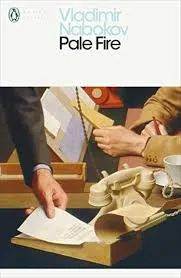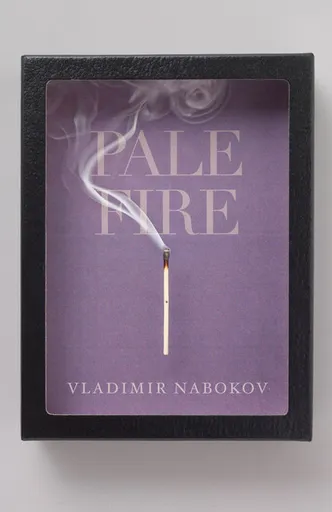

I have unfortunate news. And that’s that, unfortunately, subject is object. The two are inextricably welded together. Thing viewed is thing viewing and the two cannot separate despite their best efforts. Never the two shall part. Despite how often Idealism or Romanticism are brought up as punchlines or trite examples of disproven worldviews from semi-forgotten centuries. Despite how much a thing like an animal or a painting or a book may seem like a self-contained entity in itself, it is now my unfortunate duty to bear to you the unfortunate reader the news that such separations are an illusion.
As proof of these outrageous claims I submit this three hundred page book, Pale Fire—forty pages of which consist of a middling poem, twenty pages of which consist of a peculiarly personal foreword, two hundred thirty four of which consist of a set of interlinked, labyrinthine footnotes, and ten of which consist of a revealing index. But, along with these, contained within the idea and the presence of this book are thousands and thousands of pages written by people who are not Vladimir Nabokov about this book. There are people who have written explicitly about this book in the form of sometimes poignant, sometimes projective and banal criticism. There are people who have plied the waters beaten apart in the wake of this book, not explicitly writing about Pale Fire but creating literary experiments using the same testing apparatus that Nabokov used to help invent that strange occult substrate: postmodernity. Gag. Well, for every perfume synthesized in a lab I suppose there’s gotta be a dozen eye-watering pesticides.
Nabokov’s laboratory cannot help but produce art though. Because, like any good experimental setup, this one attempts to recreate the world in miniature, in silica. And because I’m feeling sadistic let’s continue this derivative metaphor. An experimental setup—at least a good one—is really meant to simulate the world in some small controlled way. But more than simply simulate the world at large, an experiment and its apparatus are only successful if, despite the acknowledgement that a lab bench or a chemical hood, or the hood of your friend’s ‘98 Ford Taurus as it were, is /not/ the world, good experiments let us infer things about the world not contained within their test apparatus. That is, experiments carried out under very limited conditions tell us things about the world outside of their test apparatus. That means that people who want to carry out well-run experiments have the extremely daunting task in front of them to not only learn something about Bunsen burners but actually blur the lines between laboratory and Real World. In fact, good experiments tend to take on something of a mind of their own and turn the world into their test apparatus faster than they can be contained. Especially if those experiments are carried out within the psychosphere of a particular time or medium of art. As above, so it goes, and other classic Good Lab Practices rejoinders.
Vladimir Nabokov’s experiment with Pale Fire yielded a new way for the novel to interact with history. It sort of short circuited something in the brains of many authors who came soon after him. They started giving their books structures that resembled nonliterary reading material or Samuel Johnson’s dictionary or the Bible as much as they resembled regular narrative novels by their peers and predecessors. But they were allowed to bloom because of Nabokov and books like Pale Fire. Forewords were no longer just introductions to the texts, they were opportunities to present metatextual evidence that the book you were reading was not as it appeared—was not the book that it appeared to be. Footnotes and endnotes were no longer just supplemental explanations, they were interconnected physical interruptions from the narrative where entirely new stories could be played out under the auspices of explanation. And these tools would come massively in handy for an army of authors trying to tease meaning out of a world that had tried to shed meaning and our attachment to meaning through Modernism.
The authors that came after Nabokov and many of his peers would have to undertake a horrifically more challenging task than simply watching meaning strip off the world like metallic paint. They would have to reexamine and reestablish the process of meaning-making in a strange post-meaning Atomic age. And to do it they would need every dirty philological trick available to them. They would have to understand the world as a mad drunken poet’s death rattle in poorly constructed meter and wring meaning out of it the same way that we’ve always tried to wring meaning from things: by blending the line between fiction and reality, by telling stories where previously there had been only “fact”—in the margins, between the copyright and the colophon, in the dramatis personae, in the historical context around the book, in the criticism of the book.
History is not a narrative. It’s a palimpsest and it’s been beset upon by a hoard of censors, egoists, and megalomaniacs. It’s a document that has changed hands countless times, been underlined to the point of illegibility. The edges have been burned. X-acto knives have carefully swapped critical words. Whiteout has been leveraged as a medium of art on the canvas of this document. Xerox copies have been scanned and distributed haphazardly. Subsections have been referenced and re-referenced until the rerferent and the refereand have become hopelessly confused. Every time one of these documents changes hands it is translated by someone. Men with agendas. Men who belong to groups. Men who want something from you and want you to read this document in some very particular way. Each tries to imbue their own meaning onto history while narrowing the scope of what can be read each time their black marker touches the page.
We’ve found ourselves in a predicament where history is itself conspiracy and to understand it we often have to hope that the events themselves speak to us through opaque commentary that’s been augmented to obscure those same events. We have to hope that the part represents the whole because we will never be shown the whole. Events have become specters haunting documents that were originally written to illuminate those events. But sometimes a poltergeist makes itself known and our cloying requests for sense or meaning are rewarded. Don’t expect it though. It’s important to learn to love the impossible task set out for us. Because if fiction isn’t reality in some critical way then what hope do we have of discerning history? We are so many mad Russian assistant professors, picking up notecards from the ground, hoping they contain our life story but knowing in the back of our minds that they are all too likely just the notecards that our mad poet Gods and devils forgot to burn.
Maybe my news wasn’t so bad after all.