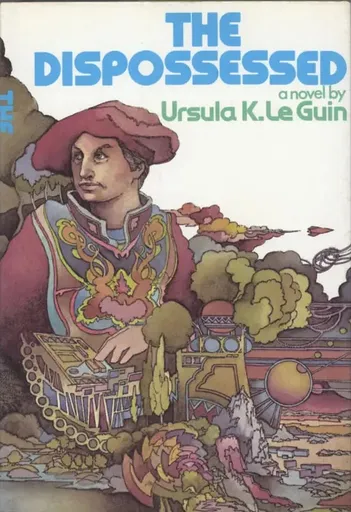

The dispossessed centers on two planets, one is an independent anarchist society free from hierarchy and personal belonging, the other is a rich earthlike society who sees the other planet (read: moon) as basically their Quaker mining colony. The novel follows Shevek, a physicist who grows up an anarchist but travels to the capitalist planet to pursue his research. The novel alternates chapters between the timelines, unfortunately one side is a lot more interesting than the other. While the $$$ planet should be the shit kicks off side, it ends up feeling like one long and drawn out epilogue interspersed into a more interesting coming of age story. I think the second half ends with Shevek leading a riot and becoming an Abbie Hoffman type for a weekend, but it's honestly forgettable. Shevek struggling to balance his family and research with the needs of his poor but functioning society was much more compelling.
What I really love about this novel, as someone not well versed in anarchist theory and not all that interested in it, is that its not about if an anarchist revolution could happen, but it says, OK we have a functioning anarchist society that everyone believes in, what does that look like? It takes a pragmatic approach to this idealized society and examines how human nature can clash against idealism and how social pressures can bend freedom into constraint.
When Shevek wants to raise his kid himself (the anarchists are against familial relation as a form of possession and egoism) and explore out there scientific ideas*, suddenly his society free of power seems quite intent on making him conform. That's not to say the novel takes a cynical "idealism is doomed" approach to the topic, it's quite clear by the end which planet is more moral, it just does a good job exploring problems and questions that would arise.
The novel is full of really fun and thoughtful worldbuilding. Le Guin doesn't resort to vague earth ideology, but instead imagines her own specific school of anarchism more focused on the social side than economic. Kids are taught not to use words like "I" or "Mine". When Shevek sneezes his daughter doesn't say "You may use my tissue", she says "You could use the tissue I am using". The novel is filled with fun bits of worldbuilding like this. My favorite is how everyone of the anarchists is given a random and unique name by their master computer. No one else alive has their name, but they recycle names. So while he barely cares about his mother, Shevek is quite proud of a Shevek before him who got a special type of screw named after her and considers her like an ancestor.
I'd highly recommend it if you're interested in reading about a unique society that's very different but also full of grounded idealism. The book is a bit slow at times and certainly lacks characters who pop, but is overall a fun and thought provoking read
*I do love how Le Guin embraces sci-fi science that makes no sense. I think the crux of Shevek's research is combing quantum physics with applied ethics for faster than light communication, it's great.