
Aug 20, 2024 6:23 PM
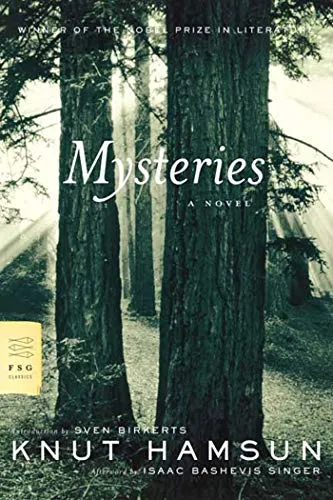
I first read this at the age of about 15, pulling it from my parents' shelves probably on some miserable rainy weekend. I remember liking the gloomy forest on the cover and thinking the book was weird, and good, and I'm of the same opinion today, although I understand it better now having read a couple of Hamsun's other novels and also being much older and wearier of the world. Now I think that Mysteries is doubly ahead of its time. It's proto-Modernist in its theme of the individual — or maybe "ego" is a better word — vs society. Its weirdo protagonist, Nagel, unlike the narrator of Hamsun's first novel Hunger, doesn't just eschew the society of his fellow Norwegians; he actively tries to shake it up, to show it for the charade he believes it to be. This is his perverse way of trying to connect. But I think it's even more relevant today, because Nagel is the kind of mythomaniac shit-stirrer that social media has supercharged.
Nagel (likely a false name, we later learn) shows up in a small coastal town wearing an absurd yellow suit, with a phial of prussic acid in his vest and among his luggage a violin case which turns out only to contain dirty laundry. He takes an interest in a local laughing-stock known as "The Midget", protects him from the abuse of townspeople, buys him new clothes, offers him money "to acknowledge the paternity of a boy", and later on takes against him and suspects him of murder. He falls in love, -style, with the local beauty; he hosts a wild "stag party" in his hotel room where he denounces liberals, communists, Tolstoy, Ibsen, and Gladstone without propounding any definite credo of his own; he pretends to be wealthy; he claims to be poor. He inveigles a lonely spinster into accepting a ludicrous amount of money for a worthless old chair, then proposes marriage to her. He professes to be unmusical, then shocks the town with an impromptu display of violin virtuosity. I read somewhere that The Midget could be seen as Nagel's alter-ego, his inner self, his conscience, and I think that makes sense.
All this mad behaviour reminds one of the eccentricities of Dostoevsky's characters, but in Dostoevsky there's always the spectre of (Christian) morality presiding over the histrionics, the sense that the unhinged antics are due to the lack of a guiding (or restraining) hand; Hamsun is Modernist because he's not interested in that shit, in providing a safety net. Mysteries is written in the third person, but the narrative voice gets sucked ever deeper into Nagel's disordered mind, finally approaching a stream (or whirlpool) of consciousness as the character, his disruptive ambitions thwarted, comes unglued. He's modern because Nagel, for all his posturing and performative trolling, needs the oxygen of an audience to survive — but in the end, the tolerance of any audience for a self-obsessed showoff, no matter how amusing, is limited. Even The Midget spurns poor Nagel in the end.