
Dec 29, 2025
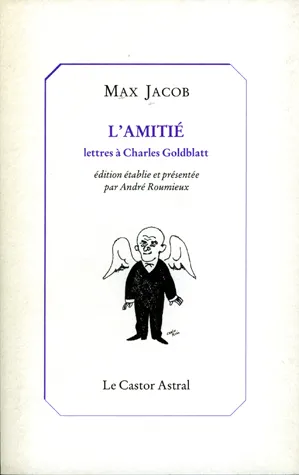
What a weird little book.
One third is one guy talking about his friend, Charles Goldblatt (actor and poet), and the friendship he had with Max Jacob (poet and artist). The second third is some letters Jacob sent to Goldblatt (mostly support and advice for Goldblatt's poetry and declarations of friendship).
Love me like I love you, that is, very much.
The latter part is a rather sad necrology: press articles telling the death of Jacob in a French camp, waiting for a train to Germany.
If you see Louis Salou, tell him it's bad not to write to me. You know I love you. Please believe it even more.
It's just friends missing friends, and sharing the memory of them. Jacob looked like a great friend. He had left the world (another hermit) for a mystical brand of Christianism (no surprise there for a surrealist/symbolist poet), and lived for 20 years next to an abbey where he officiated (wearing a yellow star during the last years).
My compliments to your wife and my heart to you.
He was still in contact with the Parisian literary/artistic circles, mostly through letters. Very modest, he encouraged a lot of young poets with esoteric advice.
Your fault, my dear Charles, is a lack of depth. Cocteau used to say that Apollinaire had a fat drop of glory at the end of his quill. Do you understand?... How does one get depth? you ask me (...). One has to think of his poem, stanza or verse for a long time. You have to "bear" it a long time before writing it. And, to avoid a pregnancy with contrary effects (meaning too much individual snail and obscurity), pick strong and flashy words, which make for strong images. This way, you'll get depth and strength. You often have to call on your guts, your good sense, the [kitchen]stove - it gives depth. You have to understand yourself well, even in the mystery, the great mystery. Even in inspiration, it requires survival.
Friendship heartbreak might be the worst.