The Consul decapitated a dusty coquelicot poppy growing by the side of the gutter with his stick.
One of Under the Volcano's smaller sentences, but isn't it perfectly-formed? The parade of plosives in the violent first half, petering out into plainness. At the other end of the spectrum is the head-spinning whirlpool of a sentence that opens Chapter 3, diverting the reader's attention, like the Consul's, from the world of objects to the eddying, allusive world of appearances. The writing is sometimes obscure because obscurity is its objective, the obscure, secretive self-deception of the alcoholic. But these misapprehensions, constructed of the endless, sometimes paranoid (but often not) recombination of a few simple motifs and symbols, add up to a reality more cogent, on its own terms, than the outside world, with its imminent apocalypse (see the last words of the antepenultimate sentence of the book). Can you blame the Consul for escaping to a mezcal Disneyland?
More reviews
The symbols, as I say, aren't hard to fathom. Take gardens — the Consul's (literally undermined) garden, run to riot in the absence of Yvonne, an "indescribable confusion of briars from which the Consul averted his eyes...", complete with snakes literal and metaphorical. The little municipal garden next door whose admonitory sign the Consul ironically miscontrues. Yvonne's cowboy riding style which is "not as in gardens". The stone-faced "Chief of Gardens" who decides the Consul's fate at the Farolito. Or take the Farolito itself — "the lighthouse that invites the storm, and lights it!" — an emblem of salvation but also of isolation and the risk of foundering. Images of horses abound, like the "uncontrolled" horse with its blotto rider seen by Laruelle in Chapter 1, various equine descriptions of nature ("dark swift horses surging up the sky", "white horses westward marked where the real sea began"), Geoff's description of himself as "still strong as a horse", and of course (a horse, of course) the fateful, 7-branded horse encountered four times by different characters. We aren't told its colour, but white would make sense.
My point is the prose might be difficult (though I think it just takes getting used to) but the symbols and the ideas are not. This is a book about perdition vs. redemption, agency vs. fatalism, and booze. These themes snake in and out of each other, chase each other's tails. The Consul has abandoned himself to fate (absolutamente necesario), his hands beyond his control whether shaking for lack of a drink or reaching ineluctably for the next one (just like Orlac the pianist's hands in the film, grafted onto his arms by Peter Lorre's mad scientist and inclined to enact the murderous urges of their original owner). Hugh wants to shape his fate but is increasingly doubtful of his ability to do so (the preoccupying battle of the Ebro and his non-participation). He fears, suspects, that his brother is right when he spits, in their final rupture at the Salon Ofélia, "freedom—of course there is nothing of the sort, really". And yet Geoffrey is deluded, too, delusively insisting on his freedom to decline the next drink. Even the environment equivocates — at one point, while a steady breeze obtains in one direction, "the leeward side" of the house "swayed imperceptibly, as to another control..."
The novel's polyphony and use of intrusive text — snatches of overheard conversations, radio, print ads, the tourist brochures with which the Consul wipes his ass —makes it realistic and borracho at the same time. Many of its detractors complain about its use of stream of consciousness, but there's very little real SoC as one finds in Ulysses or The Waves. The dominant discourse is free, indirect, and really not difficult to follow. To take an example at random: "The Consul sat perfectly still staring at the floor while the enormity of the insult passed into his soul. As if, as if, as if, he were not sober now!" I mean, Austen writes that way and no one complains that she's hard to understand! There are very few unusual words (nutant, tabid, thalavethiparothiam — handy additions to anyone's vocab, I'm sure you'll agree) and several funny scenes, like the Consul's drunken conversation with his white-bread American neighbour, (not de) Quincey, or when, Withnailesque, he takes a swig of bay rum:
Before Hugh could stop him the Consul took a large drink. "Not bad. Not at all bad," he added triumphantly, smacking his lips. "If slightly underproof... [...] Wait a minute, I’m going to be—"
I laughed, too, at Hugh's ditty on silly prairie place names ("take me back to dear old Horsefly/ Aneroid or Gravelburg") and Dr. Vigil's endearing, Learlike "Guanajuato is sited in a beautiful circus of steepy hills". But it's Lowry's long, lyrical passages that I like best, e.g. Yvonne's imagining of their future shack in idyllic Dollarton:
And at half-tide they would look down from their pier and see, in the shallow lucid water, turquoise and vermilion and purple starfish, and small brown velvet crabs sidling among barnacled stones brocaded like heart-shaped pincushions.
It's a satisfyingly constructed book, too, although that first, posthumous, scene-setting episode with Laruelle and Vigil still sits awkwardly in the purported 12-hour, 12-chapter schema. The scene where Hugh shaves the DT-stricken Consul, right at the center of the book ("Hugh shaved adroitly along the edge of his brother’s beard, past the jugular vein and the carotid artery") feels pivotal, the closest the two of them (really the author at two periods of his life) come to each other in their peregrinations, fraught with tenderness and the lethal potential of the blade. And no book captures the varieties of bibulous experience so well. The thrilling joy of it ("the Consul felt the fire of the tequila run down his spine like lightning striking a tree which thereupon, miraculously, blossoms"), the befuddledness of it, the dissolution of surfaces, the soul-trampling crapulous times. If ever a novel exemplified the "affluence of incohol", this is it:
...not even the gates of heaven, opening wide to receive me, could fill me with such celestial complicated and hopeless joy as the iron screen that rolls up with a crash, as the unpadlocked jalousies which admit those whose souls tremble with the drinks they carry unsteadily to their lips. All mystery, all hope, all disappointment, yes, all disaster, is here, beyond those swinging doors.
Dolente... dolore...
The first time I read Under the Volcano I knew I loved it, but not exactly why. The second time, 10+ years ago, the book's baroque weft of symbols started to come into focus, and I knew why I loved it, but also how little I understood. And with this third reading, I felt at home in its dense jungle of language and signs, although still quite far from grasping every interconnection. It's something of a cliché that "great books teach you how to read them", although true of most of my favourites. But UtV (or any other book) isn't good because it's hard — its quality and its difficulty both arise from its density, from the intensity of experience, inner and outer, that's packed into its pages. Here's to the next read — y tiempo para disfrutarlo.
I have this book (the teal cover with the stylized skull on it) and never found the time to read it. Your review pushed it closer to the top of queue, thanks!
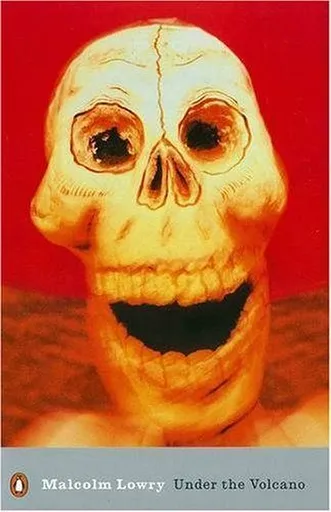



I have this book (the teal cover with the stylized skull on it) and never found the time to read it. Your review pushed it closer to the top of queue, thanks!
Glad to hear it! Plan to read it multiple times!