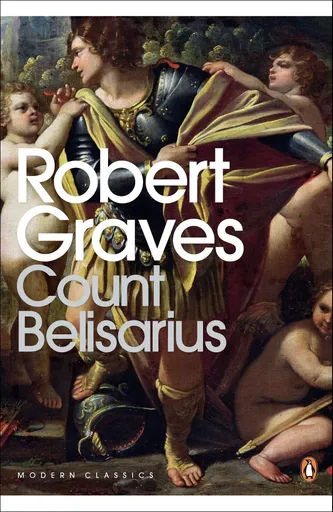
Set in the Eastern Roman Empire in the 500s under the rule of Justinian, Graves’ novel details the exploits and reconquests done by the General Belisarius against Sasanian Persia, Vandalic Africa, and Gothic Italy, all while having to navigate the political intrigues of the Byzantine Court. Belisarius’ military record is illustrious, but he is pitted in the middle of multiple opposing forces, and Justinian’s ingratitude, and ultimate hostility lead to his downfall. I think the novel’s opposing forces could be categorized in a Nietzschean manner: with the orderly Apollonian forces clashing with the chaotic Dionysian, leading to tragedy. Graves has a similar rubric that’s perhaps not exactly equivalent, but similar enough.
More reviews
Graves’ later work The White Goddess, argues that poetry can be divided in two aspects: the Apollonian and that of the White Goddess. In his opening to that book, he leads with a panegyric poem to this White Goddess:
“All saints revile her, and all sober men
Ruled by the God Apollo’s golden mean-”
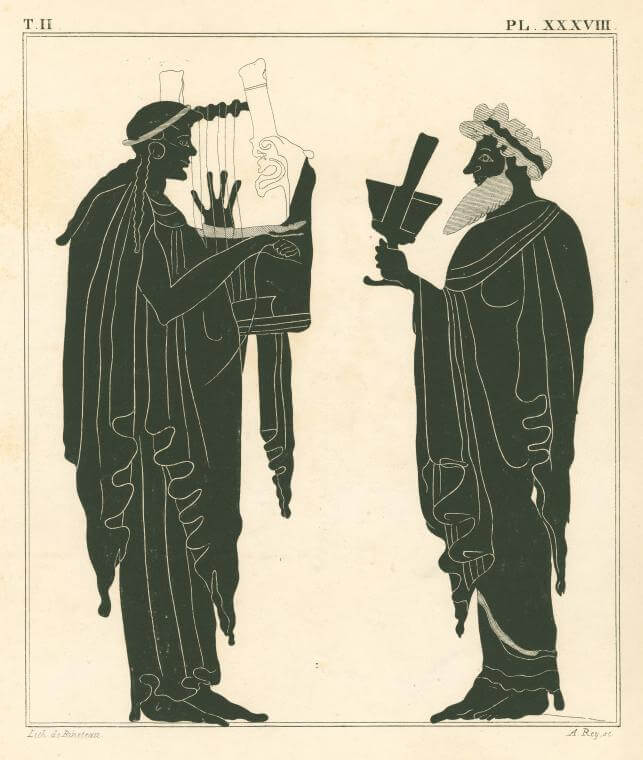
On three points this aesthetic force of the white Goddess is opposed by something. Christianity, sobriety, and moderation, with the latter being specifically tied to Apollo. Their opposites, paganism, drunkeness, and excess are Dionysian characteristics. I only skimmed The White Goddess, and Graves is more than willing to make his argument completely on vibes, citing nothing other than his own poetic sensibility, so he'll have to put up with me playing fast and loose with his ideas in turn. In essence, it is a rejection of ordered Apollonian poetry, in favor of the more ecstatic muse poetry under the dominion of the White Goddess, which is essentially just a feminized Dionysian force. Well, for Graves it’s probably the reverse: the Dionysian is a masculinized or neutered White Goddess, but for our purposes I think we can say they’re roughly equivalent.
Nietzsche saw the Apollonian and Dionysian as necessary opposing forces that compliment one another, with the Apollonian providing a necessary structure to the chaotic, formless Dionysian, a strained mutualism that found its perfect structure in Greek tragedy. Graves, while placing more value on rejecting the Apollonian in favor of the Dionysian, still has this tension result in tragedy for his novel. Graves’ Belisarius throughout the novel is an instrument of the Apollonian. He’s the Christian instrument of a Chrstian emperor, he doesn’t get drunk or allow it in his men, and is an exemplar of the Greek virtue of sophrosune, or moderation. Dionysian forces call out to him to betray these Apollonian characteristics in the novel, and he rejects them. It’s a choice that seals his tragic fate.
The novel’s sources and framing device follow this schema as well. Most of what we know of Belisarius comes from Procopius, who authored the state-sanctioned, lucid History of the Wars and the more rumor laden Secret History. Graves was able to pull from two conflicting sources, one with the rational, Apollonian aspect, and another with the chaotic, irrational, feminine Dionysian/White Goddess aspect. This allowed him to pick and choose points to structure his narrative as “historical” but also allow it to conform to his poetic sensibilities. Even the eunuch narrator, Eugenius is symbolically indicative of this synthesis.
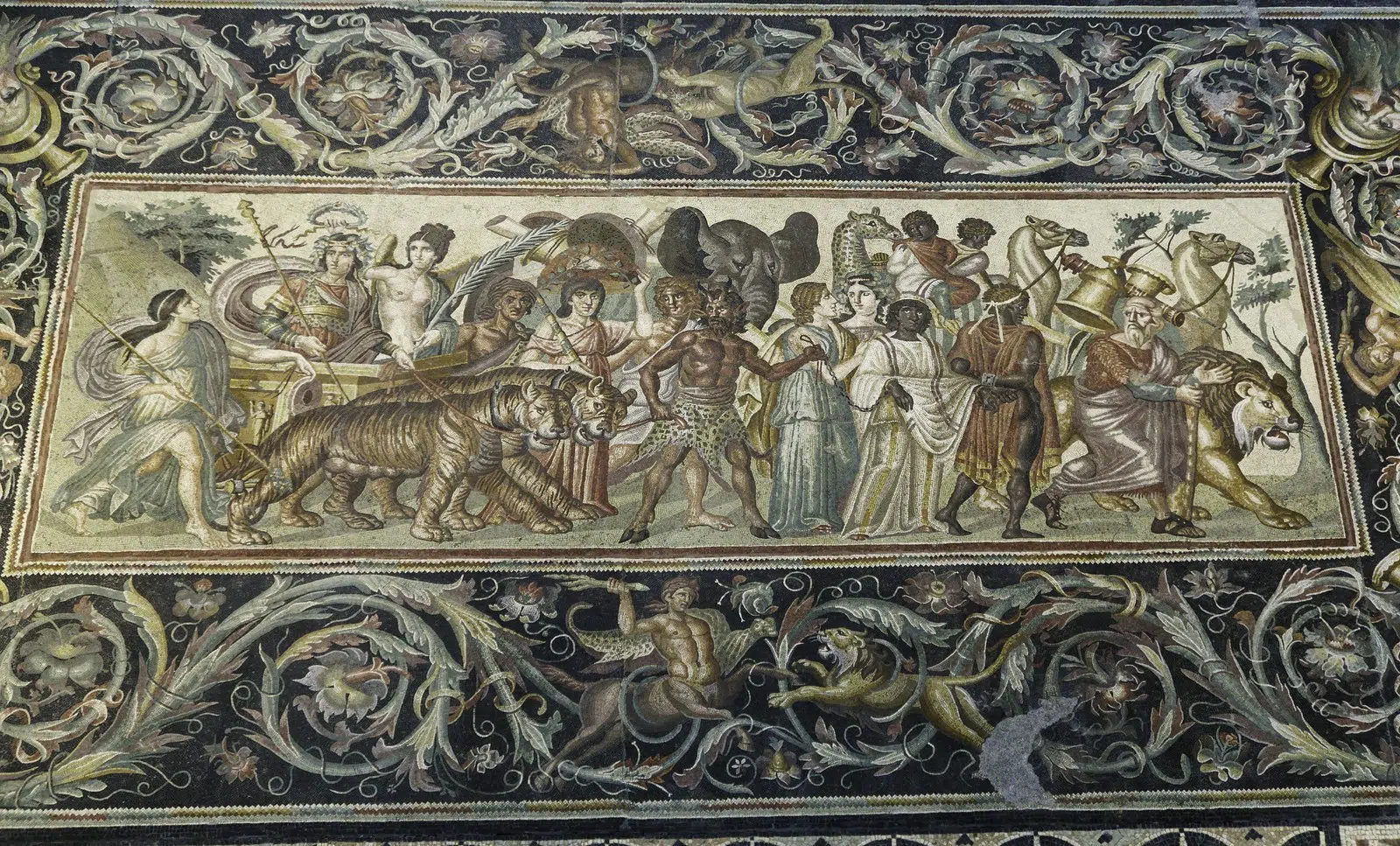
The first two chapters are completely contrived by Graves, and the second chapter is probably my favorite in the novel, and is crucial for its introduction of this Dionysian element. It involves a symposium at Adrianople ranging from topics of paganism, military history, and Christianity. References to Dionysus (by mention of his Roman equivalent, Bacchus) are explicit. The entire symposium takes place under a frieze of Bacchus, drunkenly returning from India.
A character Simeon remarks that
“[t]he half clothed women of the frieze are, in attendance on Bacchus, not proper ornaments for a Christian dining room. Looking up at them, one might imagine oneself inside a brothel at Tyre or Sidon.”
It’s a comment that seems irrelevant, but makes a symbolic connection to the future empress Theodora and the future wife of Belisarius Antonia. Both were initially actress-prostitutes. Antonina is even present at this symposium as a sort of hetaera. Belisarius’ uncle Modestus responds,
“Those naked women, Simeon, are your own ancestresses, the Thracian women who piously tore King Pentheus in pieces because he spurned the God’s gift of wine”
Later in the chapter it is noted Belisarius and Antonina stay up talking, and Belisarius is the only one at the party not drunk. These comments by Modestus and soberness of Belisarius foreshadow later plot points in the novel. Belisarius throughout the novel, remains lucid, never getting drunk and also requiring this of his troops. Antonina and Theodora, for their part, regularly lapse into paganism throughout the novel. Belisarius will eventually be offered the diadem of the Western Roman empire by a Gothic confederation. Theodora and Antonina push for him to accept, but Belisarius out of loyalty to Justinian refuses. Everything for Belisarius goes downhill after this refusal. He is metaphorically ripped apart like the mythological Pentheus.
Modestus then begins to wax poetic about the old pagan Romans' method of battle.
“They trusted to their own powerful right arms for hurling missiles - sharp javelins - not to the adventitious bowstring; and in these right arms wielded the short, stabbing sword, the weapon of the courageous, civilized man, not the cowardly lance or the hurtling, barbaric, bowstring.”
Belisarius will eventually form a retinue of cavalry, the bucellarii that focus on switching between lance and bow as the situation needed. It’s a choice that eschews everything Modestus lauds here and embraces everything he detests. Symbolically, this orients Belisarius away from these pagan, Dionysian elements and situates him toward the Apollonian.
Perhaps another example of Belisarius’ sophrosune is Graves fictionalization of an encounter between Belisarius and Porphyrios, a whale terrorizing the Sea of Marmara. The narrator mentions that this is the only battle Belisarius did not win. Belisarius attempts to kill the whale, is unsuccessful and gives up his pursuit. Even this serves as a literary foil to the monomaniacal Ahab of Moby Dick. Belisarius is not willing to descend into madness or obsession.
Over the course of the novel, Belisarius thanklessly answers the calls of Justinian to save the empire. Persians are kicked back, Vandals brought to heel, and the beleaguered Goths offer Belisarius the diadem of the western Roman empire, which Belisarius refuses. As Justinian’s indebtedness to Belisarius grows, so does his resentment towards him. Justinian repeatedly strips and restores Belisarius’ titles until the very end where Belisarius is left blind and destitute.
The novel is often understood as Graves attempting to vindicate Belisarius against the slanders made by Procopius. Thematically, however, Belisarius' character is opposed to the poetic and aesthetic values that Graves prizes. I’m tempted even to draw parallels between the four main characters of Justinian, Belisarius, Theodora and Antonina to that of Graves’ own 1930s polycule that included him, another man and two women.
There’s also a rich theme of contrasts between the various sects of Christianity in the novel, particularly over the doctrines and disputes over Christ’s divine and human natures. Monophysites, Arianists, Dyophysites, and even Manichaeists are all represented in the novel and manifested in different characters, but I’m not quite sure how they play into the above rubric.
I enjoyed Count Belisarius a lot but not as much as the Claudius books. I thought Graves was better at being dispassionate on the central struggle there (between republicanism and monarchy) whereas in CB he intervenes pretty clearly at points to give his own opinions, especially on Christianity. The way he uses 'monkish' has left it with permanent negative connotations in my mind.
I actually wish Graves intervened with his opinions more. Most of the historical parts of the novel felt dry to me, and my favorite part was completely made up by him. I read somewhere that this novel was hastily written to pay off a debt. This was my first novel by Graves so, I don’t know if and how that impacted the quality, but I definitely want to give some of his other work a shot.
I do remember “monkish” being bandied about a few times, lol.
I, Claudius was definitely knocked out quickly to pay off a debt. Don't know if it's true of CB but could well be. I'd enjoy reading your take on IC. Wife To Mr Milton is my other favourite of his historical novels.
Sounds like a lovely book. I'm about two-thirds through Graves' translation of Suetonius, and it's a very pleasant and relaxing read. The entire period from the sack of Rome to the fall of Constantinople is historical terra incognita for me. My unabridged Gibbon stares threateningly at me from my shelf, as I'm too stubborn to go for less, but I'm only on the third chapter. Maybe (probably not) this review will spur me to crack it open again...
I’ve read the whole damn thing twice, some of it three times. Just can’t get enough of Gibbon’s epic style. Although the lengthy disquisitions on ecclesiastical schisms are admittedly a bit of a slog.
But yeah Gibbo had a major crush on Belisarius, second in intensity only to his infatuation with Robert Guiscard.




I enjoyed Count Belisarius a lot but not as much as the Claudius books. I thought Graves was better at being dispassionate on the central struggle there (between republicanism and monarchy) whereas in CB he intervenes pretty clearly at points to give his own opinions, especially on Christianity. The way he uses 'monkish' has left it with permanent negative connotations in my mind.
I actually wish Graves intervened with his opinions more. Most of the historical parts of the novel felt dry to me, and my favorite part was completely made up by him. I read somewhere that this novel was hastily written to pay off a debt. This was my first novel by Graves so, I don’t know if and how that impacted the quality, but I definitely want to give some of his other work a shot. I do remember “monkish” being bandied about a few times, lol.
I, Claudius was definitely knocked out quickly to pay off a debt. Don't know if it's true of CB but could well be. I'd enjoy reading your take on IC. Wife To Mr Milton is my other favourite of his historical novels.
I must have mixed the rumors about the two books up. I’ll make IC the next one I read by him.