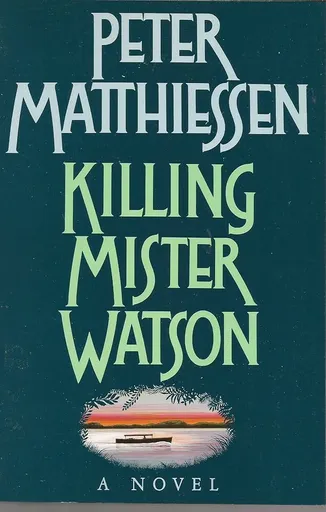
Peter Matthiessen was an interesting dude. I won’t go into his background here — you can read his wikipedia page for that. Suffice to say, he was pretty familiar with man’s natural inclination towards destruction, pillage, and power. Killing Mister Watson must have been fertile ground for him to plant his literary seed in, or something like that.
More reviews
Edgar Watson was an interesting dude, too, a Confederate son turned outlaw drifter turned semi-respectable businessman, beloved by his neighbors. Or he would have been beloved by his neighbors if he’d been able to stop himself from killing people who inconvenienced him. He doted on his family, and was by all accounts rather generous towards his friends. But, as we learn in the opening pages of this novel, his friends eventually ganged up and shot him down. If Killing Mister Watson is a mystery, it’s less about the “who,” which we know from the start, and more about the “why.”
I should mention also that this trilogy of novels has an interesting history of its own. Written by Matthiessen as a 1,300-page manuscript, his publishers released it as three separate books - the Watson Trilogy, which begins with this novel. Matthiessen later whittled those 1,300 pages down to 900 and released it as a single novel called Shadow Country, which was widely lauded.
For my part, I loved Shadow Country. In some quarters, however, critics thought that too much was cut from that release. That piqued my curiosity, and I decided to read the trilogy in full.
I’m one book in, and already I feel that my decision was worthwhile. While I greatly enjoy Shadow Country, I’ve always felt that something was missing, though I couldn’t put my finger on what. Here, I found the shades and contrasts that Matthiessen had to forsake in cutting down Shadow Country. If that novel distills the plot of the trilogy to a singular essence, to a neat throughline, Killing Mister Watson revels in the many stray threads, inconsistencies, and tangents that the sprawling narrative brings forth.
In fact, they may be this novel’s raison d’etre. I’ve never much ascribed to the notion that form is, in itself, function, but there’s a good argument for it here. Unlike the other installments of this trilogy, Killing Mister Watson is composed of shifting perspectives - of Watson’s friends, enemies, neighbors, and family offering their recollections, as if they were being interviewed years after the fact. In capturing these memories, Matthiessen’s mastery of voice and perspective is nothing short of magnificent, replicating the speech of poor southerners, their light hearts, their heavy souls, and their sense of humor better than most other authors I’ve read.
And, yes, he gets the bad parts too. He understands their complexity. As an example of this mastery of perspective, I present to you a case, later in the novel, where a character thinks she’s caught a black man in a lie. We know from her own recollections, and those of others, that she is tough, honest, perceptive, kind - and a racist. Did she really catch this man out? Or did she see something that confirmed her own beliefs?
There are no answers, and I think that’s part of the point. Shadow Country’s singular throughline belied its attempts at ambiguity; here, the ambiguity is the throughline itself. Discerning the truth - about a man, about a crime, about a nation - is almost impossible. We lie to others, and to ourselves. Such is the corruption rendered on these pages.
Matthiessen’s environmentalist tendencies are present, though not as much as in the rest of the trilogy. The destruction of nature is found in background detail - in the wholesale massacre of birds for their feathers, of gators for their hides, the dredging of rivers, the destruction of wilderness for nothing more than the vanity of man. For that matter, man gets a rather unkind review here, in his murderous, prejudiced, ornery ways. At a certain point in my read-through, I thought to myself that the world could end tomorrow and I wouldn’t give a shit.
Yet there is dignity. There is struggle, and hope. Watson himself is probably the best example of Matthiessen’s talent in rendering man’s complexity. He is the black hole and shining star at the center of this trilogy, and one of my favorite characters in fiction. He is loving, he is caring, he is troubled, he is unfair, he is murderous. Other characters try to distill him to a single vision, but he eludes them, vibrating beyond the boundaries they would trace to contain him.
So too does the world evade our grasp, in this life, moving through our hands like wisps of vapor. It is rare to find a book that evokes that feeling so well.