
Sebald is a silkworm inching his way along a mulberry leaf, drinking in every detail no matter how banal, so that he might transmute the world into a single delicate thread. Out of calamity he gathers all that we’ve put into the world and distills it into a meandering web spun through a foggy, despondent British seaside. A strong silk tendril that yellows in sickness along its length. Nothing escapes his scanning gaze—external, internal, near, far, ancient past, prescient future, real, imaginary. He’s mixed the chromatic average of the history of the Western world and painted a gloomy but transcendent cloudy promenade. If I were Sebald here I might employ James McNeill Whistler’s “Trouville (Grey and Green, The Silver Sea)” for visual effect. But his art isn’t in color. It’s a black-and-white film photograph of something atavistic and unspoken evoked within the human soul in the shape of an old ruinous cottage. His tale trickles out of a crackling phonograph that skips and slowly lilts back and forth over the same passages and audible motifs in a sort of lazy forgetfulness that deeply believes in the connected nature of our reality. He’s captured the beautiful inexpressibility of a solitary walk in the countryside on a dreary day, melancholy and all.
I read someone say that Sebald’s world is one of despondence but never one of cynicism. I like that quite a bit. Cynicism is to project sadness onto the future, to claim to know that nothing good will happen because something good rarely happens. Despondence, on the other hand. is to feel empathy for a world that’s in pain. Sebald here walks through a world where little has gone right, where more often than not things have gone wrong to the point of unspeakable catastrophe. But buried under the catalog of atrocities there is a curiosity to his narrator that feels like the shadow of a deep unbreakable hope. A cynical person looks at the world and says “I know enough, I’ve seen enough to know what else is there.” Sebald has none of that in him. He walks and he burrows and he digs at the roots of great trees and he begs them to give up their knowledge no matter how much they choke and sputter with their beetle-borne afflictions. Though they may die we can still trace out the coincidences that they overlay in the soil. We can be saved by the funny half-divinity of lines of power that draw themselves between chance facts. The netted quincunxes of momentary impossible coincidence that thwart our thoughts of headlong escape out the asylum window.
Leyland Kirby is a fisherman who’s helped snare the world in such a net for me. He creates experimental music under the name The Caretaker. Or he used to. He’s publicly announced that the project is finished and that there will likely be no more music released by The Caretaker. Now the music exists purely in the state of fond nostalgia that Kirby so meticulously tried to capture as The Caretaker. That same nostalgia that Sebald tried to capture in The Rings of Saturn. Kirby’s works all orbited around themes of memory loss: Alzheimer’s Disease and the simulated experience of dementia. An empty bliss beyond this World was a tentative step, the seed of a concept. Everywhere at the End of Time was a magnum opus, six albums in a box set, each representing a stage of memory loss in Alzheimer’s Disease. But then, uncanny, like a ship’s silhouette in the fog, nestled between other experiments in memory loss comes a curious album: Patience (After Sebald). Not an album about forgetting but a soundtrack for a documentary about a man and a book. A book in which a man walks through a recession-hit post-apocalyptic seaside British landscape remembering the entire history of the world. A man who, rather than forgetting, is nothing but memory overlaid onto place. His memory welds inexorably with place. So perhaps that is Sebald’s forgetting—the forgetting of the existence of boundaries. Between identities, between places, between fiction and reality. These lines blur in and out of his narrative, loose and momentary, like ghosts that can muster enough energy to gather out of the ether only for a moment, long enough haunt an old photograph. This world isn’t even delineated enough for individual voice. Dialogue is unquoted, unattributed, whether it’s spoken by King Lear lamenting the death of his daughter or an old fisherman at a bar relating the history of a manor home in a nearby village. Their worlds are one and the same, intertextual to the point of dissociation.
Ultimately that’s the shape of this book. One of pure dissociation at the expense of almost all else. An untethered freedom. This is the appeal of a long walk and the process of writing. They are human processes that go hand in hand. Walking and writing let us come out of ourselves and come to a place of pure observation. Allowing thoughts and images of the world to come in and move through us. Becoming the world’s detached confessor simply in our ability to be a part of it and to experience it. This book is shaped like the human mind, wandering through loosely attached thoughts, sometimes lighting on one that’s a bit too dark for comfort, doomed to return to it because of that darkness not in spite of it. We are sucked in like a swimmer caught in a vortex. Sebald has captured the freedom of a walk and anyone who’s spent any amount of time walking around a dusky city lost in thought can tell you that freedom comes with a price. When the mind wanders for long enough it will find darkness. It’s as if we seek it out. Wherever we walk it is next to a great black ocean.
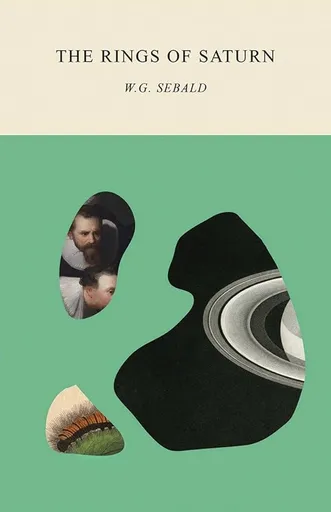
Saturn’s rings were born of catastrophe. Some wayward moon found itself too close to the planet’s far greater mass and ended up annihilated, pulled apart into sharded ice crystals and burst out in a radius around the planet’s equator. Its main distinguishing feature. I think this understanding holds the key to unlocking Sebald’s takeaways from his wandering. Our own history, our own art, is often born out from events that are miniature armageddons for those involved. We come back to them again and again, returned by Time and Memory transfusing into coincidence. We make art not in spite of these catastrophes but because of them. Art is how we overlay meaning onto the senseless. Our efforts are hilarious and doomed, but no less doomed than those of Enlightenment scientific stabs in the dark. One of the little new vertices in my mind’s quincunx pattern is now Rembrandt’s painting, The Anatomy Lesson of Dr. Nicolaes Tulp. One of the essays in the book I read before this one was about the painting and, funny enough, The Rings of Saturn lights on the same painting. the cover of my copy even features the painting (I have the NDP edition with a beautiful cover designed by Peter Mendelsun that features abstract fragments of the anatomy lesson, the rings of Saturn, and what I think is fittingly an Ernst Haeckel painting). Both of these books use the painting to highlight the strange danger an overly examined world. So often our efforts to understand lead to schematization and subsequent catastrophe. But zoomed out far enough there is a persistence to the combustion, a frozen moment of time that captures the moment of annihilation so beautifully that we forget its violent origins. This is the world of W.G. Sebald and it’s the world of Memory.