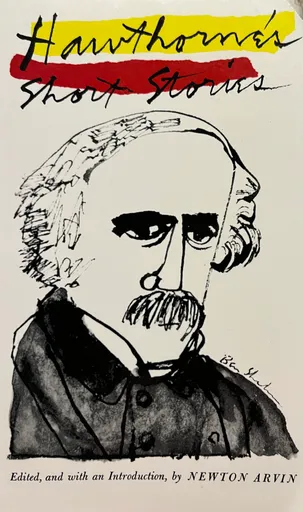

Worth pondering: what interest might Hawthorne have for someone in 2025? I picked this up at a used bookstore because I liked its cover design and the fun, inky portrait of the author by Ben Shahn. But the passage of time and changing literary appetites are absolutely brutal in their reduction of entire periods and genres into a few authors, so only one American name from the first half of the 1800s currently has an active readership around his fiction (rather than poetry) and is cherished and loved by an avid circle of Dick-heads and sub-subs, including myself; and that name is not Hawthorne but MELVILLE.
Melville has a lot of stuff we love nowadays. Moby-Dick sprawls, divigates, switches among narrative modes, instead of keeping the story slim and tidy. The language is full of free-roaming ratiocination and lavish, propulsive description. Characters and sideplots bustle about and strike fun poses. All these have resemblances to the types of fiction people like today: go ahead and replace Moby-Dick with "Thomas Pynchon's books" in my description and see if it still holds up.
It's different with Hawthorne. Even contemporaries who loved his writing knew it. So Melville will talk in a letter about how there's "something lacking" in Hawthorne, who "needs roast-beef, done rare." Meaning, I guess, that his writing is anemic and over-spiritualized. And Longfellow on The Marble Faun mentions "the old, dull pain in it that runs through all of Hawthorne's writings." If you've read The Scarlet Letter, you know what they mean, and some other offputting characteristics: the stiff allegories, the compulsive gloominess, the thin depiction of social life, the double-underlined religious moralism, the old-style voice of some (though not all) of his stories.
So is Hawthorne of non-academic interest? I, at least, found a way into these stories by thinking of them as nervous, sometimes spastic responses to the anxieties of American life in Hawthorne's time and, in some ways, those of our time too. This volume's excellent introduction by Edward Arvin is helpful, noting how Hawthorne's solitude also gives his work an astonishing interior intensity, and that images of sociality are conversely the furtive expression of happiness and contentment: “The simplest and truest thing to say of Hawthorne’s human vision is that for him the essence of wrong is aloneness; you begin and you end with that.” And if you think of that in light of the U.S.A.'s status as a self-consciously "clean slate" unburdened by history and the alienated, unrooted character of life in what was then the cutting edge of capitalism—then Hawthorne seems very contemporary as a portraitist of anomie not far from, say, Carver.
Unlike Carver, Hawthorne doesn't have the apparatus of realism, and instead his writing expresses these anxieties in an older, melodramatic, religious vocabulary. What makes his depiction of "evil" piquant is its often contentless or causeless character; you don't learn (or have to learn) what the Unpardonable Sin is in "Ethan Brandt," just as the black veil in "The Minister's Black Veil" represents all sins, not any specific sin. What matters is that sin is so imminent, it's right there, nobody will stop you; this is America, sin or don't, nobody cares what you do.
This dilemma is nicely dramatized in "Wakefield," one of my favourite stories, where a man leaves home and decides, on a whim, not to return that night; then makes the same decision, day after day, for decades; and then, just as contingently, steps back into his house and takes his life back up with his "widowed" wife.
These stories try out any number of resolutions to the anxiety of freedom. In many, a generic religious perspective prevails: the wicked are punished for straying. You get this in "Rappaccini's Daughter" or "Lady Eleanore's Mantle," and I didn't respond very much to these, though maybe other readers would. In others, the saving grace is a beautiful, heavenly woman, and marital contentment, as in "The Great Carbuncle" or "The May-Pole of Marymount." Marriage here is a tiny Utopia: an escape from terrible solitude that doesn't need to be stained by the shabby compromises of commercial society. (Worth recalling that if Hawthorne isn't an individualist—one story takes aim at "Egotism" as the ultimate consequence of sin—he's no collectivist either).
And then there's a third resolution: unselfconsciousness, the person who's a saint because he doesn't know he's a saint. This is given a try-out in at least two stories, one of which is the excellent "Feathertop." This story's comic tone is very rare in Hawthorne, but it has surprising results: the moral ironies are sharper and more savage than ever, but the leaden atmosphere is replaced by a bouncy, satirical one. Hawthorne even makes fun of himself a bit, likening his scarecrow protagonist to "some of the lukewarm and abortive characters, composed of heterogeneous materials, used for the thousandth time, and never worth using, with which romance writers (and myself, no doubt, among the rest) have so over-peopled the world of fiction." A very vital strain of American fiction does seem to flow through this comedic conceit of the optimistic hayseed with unerring moral instincts travelling through a society of hypocrites: wait a generation, and Feathertop becomes Huck Finn.