
(Sure they might, but political bait seems to get clicks on this site.)
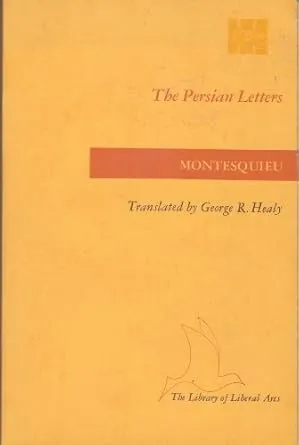
Before Montesquieu wrote the Spirit of Laws in 1748, he wrote this epistolary novel (anonymously) in 1721, a supposed collection of letters from and to a duo of Persian visitors to Paris, which satirized the extravagant aspects of society through comments from the visitors, who could look upon France with fresh eyes, and innocently question its institutions.
It's very witty, in the general Enlightenment style.
Letter LXXV; Usbek to Rhedi, at Venice
I must admit that I have not noticed among the Christians that lively faith in their religion which one finds in the Mussulmans... Moreover, they are no more firm in their incredulity than in their faith; they live in an ebb and flow which carries them constantly between belief and disbelief. One of them once told me: "I believe in the immortality of the soul in periods of six months. My opinions depend entirely upon my body's constitution. According to the level of my animal spirits, the adequacy of my digestion, the rarity or heaviness of the air I breathe, or the solidity of the food I eat, I am alternately a Spinozist, a Socinian, a Catholic, an unbeliever, or a zealot. When the physician is close to my bed, the confessor has an advantage on me. I easily prevent religion from affecting me when I am well, but I permit it to console me when I am ill. When I possess nothing more of earthly hope, religion comes and seizes me with its promises; I am pleased to surrender to it and die on the side of hope."
Letter XCIX; Rica to Rhedi, at Venice
I find the caprices of fashion among the French astonishing... What would be the use of my describing to you their dress and ornaments? A new fashion would come along and destroy all my work and that of their workmen; before you received my letter, everything would be changed. A woman leaving Paris for six months in the country returns as old-fashioned as if she had disappeared for thirty years. The son does not recognize the portrait of his mother, so alien to him are the clothes in which she is painted; he supposes the picture is of some American, or that the painter has indulged one of his fantasies. Sometimes coiffures go up gradually, to be lowered all at once by a style revolution. At one time their immense height put the women's face in her middle. At another, her feet are there, with her pedestal heels holding them high in the air. Who would believe it? Architects have often been obliged to raise, lower, and enlarge their doors according the the exigencies of dress style, which the rules of their art must be bent to serve.
It's not only a satire; Candide falls into this, and it makes it less interesting than the Persian Letters. It has many moments of sage cultural reflection and comparison. It doesn't take a side on either France or Persia, or deprecate either categorically. (It also brings in, through anecdotes, reports, legends etc., information about other cultures besides the two.) The desire from Montesquieu is always to present it as it is and let the judgment present itself separately to the reader. We sometimes agree with Usbek and Rica, the two sojourners, but sometimes we disagree. Many times it is not even clear where they, or Montesquieu, stand at all.
The introduction mentions that you can view Montesquieu as a proto-utilitarian; I came to agree with this. He takes the view that cultural standards, while always corresponding to basic social laws, are healthy for the society in which they develop, but become destructive when intended to usurp those of other societies. This was becoming recognized for specifically religious standards during this period, but it gets its more general cultural formulation in here and in the Spirit of Laws. Montesquieu was ahead of his time on this.
The letters also tell a story between Usbek, who from potential intrigues against him has left the Persian court to conduct his (royally approved) study of Western science, and the wives and eunuchs in his seraglio. This part of the novel was interesting but confused me as to its meaning. I did think there was some point to draw from it, since the novel ends with the death of the chief eunuch and the seraglio in rebellion from the conspiring of one of the wives. About as far as I've theorized is that abandoning your country for the span of ten years (1711-1720) leading to disruption is a moral lesson on something. If anyone ever happens to read this, I would be interested to see what you think of it. I saw it in a used bookstore for $1 and grabbed it without knowing anything beyond it being an early Montesquieu writing, but I haven't seen a copy before so I don't think it's a popular or well-known work nowadays.
As well, Usbek and Rica both address a significant number of letters to an unnamed recipient. Who this is might be able to be figured out, but at the moment I don't know the purpose of it.
Letter CVIII, Usbek to -----
The greatest mistake the journalists make is to speak only of new books, as if truth were forever new. It seems to me that until a man has read all the old books, he has no reason to prefer the new.