
Jan 08, 2026
The fundamental sickness at the heart of true crime as a mass media institution is the endless, fruitless attempts to pathologise the void. Not every awful act begets a complex inner. Erin Patterson's triple-homicide via death-cap-mushroom-infused-beef-wellington is perhaps the most publicised criminal case of my adult life, unquestionably so from the vantage point of local Oz media, and yet not once, not in the TV news spots, the splashy front-page grabs, the courtroom livetweet threads, nor in any of the cash-in 'what really happened???' books that were rushed to shelves, and that I've idly thumbed through in the off hours at work, has anyone managed to explain what about this trial has captured the minds of a nation. I'm not sure anyone has successfully convinced me that it even has. Is this crime compelling, or novel, or does it just have the appearance of novelty? Did the media cycle spin so fast that the coverage became the story? Are we reacting to a modern myth, or are we projecting heightened philosophies onto a story that only seems to hold the shape of one? Is there actually anything to glean from this trial past the simple evil of the act that spurred it?
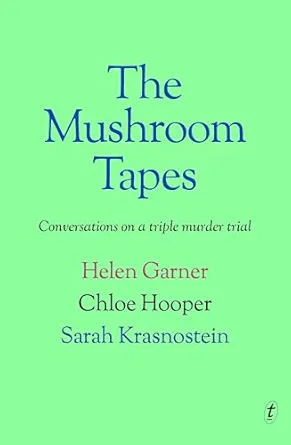
I am pleased to discover that this book, The Mushroom Tapes, is also asking these questions. Now, calling it a book at all is a little generous: its advertised subtitle (conversations on...) is far more accurate, and the words that make it up could have just as easily taken the shape of something less formally constructed. The p-word (podcast) is mentioned as the original plan for the recordings that were eventually transcribed into this book, which makes a lot of sense given how loose the material is. The end product isn't so different from listening in on a discussion anyway: audiobook listeners will, I imagine, detect no difference at all. There's a nice balance in perspectives between Garner's lyrical witticisms and very literary perception of the trial, and Krasnostein's more straightforwardly anatomical legal expertise, coming with a pronounced cynical bite towards the courtroom politique. Even Hooper, of whom I'm the least familiar, and who unquestionably contributes the least attempts at insight throughout the book, impressed me greatly by cottoning on the quickest to the truth that this collaboration eventually finds, which is that Erin Patterson is worth no insight.
They try so many angles throughout their conversations. They talk of her mother, of her two-plus-faced presentation of herself, of her isolation, of her desire to belong, of a jealousy of the love those around her held for those other than her; they brainstorm who the act is to spite, 'why did she follow through when her husband elected not to come?' they wonder. They hash out take after take, and yet none stick. Early on in the book, they hope to find in Erin a Medea figure, but, when she finally takes the stand, she is straightforwardly fraudulent, blandly committed to obvious lies. Garner talks about the invisible membrane that must be pierced for a person to commit a heinous act such as this, the straw that is one too many, and the entire project of analysing Erin Patterson rests on this idea, that she was an everyperson who was pushed over the edge by something, but that's inherently false when talking about something deliberately executed and premeditated. The invisible membrane that separates you or me from elaborately staging an intricate dinner murder is base human empathy, and the simple, boring answer to the entire enterprise of these murders is that Erin Patterson is a simple, boring psychopath who cooked up enough true crime brainworms to think that she could get away with murdering the members of her extended family who annoyed her if she did it weirdly enough, and she was wrong, mostly because she did it so incompetently. That's it. It is decidedly not lucrative that the answer to the question 'how did she think she was going to get away with this' is that she's self-confident and not nearly as intelligent as she believed, but that is the truth. She really just thought she would get away with it. How disappointing.
And where does that leave this book, this nascent piece of true crime content? The authors are aware that this project is empty, that they've reached no exciting conclusions, that the story is not finding itself in the shape of any of the disparate mediums they've considered slotting it into, that they're only contributing to the endless cycle of chewing and spitting that happens with every relished chance to splatter the guts of a stranger publicly, one whom they can only hope to mythologise via their work, and one whom, as Garner herself says, is not even that interesting. They know they have nothing, worse, even, they know that their nothing is one of thousands of identical pollutants that will continue to self-perpetuate the pointless story of this pointless murder, and they get as close to admitting that as their publishers will allow them to. The fact that this is what was released, that these three literary journalists combined couldn't put a single coherent study forward, speaks volumes. And so it is the definitive word on the Patterson phenomenon, for the simple fact that it argues that it ought not to exist at all.
2 Comments
1 day ago
i'm not a true crime guy, but even i understand why certain cases capture the public imagination. this one always leaves me wondering why the media was so obsessed with it it seems like our cultures (globalized individualized neoliberal capitalist etc.) do not equip people with the capacity for accepting that some people are boring psychopaths. idk lol
2 days ago
I just read In Cold Blood, which ruled. Capote would be spinning in his grave if he knew the schlock it spawned.