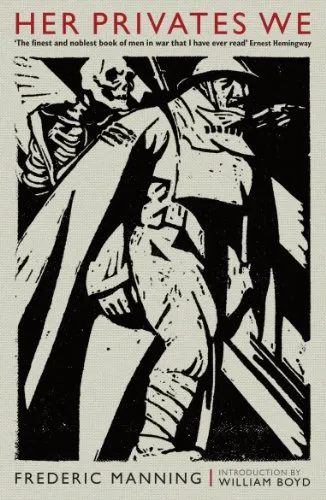


The First World War seems to have been too beastly for literature, or perhaps simply too efficient at killing the people who might have written novels about it. Other than the Poets (or to quote Blackadder, the "endless, bloody, poetry") and All Quiet on the Western Front which my not having read is rapidly becoming a mortal embarrassment, this seems to be the only significant work of literature produced by a combatant about the front line. Frederic Manning certainly wasn't your common-or-garden Tommy — he was a litterateur, an Australian, probably gay, and in his late thirties when he enlisted — but Her Privates We is a monument to the men who found themselves, through no fault of their own, entrenched in the Somme. What makes it live and breathe is the ventriloquism — the brilliantly rendered voices of a Britain where regional accents and vocab were yet unmuddied by mass media. I learnt fanti for "crazy", and snobs for a cobbler, and I was glad to see that "cunt-struck" has over a century of pedigree. The swearing is as fluent as can be. Very few writers can render accents convincingly in prose, and Manning is one of them. He was with the Shropshires (or "Westshires" in the novel), where I'm from, and some of the voices here reminded me of the codgers they brought into my primary school in the 80's to tell us first-hand what a terrific disaster the whole thing was for everyone involved.
Most of the story takes place behind — or between — the lines, as the Westshires are shunted from one desolated mining town to another, waiting to be shoved back into the meat-grinder. It's endless marching punctuated by pointless (and sometimes deadly) parading, office politics, raiding of estaminets, and attempts, successful or not, to have a "bon time" on smuggled whisky and vinegarish wine. The POV character, Bourne — a rough analogue of Manning — hangs around with a nondescript soldier called Shem and the 16 year-old Martlow, who's emblematic of Owen's "Doomed Youth", and whom I thought maybe Bourne/Manning was quietly in love with. But it's equally likely that that's the interpretation of a reader who's never been in a remotely similar situation, and for whom sentences like this will never be fully comprehensible:
They laid themselves down, as they were to get a few hours' sleep; and Bourne, dropping off between the two of them, wondered what was the spiritual thing in them which lived and seemed to grow even stronger, in the midst of beastliness.



Good review but I have to chafe at the statement All Quiet at the Western Front is the only significant WW1 novel by a first hand witness. Off the top of my head I can think of In Parenthesis by David Jones, Fear by Gabriel Chevalier, and Goodbye to All That by Robert Graves as all fairly major literary works by front line veterans. I think a big issue is a lot of WW1 literature is overshadowed by the constant demand for WW2 stuff. I will however keep an eye out for this, it sounds very interesting.
Ha! I’ve actually read the first two you mention and they’re both excellent! I want reread In Parenthesis at some point. Yeah I didn’t think for very long when I wrote that. I still think there’s a notable scarcity of WWI novels though.
On a pure numbers basis its plausible, but I do think a part of the issue is availability and popularity (for instance, I can't think of any Italian or Russian WW1 novels outside of a short story by Teffi, but surely they must exist somewhere).