Oct 5, 2025 6:46 AM
The party had been advertised as “Most popular! Limited to people in their thirties, standard marriage party ☆” with the following conditions: “Must be thirty-something, want a child, and want both partners to work. Must agree to equal share of housework and household budget, be willing to purchase an apartment in Tokyo, and have a minimum annual income of four million yen. Lovers and sex in the home STRICTLY FORBIDDEN.”
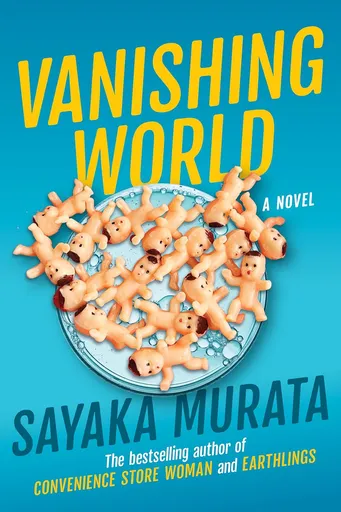
No more sexuality in the family. Husband and wife have chaste and fraternal relationships. Love is outside, often theoretical, mainly involving an Idol or a waifu, sometimes a human.
The MC, as usual, lives on the fringe of normal behavior: she was conceived the old-fashioned way by two people who loved each other. This villain origin story looms over her and her relationships with her husband, husbandos, lovers, friends, etc.
I sometimes wondered whether the red house I grew up in had put a curse on me to always fall in love so deeply.
I squeezed Krom, trying to calm myself down.
I had on occasion walked hand in hand along this path with the four real-life lovers I’d had since getting married. There was a certain charm about a flesh-and-blood hand, but there was also a unique euphoria in holding hands like this with nonreal people.
Romantic love with real people would quickly slip into a feeling of following a manual if you weren’t careful: it’d soon be time to start holding hands, and once you’ve kissed, then this is the next step, et cetera. I knew these things should be decided by both our bodies, but I still couldn’t help following the manual seared into my mind.
Love with nonreal people always started with figuring something out: how to start holding hands, how to kiss. I had to work out how to use my own body to access the object of my love. My nails and hair and earlobes—everything was a means to feel my lover on my flesh.
Murata goes on with her exploration of celness and pushes it further than in her previous books thanks to the sci-fi setting. It is a thought experiment of the dissociation of sex, family, procreation and love (and the story often takes a back seat). What happens when you don't make your own kids? When gestation can be carried by males? When you don't live with the object of your lust? How do you love a non-existing person? When you take sex out of the equation, or limit it to a hygienic means of purging feelings? Just like in reality, solitude seems to be the only destination. Individual atomized lives, rid of the complexity and burdens of family, rearing and love.
The economic aspect is briefly touched upon: the citizen now freed of family is getting closer to a more easily exploitable Homo economicus.
But I think loving real people is completely different from loving fictional characters. You can easily go out with more than one character at a time. With characters, it’s like I’m being forced to feel a particular emotion and I get tired of that sometimes. I feel they’re specifically designed to make me sexually aroused or have pseudo-romantic feelings for them. It can happen when I’m just walking on the street or watching TV, and before I know it, I’m having money extorted out of me. I feel like I’ve been deceived. It’s a bit like going to a hostess bar and finding some yakuza behind it.
But what is obviously missing in this 2015 book is the question raised by AI development: why would a futuristic robotized society bother to make its now useless members content by taking out family, sex and love?
As usual with Murata, the ending is surprising, and I can't say I understood its point.
5 Comments
2 months ago
Atomisation and dystopia seem to go hand in hand, at least in the few similar books I've read. Those words are converging to mean the same thing. The book sounds really interesting.
2 months ago
That's the paradox: there is a ton of literature about the hell that is family, group, society etc. and also another ton of literature about the hell that is life without the group, family, society etc. I guess only monk/nunhood literature pictures loneliness in a good way (once you get through the first 40 days in the desert, that is).
2 months ago
Monks and nuns at least have God. When you're alone and godless it must be pretty brutal.