
Mar 4, 2025 1:04 PM
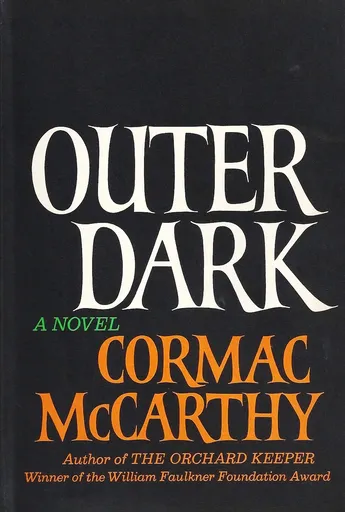
At some point, while writing this book, McCarthy's many talents crystallised into something greater than their sum. You can almost feel it, too, him not ready to wield this literary fireball so mammoth and ungainly that he can only aim it in the vague direction of the obsessions he'd pin down on later works. But for that reason, its relative scrappiness, its uncharacteristic images (an imposing forest is made up of "malign and baleful shapes that reared like enormous androids provoked at the alien insubstantiality of this flesh colliding among them," so striking, so unlike him), its front-facing empathy, it feels all the more special in his body of work.
I think (think?) I'd call this a morality play, McCarthy rendering his pair of sinners through dual punishments of Hell (Culla) and Purgatory (Rinthy). The former would be the bedrock of his future work, though never again quite like this. As I'm writing, I've just begun reading Peter Carey's , another book in which a lead character exists in self-perceptive eternal torment, in which every mundane and thoughtless act somehow and someway offsides and upsets everyone else. It's this wonderful idea of a kind of 'mark of the sinner,' the marginalia of human interaction reconfiguring and twisting around a weight on one's own soul. No one ever has just cause to blame or apprehend Culla, but he holds himself forever as someone who's done *something*, and he has, and so they do. The slow build is almost comedic, overtly so during what I've decided I'll call 'the hog scene.' However, at their peak, the laughs are instantly superseded by the long-waited visual rendering of divine punishment at the hands of the trio. Characters whom I enjoyed more as spectres haunting Culla's trail than as the actual harbingers they eventually become, though the visual potency of their final appearance cannot be denied. Sickening, truly.
Then there's Rinthy, who spends the book suspended in slow-motion mourning. Her journey is sombre and sensitive, empathetic in ways I hadn't seen before with McCarthy, and therefore all the more brutal. Dangling her resolution before her, taking it away, bringing her into the bloodied aftermath, sitting her in the crushing hollowness of it, and then having her not appear during the coda. Not to say it's cruel, just punishingly sad, and it touched me deeply. Perhaps I make this book that alternates between these two tales sound tonally schizophrenic, but the real magic trick is that it isn't. The ever-increasing fires of Hell plunge an infinite depth that can reach from terrifying to comical; unending stagnance cannot. Everything is as it should be.
As for that coda, he's already anticlimaxing his narratives to tie up his themes. We are all sinners, we are all damned, we are all forgiven. Talk about emerging fully formed! I'm reluctant to call any work of the most ceaselessly and recklessly praised English language writer of the past 50 years 'underrated,' so I'll give it this: it's really good!