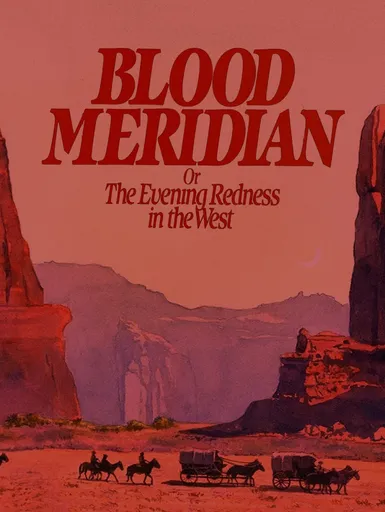
Despite the books popularity i am surprised that this is the first review that has been written on this site. This is more of an essay on my own thoughts on the book and the paratextual context it currently exists in rather then a review. I will also spoil most of the book, if you care about that type of thing. If you want a review i will tell you what you probably already know: It's incredible. You should read it.
More reviews
I also apologies for my shabby use of citations, i would love to say that i have some great genius reason as why i cite some things and not other, the reality is just that i am lazy. If you want an exact citation feel free to leave me a comment smile :).
Blood Meridian on the internet
Blood Meridian has a reputation for being "the greatest western movie never made" or "an unfilmable book" which is understandable due to the extreme violence and sadistic content within the book. It's fun to imagine the screenwriters room, 10+ writers and executives tasked with making the Blood Meridian film or TV show. Hunched over a big desk covered in half eaten takeaway, they try to come up with the appropriate way to film one of the Delawares, naked infant in each hand, swinging them by the heels like nun-chucks head first into a rock exploding their skulls in a mist of brain matter. Despite it's lack of adaptations in the traditional realm of television and movies, it has seen a great uptick in being discussed, and especially Judge Holden, on social media.
A tweet about the Judge with 12.5 million views.
The Judge is supernatural. His monstrous appearance, his superhuman feats of strength (wielding a howitzer usually operated by 3 people with 1 arm, picking up a 100lbs rock to crush a horses skull with ease, etc.), his seeming ability to manipulate a coin like magic, throwing it in perfect circles around a campfire, and afterwards, straight into the dark only for it to fly back into his hand like mjölnir. The book all but confirms that Judge Holden is not a normal human and because of this we can ask ourselves, if he is not human, then what does he represent and why did McCarthy put him in the story? For some reason there is a tendency in modern online circles to reduce him a sort of mascot horror character, a creepypasta villain. He even has his own rap battle where he "fights" the supercomputer from "I Have No Mouth, and I Must Scream". Most online writings only come up with one-dimensional answers when trying to analyse what he's supposed to represent. A video essay called "What Dark Souls 2 Stole From Blood Meridian" pins the judge as a simple Hobbesian, might-makes-right, figure to whom the social contracts, values and currencies of the world are worthless and the only true exchange-value in the universe is violence and strength. His villians.fandom.com article describes his "type of villain" as a "Satanic Nihilist".
I think both the overly simplistic analysis and the mascot-ification of the book originate in the same place, they try to pull the judge out of the book and put him in other contexts without asking the (correct) inverse question: Why is the Judge where he is? If the Judge is just the historic presence of violence or a satanic nihilist, why are we in the american frontier to begin with? Lord knows there was grander scale of violence on, for example, the eastern front during WW2 or the American interventions in Latin America, that was happening at about the same time McCarthy started writing the book.
Why is there so much emphasis on scalping?
Marx and McCarthy
"What we are dealing with, he said, is a race of degenerates. A mongrel race, little better than niggers. And maybe no better. There is no government in Mexico. Hell, there's no God in Mexico. Never will be. We are dealing with a people manifestly incapable of governing themselves. And do you know what happens with people who cannot govern themselves? That's right. Others come in to govern for them. - Captain White, Blood Meridian, Chapter 3
"If, according to Augier, money "comes into the world with natural blood stains on one cheek", capital is born with blood and dirt oozing from every pore" - Karl Marx, Capital: Critique of Political Economy, Volume 1, Chapter 24, Princeton University Press.
The Judgewas a real person. So was Galton. Probably one of the first facts anyone who has researched Blood Meridian discovers is that McCarthy took historical inspiration from the account of Samuel Chamberlain in his memoir "My Confession" following the Galton gang after the Mexican-American War that ended in 1848.
A drawing of Judge Holden from Chamberlain
Because Americans are special, they do not call their imperialism imperialism, they call it "manifest destiny" but it is largely the same. The first time the kid crosses the Mexican border it is after being recruited by captain White where he has joined a mission of paramilitary imperialism. Captain White believes that the American government has made a mistake at the end of the recent Mexican-American war by letting the state of Sonora stay Mexican, or even worse, allowing it to have a possibility to become European so he is making an army to reclaim it. Captain White's expedition almost immediately gets overrun by the Comanche and the kid ends up together with Toadvine in Glantons gang. He is joining the posse based on Toadvines lie: "[So] don't let on you aint no seasoned indiankiller cause I claimed we was three of the best." (end of chapter 6).
The scalp hunters/gang find themselves at a very interesting time in history, they are right in the centre of what Marx called "the so-called primitive accumulation" (or original accumulation in newer translations). In what has become one of the most well known passages from Capital vol 1, Marx wrote: "The discovery of gold and silver in America, the extirpation, enslavement and entombment in mines of the indigenous population of that continent, the beginnings of the conquest and plunder of India, and the conversion of Africa into a preserve for the commercial hunting of blackskins, are all things which characterize the dawn of the era of capitalist production. These idyllic proceedings are the chief moments of primitive accumulation"
Glanton has made a deal with Trias, the Governor of Chihuahua, for a payment of 100 dollars a head for scalps and a 1000 for Gomez's head. The Kid has gone from insurgent to private contractor for the Mexican state with a single goal, to extirpate, genocide, Indians. It is worth noting, that it is here that the Judge reappears after we first met him in the preachers tent at the start of the story, joining the gang on their extermination and scalping raids. Marx actually wrote specifically of scalping, writing: "But even in the colonies properly so called [or, settler colonies—in Spanish colono/a means settler] the Christian character of primitive accumulation was not belied. In 1703 those sober exponents of Protestantism, the Puritans of New England by decrees of their assembly set a premium of £40 on every Indian scalp and every captured redskin; in 1720, a premium of £100 was set on every scalp (...) Some decades later, the colonial system took its revenge on the descendants of the pious pilgrim fathers, who had grown seditious in the meantime. At English instigation, and for English money, they were tomahawked by the redskins. The British Parliament proclaimed bloodhounds and scalping as “means that God and Nature had given into its hand."
The gang, after a pistol-knife-fist brawl in front of a funeral procession, realise that the origin of the scalps does not really matter, they act as a commodity, a receipt, the part that carries the exchange value within them. Who can tell the difference between a Mexican or Apache scalp anyway? They start murdering and scalping anyone they can get away with. The gang has dropped any pretense of fighting for nation, race or government, being fully subsumed in their quest to accumulate capital in the form of scalps.
The Scalp by Frederic Remington
When they have finished with their scalping raids and start moving towards California, they change into being a business, running (as a sham of course) a ferry boat operation. They find and steal plenty of money, gold and silver, as we see when Brown enters a bar and upends his sack onto a whiskey grocers board: "There were doubloons minted in Spain and in Guadalajara and half doubloons and gold dollars and tiny gold half dollars and French coins of ten franc value and gold eagles and half eagle and ring dollars and dollars minted in North Carolina and Georgia that were twenty-two carats pure". But when the kid has finally escaped from the judge and lost track of Tobin he takes his last two dollars and is not interested in keeping the money, instead he buys: "the scapular of heathen ears that Brown had worn to the scaffold". The last thing he buys is a symbol of flesh torn from the Indians heads. The necklace of ears could of course symbolise many things, it could be a crown of thorns worn out of guilt, an albatross around his neck or just a gruesome trophy.
It could also be the final symbol of primitive accumulation, McCarthys way of saying the gang has finished the "chief moments" of theft, they have fenced off the commons and their job is done. Once they ended their contract with the"governor of the state of Sonora for the furnishing of Apache scalps", they of course do what the laws of capital demands and they switch from scalp hunting to profit hunting, intimidating and bribing their way into the capitalist class, with the ferry boat operation. A similar thing is echoed when the kid meets the old buffalo hunter, another man who, for profit, has destroyed all the commons of America, leaving it barren for anyone but the capitalist class. He talks about hunting the final buffaloes to extinction, "Ever one of them that God ever made is gone as if they'd never been at all". The old man then asks, to no one in particular: "I wonder if there's other worlds like this, he said. Or if this is the only one." the question which Marx loudly proclaims, yes there is another world, for the workers has a world to win.
After the Kid (or now also called the Man) has wandered the land he runs into the Judge again, shrouded by clouds of smoke in a bars yellow light. When he finds the judge he finds him "(...) among every kind of man, herder and bullwhacker and drover and freighter and miner and hunter and soldier and pedlar and gambler and drifter and drunkard and theif and he was among the dregs of the earth in beggary a thousand years and he was among the scapegrace scions of eastern dynasties and in all the motley assemblage he sat by them and yet alone af if he were some other sort of man entire (...)". Before the Judge would suddenly appear out of nowhere for each of the members in the Glanton gang, but now he is embedded into every part of society. Similarly the rule of capital was embedded into every Man who had lost their natural rights and would undergo proletarisation, forced to sell their labour power for a wage to sustain themselves. The judge is still just a violent and child-raping as he has ever been, which brings to mind Aime Cesaires writings about the Europeans who were hiding themselves from the truth of Nazism because: "before they were its victims, they were its accomplices; that they tolerated that Nazism before it was inflicted on them, that they absolved it, shut their eyes to it, legitimized it, because, until then, it had been applied only to non-European peoples; that they have cultivated that Nazism, that they are responsible for it, and that before engulfing the whole edifice of Western, Christian civilization in its reddened waters, it oozes, seeps, and trickles from every crack." (Amie Cesaire, Discource On Colonialism). To vaguely paraphrase a modern leftists motto, imperialism abroad becomes fascism at home.
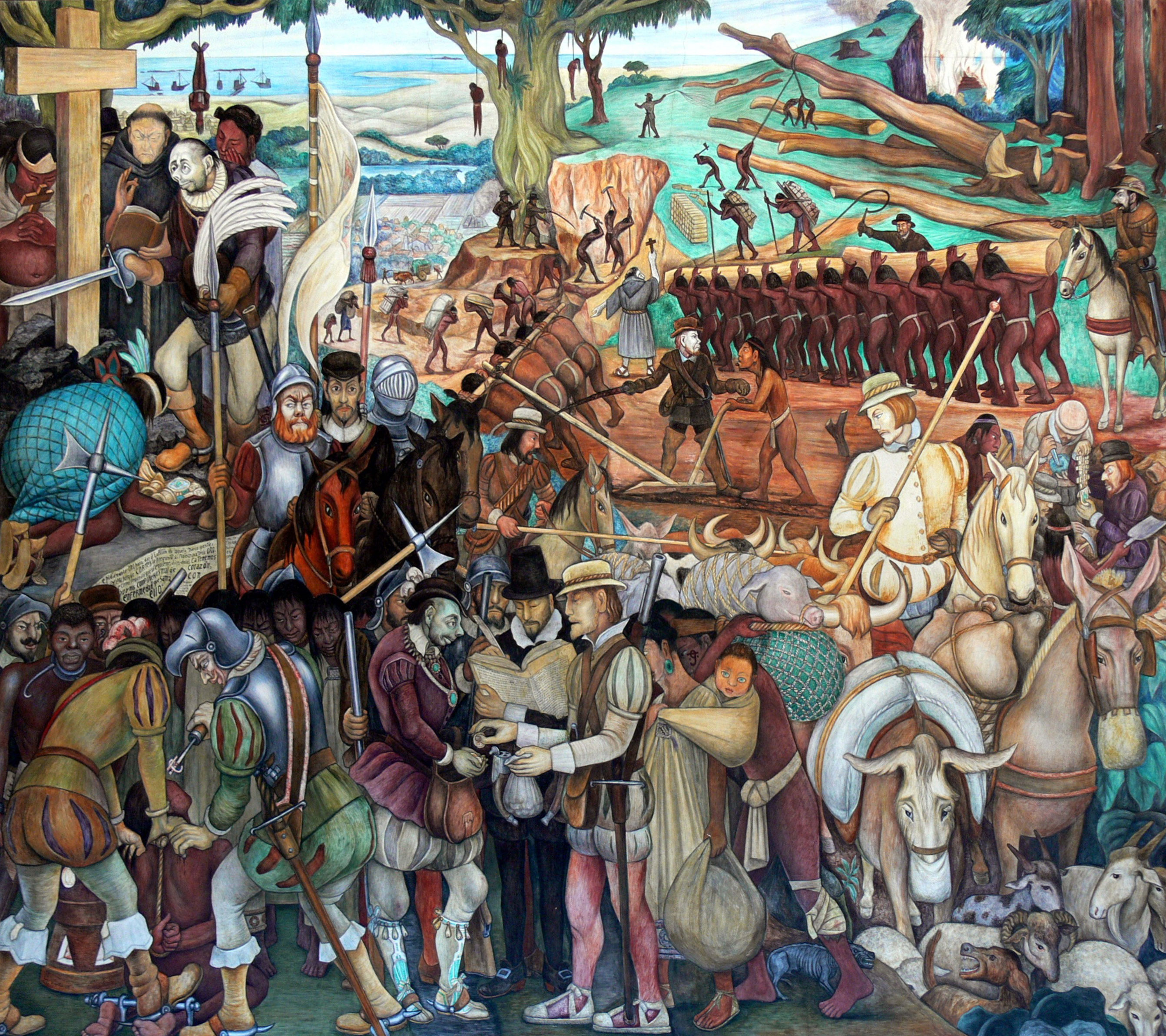
Mexico City - Palacio Nacional. Mural (1929-1945) by Diego Rivera: Exploitation of Mexico by Spanish Conquistadors
When the Judge and the Kid are talking, after the dancing bear has been shot, the judge starts asking the Kid about the reason that all the men in the bar are there:
"They come here to have a good time."
"The judge watched him. He began to point out various men in the room and to ask if these men were here for a good time or if indeed they knew why they were here at all.(...) They do not have to have a reason. But order is not set aside because of their indifference. (...) Let me put it this way, said the judge. If it is so that they themselves have no reason and yet are indeed here must they not be here by reason of some other? And if this is so can you guess who that other might be?"
"No. Can you?"
"I know him well"
Macht, Herrschaft, Subsumtion, Diziplin, Kommando, Gewalt, Despotismus, Zwang, Leitung, Aufsicht, Autorität, Kontrolle, Oberbefehl, Abhängigkeit, Beafsichtung, the many words Marx used for the force, the silent dominance of capital, that by mute compulsion shapes the social life we live. The logic of capital, as Marx was well aware, binds all of humanity, not only the class of the proletariat, but just as much the capitalist who is forced to sacrifice himself continue the forward motion of the combine harvester. The invisible fist that hides the bayonet, but who's logic still dominates every thought and every moment of your life, the authority that makes you not think of the bastardised question: "Why is it easier to imagine the end of the world then the end of capitalism?"
I do not think that McCarthy is a secret Marxist or that Blood Meridian is a hidden masterpiece of anti-imperialist writing, but there is a lot of overlap and things of interest, a lot more then one might expect. I have not even touched upon everything in this psudo-review. Marx and McCarthy wrote about the same time period and both were heavily inspired by historical sources, McCarthy by Champerlin and Marx by William Howitts "Colonization and Christianity: A Popular History of the Treatment of the Natives by the Europeans in All Their Colonies" which in my opinion opens up some very interesting parallels and readings we can find in the book.
Delaware in the Desert
The judge says he will never die, so he is still with us now. As i am writing this, in Delaware, there exists a scam non profit. A company of mercenaries, posing as a health organisation, has been hired in a joint venture between two governments to run humanitarian aid centres in a desert currently being starved to death by the same two governments that hired them. The centres are the only distributors in the area and attract hundreds of people looking for help. When the desperate goes near them for the gamble of a single can of baby formula, they are bombed, shot, pepper sprayed and killed. The modern Delawares, the private military scalp hunters of America, have outsourced their dreams of racial domination. What once existed in the form of the white mans racial superiority over Indian/Mexican/Black men has been replaced by the Israelis racial dreams and their belief in the Jewish supremacy over the Arabs. The modern-day Glantons, Browns and Captain Whites use this to continue the same American imperialist dream as they did in 1849 - the dream of scalping for sadism, fun and profit in Gaza. I am sure this is where you will find the Judge today, thriving in those concentration camps, re-living his raids on the Indians and continuing his campaign of rape.
"He never sleeps, he says. He says he'll never die. He bows to the fiddlers and sashays backwards and throws back his head and laughs deep in his throat and he is a great favourite, the judge. (...) He is dancing, dancing. He says that he will never die."
X-Ray of a 1.5 year old girl with a bullet lodged in her abdomen, shot close to a Gaza Humanitarian Foundation aid site while in her mother's arms.