
Sep 2, 2025 12:52 PM
Small testimonies from Turgenev’s time in Paris, back in 1848 (in time for the toppling of another king leading to the Second Republic), and 1870 (in time for the toppling of the other Bonaparte leading to the brief Commune and the Third Republic). No English translation that I could find, I translated here some bits from the French version.
Protests haven’t changed. Everyone feels it’s show time and gathers, expecting and fearing what is going to happen. Like going to the theater knowing the show is about to be so grandiose, you might get pulled in - and you don’t know if you want to, but you sure don’t want to miss it. Even Turgenev goes and observes that space between barricades and the Garde nationale, and the anxious waiting for the start of hostilities (and leaves when the fight starts : “Not having any reason to fight on one side of the barricades or the other, I made for my lodgings”.)
The June riots looked like another lockdown: they took place during a heatwave, and Parisians were ordered to stay in, windows open so the Garde nationale could identify an attack from the buildings. Turgenev describes the exact same boredom, the time spent with neighbors, the restlessness of caged beasts while, somewhere, people are dying.
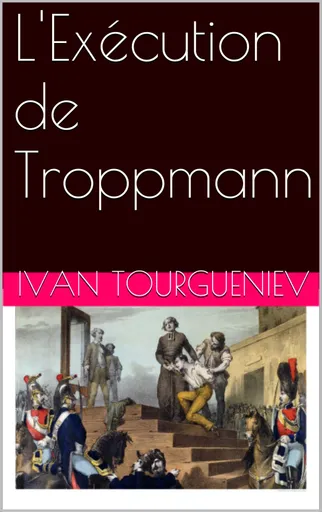
The main text is the telling of Troppmann’s execution. Troppmann is a Cohen Brothers’ bad guy. A sociopathic moron who failed despites his many tries to rob a family, and killed eight of its members one by one, and then proceeded to fail to hide their bodies. This event was a distraction from Bonaparte III’s faltering reign and its scandal of the day: one week before, the Emperor’s cousin, Pierre Bonaparte, had just killed a journalist, Victor Noir, whose funeral gathered 100K people (side note: is now a famous monument in the Père Lachaise cemetery). Troppmann’s execution is another great show for Turgenev, invited as a VIP to the execution along with Antoine Claude, the policeman that arrested Troppmann, and other writers (Maxime Du Camp, Victorien Sardou).
In order to beat the crowd (25K people, according to Turgenev), they arrive some 12 hours beforehand and wait, first for the building of the guillotine, then for the execution. He seems to regret coming, and laments the immorality of watching that spectacle (a man is about to die) and the impossibility of having an appropriate topic of conversation while waiting (a man is about to die!).
VIP meant something back in the day: they joined the policeman when it announced to Troppmann in his cell that his last appeal had been rejected. Before this:
During the two or three minutes we spent in that room - some formality was being completed during that time - the idea that we had no right to do what we were doing, that by attending with feigned gravitas the assassination of a being similar to us, we were performing in an appalling and illegal play - this idea went through my head for the last time.
Turgenev is sensitive to the showmanship displayed: he notes the priest slowing down his reciting to give more time to the executioner, who can’t find the right sized hobbles. He continually comes back to his very own fright - the “terrible minute” spent in a dark hallway walking behind Troppmann, the lock of cut hair falling near his feet. Still that same fright mixed with excitement from being so close to the scene.
He also notes the cowardice of “social justice” brought by execution: “none of us, absolutely none of us looked like a man having attended an act of social justice”. (What does that type of spectator looks like anyway?)
What benefits did I get from it myself? A feeling of involuntary admiration for the assassin, that moral monster who was able to hold death in contempt. Could the legislator want such impressions? What kind of moral goal are we still talking about, after so many disavowals brought on by experience?
Despite his many protests that must have felt like action, Turgenev reverts so easily to the role of the complacent spectator:
There was Troppmann.
He had woken up before we arrived. He was standing in front of the table on which he had just written to his mother a (by the way, rather banal) farewell letter.
Turgenev was right: there is something fundamentally uncomfortable in the watching of the spectacle. Knowing it doesn’t absolve from inaction, and the spectator’s comments (an ersatz for action, the only act he allows himself) manage to turn it into a truly despicable demeanor. But then, what is a writer, if not a commenter? So how can you be a writer, if watching and commenting is blameworthy?
His answer lies at the end : “I would be content and I would forgive myself a misplaced curiosity if my tale gave a few arguments to the defendant of the abolition of the death penalty, or at least the abolition of its publicity.” His words might have an effect, and maybe it will be the right effect. Is it enough of an answer?
Another answer is found in “A Fire at Sea”, a story inspired by autobiographical events Turguenev wrote to oppose a persistent rumor against his character: when he was 19, a fire broke out on a boat, and rumors has it he acted cowardly then. So, a few months before his death, he dictated this story (in French) to defend himself against the comments from spectators of his own life. The story he tells is that of a young man stuck in a sinking burning fire, with small braveries, small cowardices and human misery. A very ordinary experience of extraordinary circumstances. And maybe that’s just what writing is then - comments about larger-than-life events, feeble words against bigger things, against the author’s smallness, or both.