
Jan 15, 2025 8:49 PM
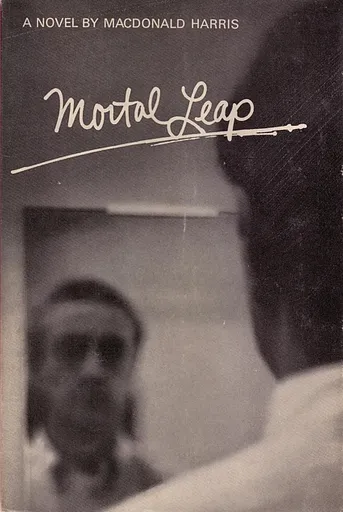
In 2007 the Guardian published a feature in which 50 writers each chose a book they thought was unjustly neglected. This was right after I got back into reading, having hardly read any fiction since university, and it was massively influential for me. As a direct result of this piece, I read Alasdair Gray, José Donoso, Ishiguro's greatest achievement, The Unconsoled, Craig Nova, Elizabeth Taylor, Aidan Higgins, Michael Bracewell... and many other books and writers I'm still into today. But it was Phillip Pullman's plug for The Balloonist by MacDonald Harris that ended up being the biggest deal for me. I've since read all 17 of Harris's novels and his short stories, and I'm now slowly going through the oeuvre for a second time. So despite already owning an old trade paperback edition of his second (and first really good) novel Mortal Leap, I had to buy this reissue when I stumbled across it the other day.
It's absolutely worthy of being brought back into print, 60 years after its original publication. In its probing — or maybe grappling or pummeling would be better words — of the nature of identity and selfhood, of what it means to be you, it sets up arguably the principal theme of Harris's fictions. And as in much of his later fiction, there's an action background in which stuff happens — explosions, sunderings, the picaresque — and the question of whether anyone is ever fully, or maybe even at all, in control of their destiny. All of his books play off the practical against the intellectual, the carnal against the existential, and Mortal Leap sets the tone. And like all his books, it's written with seemingly effortless elegance, in a tethered, pragmatic prose that never ascends into "tea-party fairy" (the young narrator's description of Proust) territory.
Unfortunately this edition, brought out by Boiler House Press in their "Recovered Books" series which grew out of the excellent Neglected Books blog, is marred by a cascade of typographical errors. I started keeping track on page 38, and counted 26 proofing snafus before I stopped counting on page 115 (out of 344). Punctuation is thrown around like confetti, words disappear into the ether, and OCR errors like "wove" for "move" and "malting" for "making" are always lying in wait for the unwary reader. I was gratified to see at the bottom of page 88 "sit" where "sat" is meant, and at the top of page 89 the favour returned, with "sat" sitting in for "sit" — until I checked my old Corgi copy and discovered that the problem on page 88 was actually the omitted word "would". Even the epigraph, from Pascal, is generously afforded an extra comma! I was discombobulated to see a proofreader credited at the end of the book — but then I saw on Linkedin that this was a six-month internship by a barista with no other proofing experience. And look, sure, 95% of these errors don't make any goddamn difference — they're obvious and it's obvious what was meant. But there are a few cases where I had to pause, like when someone is described as having "ack eyes" and (in the same paragraph) having sailed "round the Hom". I googled the ack eyes before concluding that these were merely black, and I knew right away that "Hom" was a misprinting of "Horn" (both confirmed by reference to the professionally-produced Corgi edition), but not every reader will be familiar with Cape Horn. This is why we employ proofreaders — or used to, before we stopped giving a shit about standards and capitulated to spellcheckers and even worse kinds of technology. To quote the Dude, this is not 'Nam! There are rules!
I just had to get that off my chest. If you can't find an older, out of print edition, this one is still well worth picking up.