
Dec 31, 2024 10:18 PM
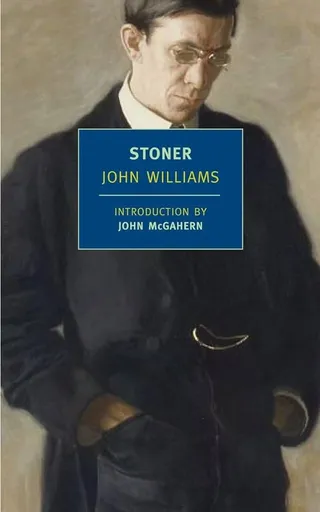
Misery loves company, and so on. That's the reason why people love this book. They see in Stoner a reflection of themselves; it's all because we are in this era where people have severely low self-esteem, everyone deep down considers themselves to be losers, everyone has suicidal thoughts, etc. That's what this novel is: pornography for losers. We see a similar phenomenon with The Stranger and Notes From Underground.
Stoner is nothing more than a worm. For one who is in such a position must recognize that there are only two options: 1. Realize that you have nothing to lose and strive for something greater, or 2. End your miserable existence. Because a life like that isn't worth living, if you lack the guts to improve your position you must at least have the courage to end the suffering. When the life of a dog becomes too pitiful we go to the vet and put it down.
And let's not get deeper into Stoner's other moral failures. For one, how he completely abandons his parents. They toil the earth day in and out, finally manage to scrap some money to send Stoner to school, and what does he do? Leaves them to rot in the fields. The marital rape is one instance where I disagree with the mainstream opinion, which decries Stoner as an evil rapist. I, in contrast, believe this is the only instance in the whole book where Stoner showed bravery. Stoner saw something he wanted and seized it, he didn't care what was moral, what other people believed; he against all odds obtained the woman he desired and then exercised his right as husband. Almost a divine act by Stoner; like Zeus raping Europa, or the Romans raping the Sabines, or Gilgamesh raping the brides. Here I am not making any kind of moral argument in regards to rape, I'm simply saying that Stoner saw something he wanted and did everything he could to obtain it, a fire which is present in all great men across history.
Oppenheimer when he went into Truman's office with Dean Acheson said to the latter, wringing his hands: 'I have blood on my hands.' Truman later said to Acheson: 'Never bring that fucking cretin in here again. He didn't drop the bomb. I did. That kind of weepiness makes me sick.'
12 Comments
11 months ago
>Realize that you have nothing to lose and strive for something greater >For one, how he completely abandons his parents. They toil the earth day in and out, finally manage to scrap some money to send Stoner to school, and what does he do? Leaves them to rot in the fields. Which one is it, strive for a noble pursuit, or resign as a slave to the wants and desires of other people? It seems like in your attempt to have a le edgy rape opinion, you've run yourself into a contradiction. Why is Stoner more indebted to his peasant family but not his wife? He abused both, but you only celebrate the rape...
11 months ago
I wouldn't have insulted Stoner if he used his triumph (abandoning his parents) for something positive. Instead he remains rotting. Nothing changed. He never seized control of his life, instead he was content with mediocrity. Thus, what is tragic is that he betrayed his parents for nothing. There's no contradiction here.
11 months ago
Mediocrity defined by who? If judged by the standards of common people, then sure, Stoner was a failure, but you shouldn't listen to common people. And I really mean 'common' in the pejorative sense— if you're worth anything, you don't slavishly follow the direction given to you. Stoner found something that made him happy and desired no more. He was content, and if he left his happy station to pursue something worth higher stock to society, then he would be a cuck.
11 months ago
Do you think Stoner's life wasn't pitiful?
11 months ago
I do not think Stoner's life was pitiful.
11 months ago
I see. I can't imagine being like you. Content with mediocrity. I strive for greatness. We are too different. Consider this conversation over.
11 months ago
Alright dear
11 months ago
On the off chance that you're not just writing your reviews to rile people up: 1. Calling non pornographic things pornography like it's some mic drop is a bit cringe 2. To suggest that the only valid response to hardship is either radical success or death is a bit reductionist. Life is not a binary of glory or misery 3. If what you got from the marital rape was Stoner 'seizing what he wanted', I don't think you really read the same novel. Williams did not frame the scene as a moment of triumph but as an example of the failures in Stoner’s marriage. You say you're not making a moral argument yet you disagree that the label 'evil rapist' can be used on him. The comparison between Stoner and Zeus is silly, one is an archetypal being from mythology where morality is often irrelevant to narrative purpose. 4. You imply that a life like Stoner’s is “not worth living.” which overlooks one of the novel’s ultimate messages; that meaning and fulfilment are deeply personal & can be invisible to others. But Stoner finds purpose in his love for literature and teaching, his affair with Katherine, and his quiet resistance to mediocrity. It's curious you began your review with accusing others of projecting...
11 months ago
I'll address your criticism point by point. 1. Agree. I couldn't think of a title. I could have done better, maybe, if I thought for it longer. In retrospect, I believe pornography is pornography for losers. 2. Never said anything about "radical success." I'm a believer that we should help those who are in need, especially when they're your parents, and especially when they're the ones who paid for your tuition. The most depressing part of the book is Stoner's parents dying in old age still working like horses. If he had any kind of virtue he would have obeyed his parents and gotten his degree in agriculture, this would ensure him and his parents an upper-middle class status at the least. In conclusion, I reject your binary interpretation. 3. I don't care about William's intent. A novel is something to be experienced, not understood. Quoth Williams himself: Then, more specifically, Williams complains about the changes in the teaching of literature and the attitude to the text “as if a novel or poem is something to be studied and understood rather than experienced.” Wooley then suggests playfully, “It’s to be exegeted, in other words.” “Yes. As if it were a kind of puzzle.” So your point of Williams "framing" a scene is moot, as he himself would disagree. To your other point, yes, I see the rape as a triumph, the same way I see Stoner abandoning his parents as a triumph; both of these things are considered immoral, yet in these actions Stoner exercised his will, instead of just being carried by the current, which is what he does most of the time. Notice how I don't have to agree with an action to consider it a triumph. 4. Revisit the aforementioned quote. There's no "meaning," Williams himself said so. What we can do is discuss our different interpretations, but please stop being condescending, implying that I didn't "understand" the novel. I'll address your point: Do you believe Stoner's life wasn't worth of pity?
11 months ago
1. Ok. 2. Ok. I simplified your position on success vs death, but now I don’t really see what you’re arguing? That Stoner does morally wrong things? That he’s a “loser”? I don’t disagree with you there, I was saying it’s reductionist to say his life wasn’t one worth living. Do you only want to read about virtuous characters? 3. Ok, it’s all well and good if you don’t care about what Williams intent was. It’s still valid literary analysis. Ok, I can see why you would argue martial rape is triumphant. The question is what makes Stoner seizing what he wants (pursuing academia, taking personal agency) not triumphant but morally objectionable, whereas marital rape is triumphant? You’re not consistent. 4. “The novel, it seems to me, is a place where one can try to make an experience more available to people than it is in ordinary life. It has the capacity to help us understand our own experiences in ways that are not immediately obvious.” The idea that these themes exist to be experienced is not a rejection of meaning, but a call to reflect upon that meaning in a more personaland less intellectualized way “It seems to me that one of the things that Stoner experiences is how the world and the people in it do not cooperate with his desires or his expectations. It is not that he fails to live a significant life, but rather that life itself sometimes seems indifferent to him and his dreams” There absolutely are meanings to every text. I don’t know how you derived from your quote that Stoner has no central themes or meaning. As you can see above it was written with intention, the idea that there is still dignity in trying to find meaning in life, even if it's quiet/ unseen. We’re not discussing interpretations, all you’ve really said is it’s a book about a loser who does bad things that other losers like to read. I would explain the difference between interpretations and observations but you’ve banned me from being condescending:( I’m not going to engage anymore
11 months ago
Ah, of course, marital rape is actually good, a "divine" act by a go-getter exercising one's "right as a husband", but when he goes into academia instead of staying with his parents, that's an example of immorality? Fuck off. I would absolutely hate to know you in person. You sound like such a slimy, disgusting human. I try and remember there is a spark of the divine in each of us, and then I read shit like this or your Lolita review, and I'm just not so sure. I don't know if I'm one of your "great men", but the thing I would stop at nothing to obtain is my fist in your face. Loser.
11 months ago
1. I never said marital rape is good. Don't put words in my mouth. I explicitly explained that I was not making any kind of moral argument, read carefully. 2. By "divine act" I was simply drawing references to instances of rape in classical mythology to the case of Stoner, the similarities are there for those who have eyes to see. 3. As I wrote on the review, I'm not making any kind of moral argument, thus when I bring up marital rape in regards to Stoner I'm seeing this through a judicial framework mainly. At the time, "marital rape" was not considered a valid concept, as it was believed that when the people married this implied their eternal consent. The foundations of this concept are laid by Paul in the New Testament. Thus, Stoner sees nothing wrong in "raping" his wife, because this concept simply wasn't in the moral code at the time.