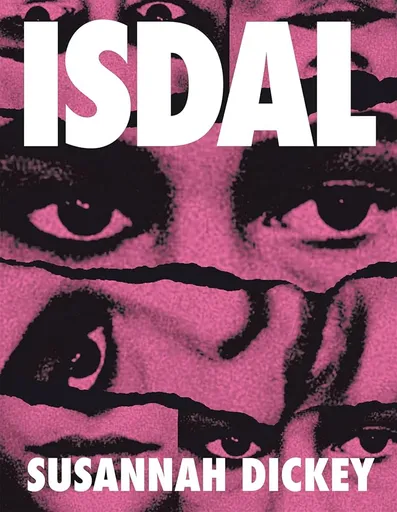

May 23, 2025 1:58 AM
Susannah Dickey is best known as a novelist in the autistic, Rooneyish, sad-Mick-chick mode. This is billed as her 'debut poetry collection' but really it's a Chimaera. "I - Podcast", three-fifths of the whole volume and the main event, so to speak, is an extended poem about a True Crime podcast on the corpse known as Isdal Woman, whose mysterious death by burning and drugging in 1970 remains Norway's most celebrated cold case.
I'm not going to cover the remainder, "II - Narrative" and "III - Composite", in any detail. The former is an essay (really a Tumblr dashboard of excerpts from Georges Bataille, Judith Butler and the like) on how we think about death. It reaches the earth-shattering conclusion that True Crime is appealing because it allows its audience to, like, experience death without experiencing death. The latter is an anthology of short, mostly unrelated poems. It's also a slog of such unrelieved shittiness that T. S. Eliot must be roasting in Anglo-Catholic Purgatory for spawning it along with modern free-verse.
"I - Podcast", while an artistic failure, has two things to recommend it by comparison. First, it's about things: the pleasures of speculation, violence against women, the ethics of making "content" out of tragedy, the difficulty of speaking truth to an audience that wants the most salacious version of things. Secondly, it's not formless, unlike the vast majority of modern so-called poetry. We begin:
Two podcast hosts capture the story's bounce and narrative thrust!
He's English! She's Norwegian! They need listeners to bestow their trust
and invest in this ten-part audio-description of cruelty.
If ratings drop there's been a failure of execution or loyalty.
Contrived? Yes. Language a touch stilted? Sure. Pun on execution corny? Obviously, but I respect the attempt. I wish modern poets weren't averse to "devices" by and large. Unfortunately it only gets worse and worse until we end:
They've tried their best to extrapolate her chronology,
but hers is a death ill-suited to big broadcast-funded hauntology.
This is the archetypal Susannah Dickey couplet. Lolloping on three lame legs, grating with unpoetic jargon, meagre content puddling towards the page-edge as it strains to fill the baggy metre.
Her pen doesn't sharpen when she attempts satire either. This is one of the podcast guests speculating that Isdal Woman may have been a prostitute:
What woman would have so many wigs! She left these fripperies
for us to find, he says. Just look at this dead woman's proclivities!
Now, Dickey's target is real. People really do infer that such and such a murder was (un)deserved from banal facts about the victim. But if this observation is going to have power, it should be expressed as naturalistically as the constraints of rhyme and metre will allow. 'She should have died hereafter.' Something brutal in its matter-of-fact-ness. Instead we have diction that would maybe, at a stretch, be at home in a Ray Cooney farce.
Last of all, I'm not sure that Dickey's conclusion regarding True Crime reflects her treatment of Isdal Woman in the poem. Dickey: 'True Crime does not encourage empathy, it encourages fetishistic interest, it cultivates our fascination with death.' Also Dickey:
How sordid is it to invent a reason to put hands in a woman?
No seriously, I'm asking. Look for the fatherly
chicken skin on her inner thighs — the parts the fire couldn't
mutate. Before she died an enemy fear must have leapt onto all
the different parts of her for them to catch in syllable-shaped
silver tins. A woman's debilitating unbelieved-ness infects anything
it touches. It must have been there on her burnt face
with winter and sabotage and misery and fabulous.
Fabulous. The gauche jump from nouns to adjective emphasises it. Dickey has some justified complaints to make about exploitation podcasting but at least that's entertaining. If Dickey had given in, like the podcasters, to the speculative impulse she might have written a poem full of pathos about Isdal Woman's death. As it is, she's content to moralise and make bad art.
This book was a pain to get through so, as a treat for myself and as thanks to you who read to the end of this, I present the official Five Worst End-Rhymes in Isdal :
He's imagining her young, with looks like an au pair.
She's imaging Russians, sneaking into the water like copper.
What is the opposite? he asks. A soup tureen,
she says. Struck hard enough to dislodge its patina of gangrene.
The former spy looks at her route. He thinks she was a courier
passing info to a handler. Sound the theory alarm (a cor anglais).
What insurgency could have driven her to the border?
(Little by little they're unravelling her mystery's disorder).
Orphans have the seeds sown early for different identities.(The host takes a moment to thank those who designed the websites.)
4 Comments
6 months ago
"Lolloping on three lame legs, grating with unpoetic jargon, meagre content puddling towards the page-edge as it strains to fill the baggy metre." incredible
7 months ago
How are Poetry prizes being assigned if this is being given awards?
7 months ago
Reading verse this bad makes me welcome our new AI artistic overlords.
7 months ago
This turd took multiple prizes. Reading the press it got makes me feel like I'm being Punk'd.