Kyla Scanlon has a great essay on ["Gen Z and the End of Predictable Progress"](https://kyla.substack.com/p/gen-z-and-the-end-of-predictable), which mostly focuses on the collapse of the "safe path"--college, a corporate job, a house, and a 401(k)-- for Gen Z and its associated effects on the economy and politics. She also coined the helpful term "vibecession" to refer to the phenomenon in which economic indicators suggest a healthy economy, but people report feeling that we are in the midst of an economic downturn. Hence our lopsided debates about how much the economy is really working and for whom it is working.
Maybe debates about what the "vibes" are and what they should be are about progress in general, not just material progress. Instead, they are about the whole sense of whether or not the human condition continuously gets better. We are not debating "is job market good?," but more fundamental questions. Are things getting better? Getting worse? Are we stagnant? In contemporary debates about progress, Pinkerites and other adherents of the "graph go up" school assert that we've never been richer, safer, or freer, and, despite headwinds, we will likely continue to become more so. Doomers point out that nobody is fucking, nobody is partying, nobody is getting married, the earth is being degraded, and that we seem to be heading toward a combination of and . But both schools tacitly accept the premise of progressive thought: we can either look forward to our glorious future or lament a bygone era of simplicity and earnestness.
More reviews
Brave New World
WALL-E
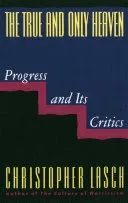
To help us cut through this inconclusive debate, we can turn to Christopher Lasch's The True and Only Heaven: Progress and Its Critics. Reading old books --and "old" here means a book published in 1991--has the disappointing tendency to reveal the poverty and unoriginality of contemporary "debate." Reading Lasch, one gets the feeling that much of the serious thinking about the moralizing, condescending progressive elite and the right wing backlash to it has already been done: it needs only to be updated for the age of X and TikTok.
But seeing The True and Only Heaven as a mirror image of contemporary discourse is a disservice. It is a searching, unwieldy, and often meandering book, that attempts to answer a "deceptively simple question. How does it happen that serious people continue to believe in progress, in the face of massive evidence that might have been expected to refute the idea of progress once and for all." To answer this question, Lasch examines progressive thought and its critics from the 18th century to the 20th.
If The Culture of Narcissism is a psychoanalytically informed critique of contemporary culture, The True and Only Heaven is a historically informed critique, which seeks to resurrect what is valuable from the anti-progressive tradition. Historically, this tradition was situated on the Left as often as it was on the Right, a fact that has been mostly ignored by critics of contemporary populism. Lasch examines a wide range of thinkers, all of whom are united by their "sense of limits," in contrast to the progressive promise of unending improvement.
Lasch analyzes progress from economic, political, philosophical, and religious angles. In the economy, he revives the critique of wage labour and the servility it supposedly fosters in workers. Directly related to this is the political critique of liberalism made by the "Republican" tradition that emphasized the civic virtues of independent, property-holding artisans and farmers and the virtues that public life demanded of them. In philosophy, Lasch devotes great attention to Thomas Carlyle and Ralph Waldo Emerson and their interest in the decline of man's capacity for "wonder" in the face disenchantment. Lasch also examines several religious thinkers, from the Puritan John Edwards to Reinhold Neibhur and Martin Luther King, Jr., all of whom fostered "hope" rather than optimism: the belief not that life would get better, but that life was good, despite its tragedies.
Instead of a unified book that builds evidence toward its thesis, The True and Only Heaven is best read as a series of essays around a set of common theme. Each essay is valuable in itself, and it would be impossible to give a suitable summary of each without straining the attention of readers. But Lasch neatly sets out his main themes in the book's introduction:
> The habits of responsibility associated with property ownership; the self-forgetfulness that comes with immersion in some all absorbing piece of work; the danger that material comforts will extinguish a more demanding ideal of the good life; the dependence of happiness on the recognition that human beings are not made for happiness
In short, Lasch is concerned with defending the virtues of the "the petty bourgeoisie," even as he is conscious of "its characteristic vices of envy, resentment, and servility." The True and Only Heaven is a valuable diagnosis of progressive liberal pathologies, made much more thoroughly and eloquently, and with a better sense of history, than many contemporary critics of liberalism.
These critiques have become familiar : the liberal metropole's contempt for the "backward" hinterlands, the fragmentation of the family in the lowest rungs of the economic ladder, the disappearance of respectable jobs outside of the professional meritocracy, the decline of self-rule and its replacement by bureaucratic expertise, the triumph of the therapeutic approach to dealing with the perennial challenges of the human condition, and the shallow comforts of sensual pleasure in an increasingly alienated, meaningless world. To Lasch, all these trends were clear as far back as the Kennedy administration.
Lasch, however, was not a policy thinker, and, as far as I can tell, had no desire to be. His interest was in how the past could inform the present, not to draft legislation capable of resolving spiritual crises. But even if a sense of limits, revitalizing democracy through civic virtue, and reawakening the spiritual discipline fostered by religion are the right course forward, it is difficult to tell how these things ought to be achieved. I, for one, am not impressed with contemporary Laschians like Patrick Deneen and Steve Bannon's attempts to glom Lasch's critique onto Trumpism.
But Lasch shouldn't be blamed for his contemporary followers. A deeper critique of Laschism is his failure to recognize that the shift in the economy from manufacturing to services has created a nation ruled by lawyers and consultants. Many of the pathologies of American life have less to do with the natural limits of progress than cultural decadence and institutional sclerosis that are downstream of this shift. The American economy and government has become defined to a high degree by credentialism and rent-seeking, and the victors in the new economy used their new positions to advance bureaucratic rule and what gets called "therapy culture."
So perhaps our situation demands not a rejection of progress, but a return to progress in the real world. We cannot overcome human nature, nor satisfy all of our infinite desires, but we can renew civic purpose by getting better at building things in the real world: advanced manufacturing plants, electric vehicles, wind and solar farms, transmission lines, cheaper and better housing, all of which contributes to an economy that is better equipped for our environmental problems and integrates the non-credentialed into building American prosperity. Five decades of New Left style "rejection" of progress has left us with NIMBY, prohibitively expensive housing, and degraded infrastructure.
A sense of limits and a more stoic embrace of the demands of life are all fine and good, but I don't look at the modern world and see it as fundamentally constrained. If anything, it is constrained by institutions and culture. These problems were not as clear in Lasch's time, but his failure to recognize them makes the book less prescient than it otherwise would have been.
To return to Scanlon's essay, I think it is clear that material prospects are declining for the young and that the social ties that bind us together (and make life worth living) are fraying, But unlike Lasch, I don't think we've fundamentally exhausted progress. So I remain optimistic, not as an article of faith, but because I see the problems the contemporary United States has and think, "This looks solvable." Nonetheless, I think The True and Only Heaven is a valuable exploration of the deeper roots of contemporary malaise.