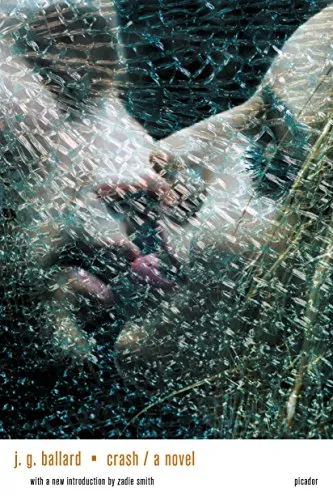


Ballard's pummelling hyper-fetishistic recombinations of the vocabularies of the human body (fluids, orifices, yielding or resisting flesh) and the automobile (steering columns, speedometers, manifold configurations of plastic and metal) induce a trance-state, a Möbius strip of stimulus and response forever interchanging with each other. They also have the effect of cross-grafting the connotations of these lexicons, so that words like nascelle and binnacle come to feel erotic, and words like vulva, glans, anus (Ballard employs strictly clinical terms) like words for the parts of a machine. And I think one thing that the book is about is how deeply cars are embedded in our persons and in our lives, an embedding that reaches its apogee, becomes literal, at the orgasmic smithereening moment of impact. It's this state of codependence, or even symbiosis, that exists between humans and cars (even more now than in '73) that makes the car crash the ultimate transgression, the violation of the communal organism that is traffic and of the womblike sanctity of the private automobile. Ballard's novel, like the car crash itself, is a forensic analysis of how we relate to, understand, and interact with objects, and the degree to which that understanding is inescapably sexual. The only things in the book that seem immune, able to transcend the supercharged tango of machine and man, are the crisscrossing planes that periodically draw the eyes of the characters, and us, up and away from the carnage and from the carnality of the cloverleafs and automatic car-washes and debris-strewn hard shoulders. Crash is one of Ballard's best.
.jpg_3ba813237690bcef_512x512.webp?alt=media&token=7b4fc564-e989-4477-af19-33a248844822)