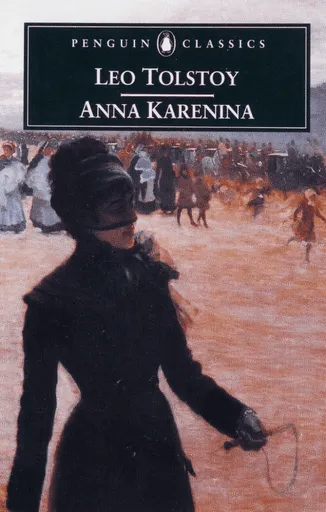


What can one say about Anna Karenina that has not already been said? I am not sure, but perhaps on a twelfth or twentieth reading some novel interpretation or cutting insight will strike me. But I have just finished the novel for the second time, so I cannot claim that any of my remarks below are original.
Anna Karenina is a nearly perfect novel. I say "nearly" because it would be too depressing to admit that the perfect novel has already been written. The possibility of great novels would disappear from the future, and that would be terrible. But Anna Karenina is closer to perfection than most novels I have read.
When I first read it a number of years ago, I thought it (or, at least I now remember having thought it) a tale of onerous social norms destroying a passionate, intelligent woman. If only the legal institutions and social mores of 1870s Russia were less rigid, Anna would have avoided her tragic fate. We moderns can pat ourselves on the back knowing that we have done much (though surely not enough!) to destroy the sort of sexism Anna encounters. The forces of Progress have won!
But on reading the novel again, it struck me as deeply conservative, even reactionary in outlook. Not in the narrow sense of day-to-day politicking, but in the grand philosophical sense that rejects the narrative of Progress that was all the rage among freethinking intellectuals in the latter half of the 19th century.
This is most forcefully demonstrated by the role of the railroad, that great symbol of Western rationalism and materialism grafted on to Russia. Anna and Vronsky first meet at the railway station, where a watchman is run over by a train. For Anna, this is a bad omen. Of course, her story ends at the railway station where she, too, is literally crushed by the force of modernity. But though Vronsky is spared this fate, he is, too, crushed by the forces of progress. He abandons his duty as an officer, dabbles idly in painting and politics, and never really renounces the unconstrained freedom that modern, liberal man is thought to have.
The conservatism of the book is more forcefully demonstrated by Levin, the novel's real hero. Levin has nothing but contempt for the liberal institutions being imported to Russia. To Levin, the zemstvos are a waste of time, lawyers are swindlers, and provincial elections a trifling farce. Even Russian agriculture, in Levin's view, is best improved not by scientific rationalism but greater insight into the essential character of the Russian muzhik .
But Levin is not a hard nosed reactionary. He is sensitive, compassionate, and searching. He is devoted to his wife, Kitty, but without all the mawkishness of Romantic love. He doubts his wife's love for him, and he worries about his own performance as a husband. His search for meaning in his settled, comfortable existence leads him to read deeply in philosophy and theology before embracing the wisdom of time immemorial: he devotes himself to his family, buckles down to his work, and, in the novel's last pages, abandons his materialist skepticism for Christianity.
What makes the novel so powerful, however, is not its political or moral content, but Tolstoy's power of characterization. Nobody in the novel, even the dallying and frivolous Oblonsky or the careerist bore Karenin, is less than fully human. Just when we think we know a character through the rumors thrown around in "Society" we are presented with a fuller picture of their perspective. And despite the high drama of adultery and spiritual crises that make up the novel's plot, its characters ultimately continue to live in the humdrum, quotidian world that we all must once our passions die down. It is this world that Levin accepts in the novel's final lines:
I shall still get angry with Ivan the coachman in the same way, shall dispute in the same way, shall inopportunely express my thoughts; there will be a wall between my soul's holy of holies and other people; even my wife I shall still blame for my own fears and I shall repent of it. My reason will still not understand why I pray, but I shall still pray, and my life, my whole life, independently of anything that may happen to me, is every moment of it no longer meaningless as it was before, but has an unquestionable meaning of goodness which I have the power to invest it.
It may sound trite to say a great novel is about the "human condition" in general, but I don't see a better way of putting it.