
Oct 3, 2025 10:38 PM
I think this makes Vineland the only book on this site that has two reviews to its name. Congratulations, Mr. Pynchon. You've hit the big time. [Edit: How wrong I was. A Little Life has four reviews. Sad!]
This was the only Pynchon novel that I hadn't at least taken a whack at - Against the Day defeated me quite handily - and with the release of both and on the horizon, it seemed like a good time to knock this one off my list. I already knew it by reputation, though. Most people consider it one of Pynchon's lesser works. A college professor who I respect very much told me that he hated it so much that he never picked up another Pynchon novel.
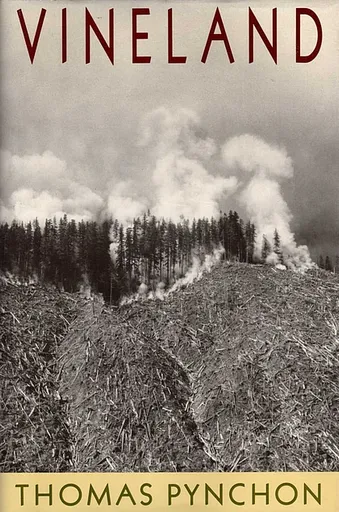
Doing my best to enter with an open mind, I found a novel less disappointing than puzzling. Here was Pynchon, here were his hallmarks, but why did I not love this as I loved, say Mason & Dixon or Inherent Vice? Frankly, some aspects of Vineland verge on parody. I first realized this when I encountered the long - long, long, long - chapter recounting DL Chastain's history with Takeshi Fumimoto. Gone was the extensive rumination on times past and dangers present. Here were giant lizards, corporate conspiracies, and ninja hijinks. Yes, this is the same author who incorporated an inter-zeppelin pie fight into Gravity's Rainbow and a mechanical duck's love affair with a French chef into Mason & Dixon, but those asides somehow felt more tangibly connected to the meat of their novels than the asides in Vineland. I wondered: had Pynchon written himself into a funk and didn't know how to get out of it?
Maybe. But hell, he's still Thomas Pynchon, and Vineland, even at its most annoying, is never without value. The most interesting chapters focus on the family at its center, using their dynamic - and a great antagonist - to examine the politics of yesteryear and weigh them against the politics of today (the today of the Reagan Era, anyway). Death is predominant, always. The Hippie moment has died, killed by the same cameras that captured it, digested it, and now beam it back into everyone's heads edge-free. In a more literal sense, the dead still live, as part of a strange commune in the California mountains, refusing to release their hold on life, refusing to let old scores go unsettled.
There's a healthy sense of "what goes around comes around," and some nice complication of what might otherwise seem a 2-D conflict. The left takes a lot of shit for its self-indulgence and lack of seriousness here, that's no secret, but more surprising to me was the empathy shown for Hector Zuniga, a DEA pistolero gone to seed. It's like both sides of the aisle are being corroded by their mid-century transformations, Traverse-style anarchism becoming drug-addled navel-gazing and its inverse becoming something much uglier, the former castrated by technology as the latter is empowered by it in the same sense that Tetsuo becomes empowered at the end of Akira. And somehow, in the end, it wraps up in a beautiful climax that delivers a stirring family reunion, the villain's Karl-from-Die-Hard-esque reappearance and comeuppance, a lone girl's temptation by the dark side, and divine intervention in the form of... well, I won't say.
I can't think of a single Pynchon novel that doesn't have a wonderful conclusion, though they conclude less in story and resolution and more in theme, which is remarkable in itself. The camera looks away, and time keeps rolling on, operating just out of sight. Truly, nobody does endings like Pynchon.
I mean it. I don't know how to end this review. This is it. It's over, just like the Hippie movement and the Reagan Era. Or is it?