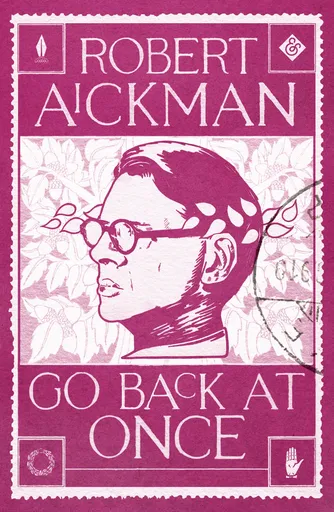

I really like Aickman's 'strange stories' and was curious to see if his writing would hold up over a full-length novel (finished in 1975 but unpublished until 2020).
Go Back at Once follows Cressida and Vivien, young women fresh out of boarding school who like quoting Shakespeare and hate boredom. After several horrible parties and a hilariously bizarre psychoanalysis session, they run off with Viven's aunt to the Adriatic city-state of Fiume Trino where Gabriele D'Annunzio 'Virgilio Vittore' is governing according to the 'laws of music'. The rest of the book consists of increasingly surreal run-ins with Vittore's eccentric devotees until the whole thing predictably implodes.
I'm happy to say that the absence of the supernatural did not impede Aickman's talent for being weird & unsettling. A bit like David Lynch, he's brilliant at creating images and scenes that feel significant at a pre-conscious level. A huge flock of birds is released during a banquet and the male guests stand up to fire tiny pistols at it. The city floods and a captured boat placed in the central square as a trophy starts sailing down the street -- below decks sailors(?) are singing 'The Internationale'. Cressida falls ill watching an unspecified spectacle of staged cruelty and has a vaguely homoerotic encounter with Vittore's 'sister' (possibly the goddess Diana?). A man called "The Professor" lives in a house that used to belong to a serial killer and hammers out tunes on a piano lined with human teeth.



Great review! Captures my thoughts on this very strange novel. Like you, I think his short stories are where he’s at his best, but this and his novella “The Model” are also quite delicious. His posthumous novel “The Late Breakfasters” isn’t quite up to the mark but still supremely strange and funny in places.