
Some call this poem-treatise the beginning of metaphysics, and qua metaphysics it is certainly a great leap in thought from the Milesian and Pythagorean schools. By itself it can establish the true bite of pre-Socratic thought, and that of the ancient Greeks as well. The relatively fanciful natures of the popular works of the period, the Republic and the Nicomachean Ethics, can give the impression the Greeks were mere bandiers-about of words, not as far removed as they thought from sophistry. Yet Plato's Parmenides or Aristotle's Metaphysics, neglected by the tourist of philosophy, are no sophistries, but profundities, and profundities developed essentially in response to the crisis caused by Parmenides, and the flood of varying responses to that crisis.
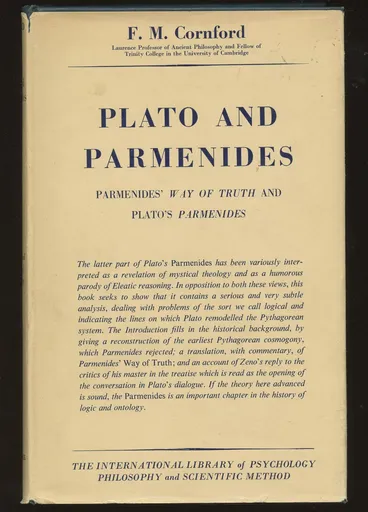
That might overstate the role of this work a little, but it is not wholly untruthful. The poem is split into two parts, the Way of Truth and the Way of Seeming. The first part is the more important one, since it contains Parmenides' metaphysics, and a lot of it has been preserved through quotations by later writers. The second part is scantily preserved, and is where Parmenides describes how the world seems (but not how it is) in a similar fashion to Pythagorean cosmologies. His metaphysics is somewhat simple: Being is One, it is Unity, it does not move, it cannot be split into parts, it does not experience change, it did not come into being nor will it ever pass from being; this is all deduced logically. I read this work in Francis Cornford's , which includes a commentary on both and , and a commentary is especially helpful for filling in those sections which are lost. As well there is some great scholarship on trends in philosophy around that time, tracking the influences on and from both works.


One of my favorite pre-Socratic philosophers, and arguably the one with the largest influence on Plato. I think it's telling that in the dialogue "Parmenides," Parmenides was given Socrates' usual role, and Socrates was relegated to the position of being questioned. It's been about 15 years since I've read Plato's Parmenides, but I'll probably check out Cornford's commentary if/when I get around to a reread. I read Heidegger's commentary on on Parmenides (the philosopher) around that time as well, but as with most of Heidegger's commentaries, he seems to read too much of his own project into other philosophers.
That's a good point, I didn't see that consciously. What is Heidegger's commentary on Parmenides? He's a bit far down on my list but I can intuit a connection between them.
Iirc, it’s mostly about his interpretation of aletheia as “unconcealment” rather than the modern conception of truth. I don’t think he’s completely off base etymologically: with “a-“ as the privative prefix and with “lethe” as forgetfulness (like the river in Hades).