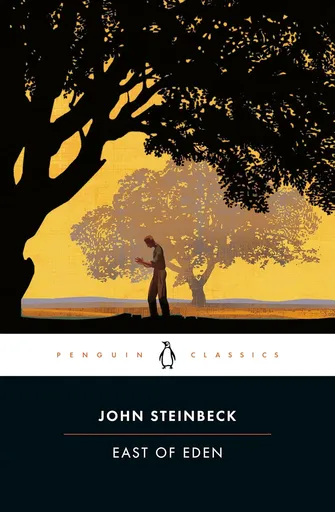

Steinbeck conjures such vivid images of the Salinas Valley--the book begins with a multi-page description of the mountains, the rivers and streams, the unspoiled beauty of turn-of-the-century California. I've always been attracted to books that are anchored by a strong sense of place, and East of Eden succeeds beautifully in capturing this specific epoch of the American West.
Besides that, I don't think I've ever read a novel that delivered such pertinent observations about human morality. The main theme of the novel is the interplay between good and evil, based loosely off of the Biblical account of Cain and Abel. Some characters are clear stand-ins for the concepts of good and evil--Aron and Adam are both paragons of goodness, while Cathy is one of the most depraved and irredeemable characters in literary canon. Still, these characters are not reduced to one-dimensional allegories. Toward the end of the novel, Lee (one of my favorite literary characters of all time) argues that those who appear to be perfectly morally good will crumble when faced with the inevitable evil in the world. There is strength in being able to balance the good and the evil parts of yourself, and mastering this balance is key to living a fulfilling life. The novel's most compelling characters- Cal, Lee, Abra, Sam Hamilton- all struggle bearing the self-inflicted weight of their shortcomings. Yet, these characters are not defined by the bad parts of themselves. East of Eden is Steinbeck's magnum opus and one of the greatest testaments to the human spirit.


I think other Steinbeck novels are far superior. This one I judge as too gimmicky. His modern take on the noble savage and such; how Lee and Samuel are depicted as genius, I feel because he wanted to push back against racist stereotypes of the time. I like the idea of the novel more than the execution.
Yeah, I get where you're coming from. I didn't think Lee and Samuel were portrayed as geniuses, per se, even if other characters thought highly of them. I don't think having intellectual characters is a bad thing or that their preachier moments were turn-offs. Especially toward the end, it was emphasized that they too had that balance of virtue and vice. But I preferred this to Grapes of Wrath by a lot, though it's been a few years since I read GoW. Maybe it's time for a reread haha