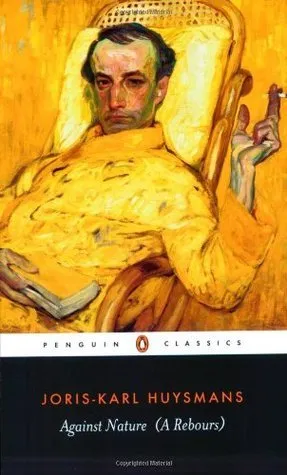

Have you ever met someone who happens to like all the same stuff as you, but somehow in that exact mirroring of your taste without sharing the underlying consciousness beneath it doesn’t ingratiate themselves to you but actually presents a really perverted version of yourself and your tastes that makes you question why you like all of the things that make up who you are? If you haven’t then you can read this book to get an idea of what that would be like for me, or anyone else who loves late 19th century Symbolism. But in the age of the Internet forum and Google “<thing I like> reddit,” I imagine this feeling is getting more and more relatable.
A Rebours is the story of a man collapsing under the weight of his own decadence. It’s sort of the Grey Gardens of its day where we’re treated to this really insane window into the life of a person who’s become consumed with the project of exploring their own personal aesthetic preferences to the point that we don’t really know who they are in between the tiles of their taste. The book is incredibly detached, entirely in the third person, doesn’t have a single line of dialogue in it or really even any internal monologue, and in general it’s not much of a window into the actual mind of the only character that the book follows: one des Esseintes, a member of the Parisian aristocracy who has all of the heavily inbred paperwork to prove his pedigree. And as des Esseintes, the protagonist/head weirdo of A Rebours continues to self isolate, we see the same penchant toward the dusty macabre hyperreality of memory that we see in Grey Gardens. We get the sense that, ultimately, there isn’t much under the surface of a man who is so concerned with how he presents on the surface that he takes the artifacts of his taste as his only consorts in a life of isolation. He is a haunting figure. Huysmans himself describes this novel in my edition’s introduction as “a jewel encrusted casket.” Which would make des Esseintes the living dead Count Orlok who sleeps in the casket until he must rise to drink the blood of the young.
Here’s a characteristic example of the semi-disturbing opulent death that waits at the edges of this book. At one point in this volume, between hundreds of pages that read like a teenager giving a breathless “and then”-filled tour of a bedroom covered in band posters, we get a description of a pet tortoise that des Esseintes has acquired. In an effort to fit the tortoise to the rest of his abode’s aesthetics, that’s right, des Esseintes completely coats the poor thing’s shell in gold and heavy jewels, killing it under the weight of his shallow home decor preferences. A decadence unto death. And of course that jewel encrusted death comes directly as an effect of a man’s thematic attempts to fine tune nature.
That is des Esseintes’ true goal in his isolation and hoarding of Symbolist artifacts: to perfect what nature cannot. He is a master of artifact and the synthetic and he feels that this mastery is deeply entwined with his taste in media. Instead of fresh air he will have incense. Instead of daylight he will have ornate Oriental lamps. Instead of travel he will have the wonderful pleasure of sitting in his dark room at night, imagining what it would be like to travel, never having to experience the humiliating disappointment of travel not meeting our expectations. And in the end, his final hyperbolic example: instead of subjecting himself to the painful all-too-human ordeal of eating, he will have enemas administered daily.
If reading this you can’t help but map our own modern Ayn Rand-style California aristocracy onto the actions of this screwball, then you’re a lot like me. Poor misunderstandings of William Gibson, Tolkien, Nick Land, and even Neon Genesis Evangelion line the spartan walls of today’s techno-decadent hyper isolated bunkers. The modern ruling class abhors the simple pleasures of nature. Every task of life is hyperoptimized. Fake plants line the walls of every restaurant. ChatGPT is asked again and again to “make it more human this time.” Huel abounds. These are the actions of an aristocracy seated in an Empire which is decidedly in cultural decline. And in some ways our own online presences are like des Esseintes. We decorate these little interior spaces which are hermetically sealed against any possibility of sight from other eyes that could yield impressions of our actual soul. We pray only to altars of A E S T H E T I C. If you’re like me, some of your computer backgrounds are even hi-res Moreau or Redon paintings just like the ones that line the walls of des Esseintes’ home.
But Huysmans is shrewd in his ability to pick a title and key us in on his irony. So shrewd that to this day no one can agree if this book should be called Against the Grain or Against Nature. Both are perfectly pertinent for the book so it’s often published under simply the French A Rebours. When we try so hard to carve out our own unique space that represents what we like, without truly trying to understand our own thoughts and feelings that should in theory lead to us knowing what we like, we create a strange simulacrum of taste, a simulacrum of individuality and free expression. That’s why ultimately the one piece of art or literature that is missing from des Esseintes treasure hoard is the only one that’s impossible in this world: art created by him.
If we want to be able to fully absorb the weird beautiful worlds of Moreau or Redon or Jan Luyken or Delacroix or Baudelaire or Verlaine or Rimbaud or Edgar Allan Poe then we must do so in moderation. We cannot entomb ourselves in the works of these dark princes. They are like bittersweet dark chocolate: a great dessert but when consumed exclusively and in excess, hollow and emaciating.

This book filtered the hell out of me - amazing analysis