
Jun 4, 2025 7:04 AM
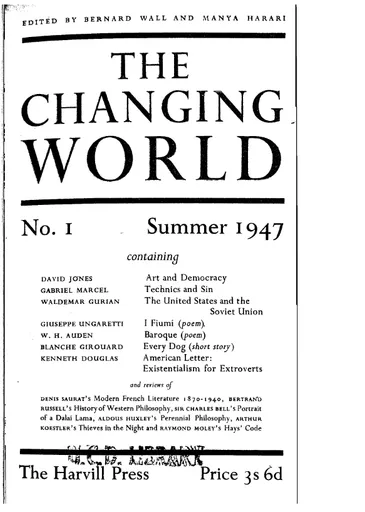
This review is of Yorick Smythies' review of Bertrand Russell's A History of Western Philosophy, which can be found online.
I have often privately remarked my disdain for analytic philosophy, and may on rare occasion even supply for it a good reason; yet always an incidental reason, I never find the pearl-argument. But what should I resent!?—here it is written, look no further. Our prophet, for the span of a half a score of pages, is one of the disciples of the immortal Wittgenstein; Yorick Smythies, an unfigured figure in the landscape of letters, and that so because he was not a prolific writer. This review, along with various notes of the immortal's lectures, composes the sum of his published work.
On the table is Russell's work. It is not a work I care to read, front to back. I have been—shall I say misfortunate?—to have consulted this from sporadic time to time, on names which I was wont to desire his opinion of. The History has a reputation in the way all titles that regularly occupy the shelves of bookstores have reputations; in that they have not reputations simpliciter but reputations for having reputations. To find out its reputation is hard enough for me to shirk the task, though one can tell there are at least some who think its reputation is that of a poor history. More than that I will not (and cannot) say, though we may be thankful at least it is not one of those titles with reputation for a reputation for a reputation.
Russell—or as Smythies obsequiously repeats, Lord Russell—is accused of "teaching successfully a popular substitute for thinking and for knowledge." He smooths down, for the purposes of easy understanding, the difficulties of philosophical problems, and in so doing "smooths out of existence the problem itself." It is best to quote the man himself—
I have imagined someone who realises that there is something unclear in what Lord Russell says, and who asks questions in order to try to follow what has been said more clearly. But these smooth, easy sentences are not designed to be questioned. It is easy to glide through them, feeling, vaguely, instructed and entertained. But any search for greater clarity exposes some underlying shoddiness of thought which is covered up. The sentence looks straightforward. A typical sentence is, for instance, "While physics has been making matter less material, psychology has been making mind less mental." One might demand greater clarity by asking, e.g., the questions: How does a physical thing—this chair, for instance—become "less material"? And, from what propositions of physics does it follow, and how does it follow, that statements attributing physical features to chairs are in some way false? What propositions in physics contradict, e.g., the statement that this is solid, has such and such a size, shape, position, etc.? If you ask even such vague and general questions as these, you begin to see what happens to the apparent straightforwardness. The unclarity of thought was covered up, partly, by the crisp and "clear" manner in which the sentence reads, if one just skims through it. Would someone who, after reading this sentence, recited this "fact" (perhaps with some vague reference to "electrons" and "indeterminancy") have learnt anything except how to appear and to feel knowledgeable about "big" subjects, on the smallest possible basis of actual knowledge?
In such ways does Smythies wiggle open large gaps from small incisions in Russell's exposition. For of course the History of Western Philosophy is not any such History but Russell's History, which in any case, if the writer knows what he is doing, is claimed to be the right History. Thus proclamations such as that Plato was "hardly ever intellectually honest" are such that men of science cannot but agree with Russell in making them. It is fortunate then that Russell is here with his method of "modern analytic empiricism"—evidently a soon-shortened moniker—and that we have finally succeeded in making philosophy a science.
Aye, philosophy has always had to deal with her poverty of proof in relation to her well-endowed sisters in mathematics and physics; this breeds jealousy internally, and sometimes imitation as well. Analytic philosophy is but this new flavor of imitation. So Smythies finds Russell saying this:
"Philosophy, as I shall understand the word, is something intermediate between theology and science. Like theology, it consists of speculations on matters as to which definite knowledge has, so far, been unascertainable; but, like science, it appeals to human reason rather than to authority, whether that of tradition or that of revelation. All definite knowledge—so I should contend—belongs to science; all dogma as to what surpasses definite knowledge belongs to theology." This, if it is interpreted literally, seems to mean: A theological question is one that hasn't so far been answered in a definite way; and if it were answered, would be answered by scientific methods. A philosophical question is therefore something intermediate between an answered scientific question and an unanswered, though scientifically answerable, question. It has the further property that it "appeals to reason" for its answer; that is, it claims that its answer can be definitely known; that is, it appeals to science for its answer—but in this case it seems indistinguishable from a scientific question.
For in philosophical inquiry its facts "seem slippery, retreating from us as we look for them more closely," not quite the same as the facts of science. Most pressing is Smythies' attack on the oversimplification of Hume's notion of the self; which is an operatic section even by itself.
The arrogance of the analytic philosophy lies in its belief that the right method of doing philosophy has been found, and what is left to us who come after the revelation, is but the task of a precise application. Or rather, not simply in that belief, but the persistence withal for over 75 years to incredibly limited success. As Russell predicts:
In quite recent times, although no decision has been reached, a new technique has been developed, and many incidental problems have been solved. It is not irrational to hope that, before very long, a definite agreement may be reached by logicians on this question...[which may happen when] all the words of ordinary languages will have yielded to analysis and been replaced by words having less complex significance.
The extent of the agreement among analytic philosophers on even the simplest of philosophical questions may testify to whether their technique has worked, or not.
It is a review I unabashedly recommend to any philosopher or curious mind; it is more concise than I could hope to achieve, and can help to remove many superstitions that arise from approaching the field from a standpoint too mathematical or scientific. (In a way one might say the continental approach is too literary or artistic, and this is their failure.) Philosophy above all should be philosophy, and not run hither and thither to the standards of a separate domain. I may wish Smythies had written more, but what he has is of the highest quality.