
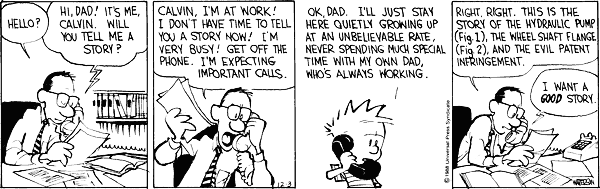
When I was a child, I read so much Calvin and Hobbes that I could recite some of the strips by heart. At the time, I connected with Calvin more than any other character in any other children's book or show or movie I was exposed to. Watterson captured the angst of childhood---not teen angst, which has been done to death in various mediums---but an angst particular to a prepubescent child that we acknowledge much less. Watterson portrays childhood angst (specifically, male childhood angst) as an almost existential dread that results from the repression of creativity and curiosity, as well as the many problems with the adult world that can be seen by a child's clear eyes. And, of course, the child's powerlessness to do anything about it.
.jfif_f77aa02c0045c0d8_512x512.webp?alt=media&token=3273c3ed-2b53-4af9-8873-66847616fb4e)


Very nice text, thank you. My comment has no definite point, but your comment, "specifically, male childhood angst", sent me on a path. I recognize some of my childhood experiences in C&H, so probably not all of it is specifically male, and then I was reminded of TLP commenting a scene from Django Unchained(1): >perfectly ordinary slaveowner DiCaprio asks a rhetorical question, a fundamental question, that has occurred to every 7th grade white boy and about 10% of 7th grade white girls, and the profound question he asked was: "Why don't they just rise up?" >Kneel down, Quentin Tarantino is a genius. That question should properly come from the mouth of the German dentist: this isn't his country, he doesn't really have an instinctive feel for the system, so it's completely legitimate for a guy who doesn't know the score to ask this question, which is why 7th grade boys ask it; they themselves haven't yet felt the crushing weight of the system, so immediately you should ask, how early have girls been crushed that they don't think to ask this? Recently, I've been looking for all-male or all-female movies and books (I'll take suggestions if you have them). I've watched a very strange and dreamy movie about the raising of little girls, the taming of their bodies, and the breaking of their spirits, the learning of obedience : Innocence by Lucile Hadzihalilovic, 2004, France, featuring Marion Cotillard (2). I have no idea if men would be reminded of their childhood by it (and this is not even accounting for cultural differences), but I am curious. I'm still not sure if there is a point in delineating what human experience, male experience, and female experience are, and where is the frontier, if it exists and if it doesn't change from individual to individual - I'll let a gender studies department answer this, but this is a fun exploration. (1) https://thelastpsychiatrist.com/2013/01/no_self-respecting_woman_would.html (2) Legally free to watch here if you have a French or German IP https://www.arte.tv/fr/videos/124436-000-A/innocence/